Most guides stop after naming a niche. This one turns one repeatable promise into fifty distinct episodes, then adds the production and originality checks that decide whether the channel can survive week six.
The hard part of a faceless YouTube channel is not hiding a face. It is making the next forty-nine episodes belong to one identifiable idea without repeating the first one. A list of niches cannot make that decision for you. A production plan can.
Start with a repeatable promise, not a niche label
A niche label such as “history,” “finance,” or “true crime” is too broad to guide production. Viewers need a repeatable promise: the specific change in understanding they expect from every episode.
Try writing the promise as one sentence that contains a subject, a useful outcome, and a boundary:
Every episode explains one small-business cash-flow mistake, proves how the mistake behaves using a source or worked example, and ends with the number an owner should watch first.
That promise gives a writer, editor, narrator, and visual designer the same target. It also makes overlap visible. A video about a failed restaurant brand is not automatically part of a channel about cash-flow decisions; it belongs only if the episode actually teaches a cash-flow lesson.
Use the promise test before you choose a name, logo, or software. If you cannot state the promise in one line, you do not yet have a channel format. You have a topic area.
Run five tests before you write episode one
These tests protect the channel from the most expensive failure: building a polished workflow around a premise that cannot carry fifty episodes.
Repeatable
Can you name fifty different viewer questions today, without inventing synonyms for the same question?
Proof-led
Can each episode include a document, experiment, comparison, chart, interview, or first-hand test that you can cite?
Rights-safe
Can you make fifty episodes without depending on music, film clips, or photographs you do not own?
Visibly distinct
Can you describe a visual system that differs from the usual stock-footage slideshow in two or three concrete ways?
Weekly viable
Can one person complete the research, script, publish review, and final cut within a repeatable weekly time budget?
Any “no” is not a reason to use more AI. It is evidence that the format is too vague, too dependent on borrowed material, or too large for the production cadence. Fix the promise before investing in tools.
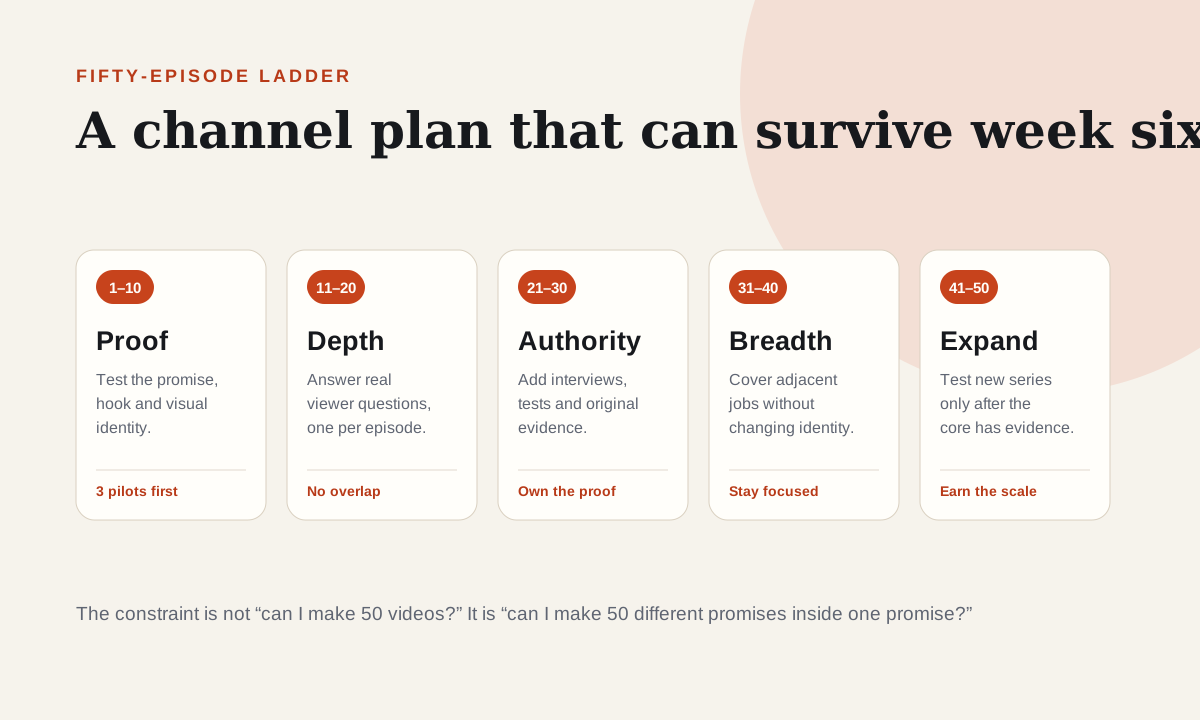
Build the channel as five ten-episode blocks
The exact topics can change as evidence arrives, but the function of each block should stay stable. This structure prevents a new channel from treating every upload as an isolated experiment.
| Block | Purpose | What you publish | Decision at the end |
|---|---|---|---|
| 1–10: proof | Test whether the promise is understandable and repeatable. | Short, tightly sourced episodes with one clear proof object. | Does the hook, topic, and visual treatment still work after five uploads? |
| 11–20: depth | Answer the questions that appeared under the first ten. | One viewer question per episode; no two episodes share the same answer. | Which repeated question deserves a recurring series or a longer explainer? |
| 21–30: authority | Show original work rather than paraphrasing the same public summaries. | Worked examples, interviews, experiments, original records, teardown tables. | What evidence can only this channel provide? |
| 31–40: useful breadth | Cover adjacent jobs without changing the central promise. | Comparisons, mistakes, scenarios, and decision guides. | Do the new topics bring the same audience or dilute the channel? |
| 41–50: controlled expansion | Test new formats only after the core format has evidence. | Series, case studies, live tests, longer episodes, or translated editions. | What can expand without forcing every old episode into a new identity? |
The key is not to publish fifty mediocre installments. Keep a fifty-topic backlog so that research can begin early, while allowing later episodes to be revised or replaced as audience questions sharpen the promise.
Give every episode a production passport
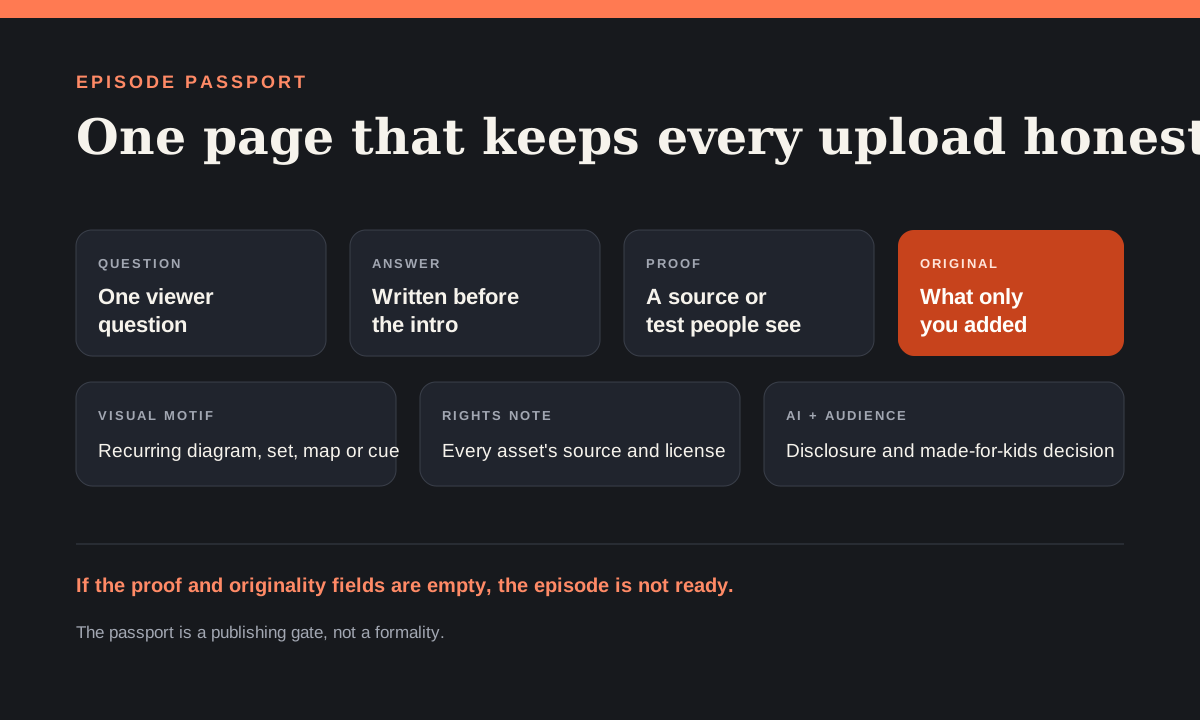
A repeatable format needs a compact decision record. Call it an episode passport: one page that prevents next week’s script from becoming a new channel.
- Question: the one viewer question this episode resolves.
- Answer: a truthful answer written before the intro.
- Proof object: the document, test, table, interview, screenshot, or comparison viewers can inspect.
- Original contribution: what you added that is not already in the source material.
- Visual motif: the recurring diagram, map, prop, set, or animation cue that makes the episode recognizable.
- Rights note: where every visual and sound asset came from and what allows its use.
- AI note: which outputs were generated or meaningfully altered and whether disclosure is required.
- Next link: the related episode that answers the next logical question.
This page is also a publishing gate. If the proof object is weak or the originality field says “summarize three blog posts,” the episode is not ready. Changing the title will not repair a hollow episode.
Design a visual system that still works at episode fifty
Visual consistency is more than a color palette. It is a set of rules that lets a new viewer recognize the channel while keeping each episode’s content distinct.
Fixed
Title position, number system, type pairing, image treatment, transition grammar, and a short recurring opening cue.
Variable
Subject matter, proof object, location, chart shape, and the specific tension in each question.
Forbidden
Generic stock montage used as visual filler, unexplained dramatic footage, and any asset whose source is unknown.
Create the first version in plain typography and simple diagrams before buying an AI video subscription. A channel that is clear in black-and-white storyboards can survive a tool change. A channel whose entire identity is a model’s default visual style cannot.
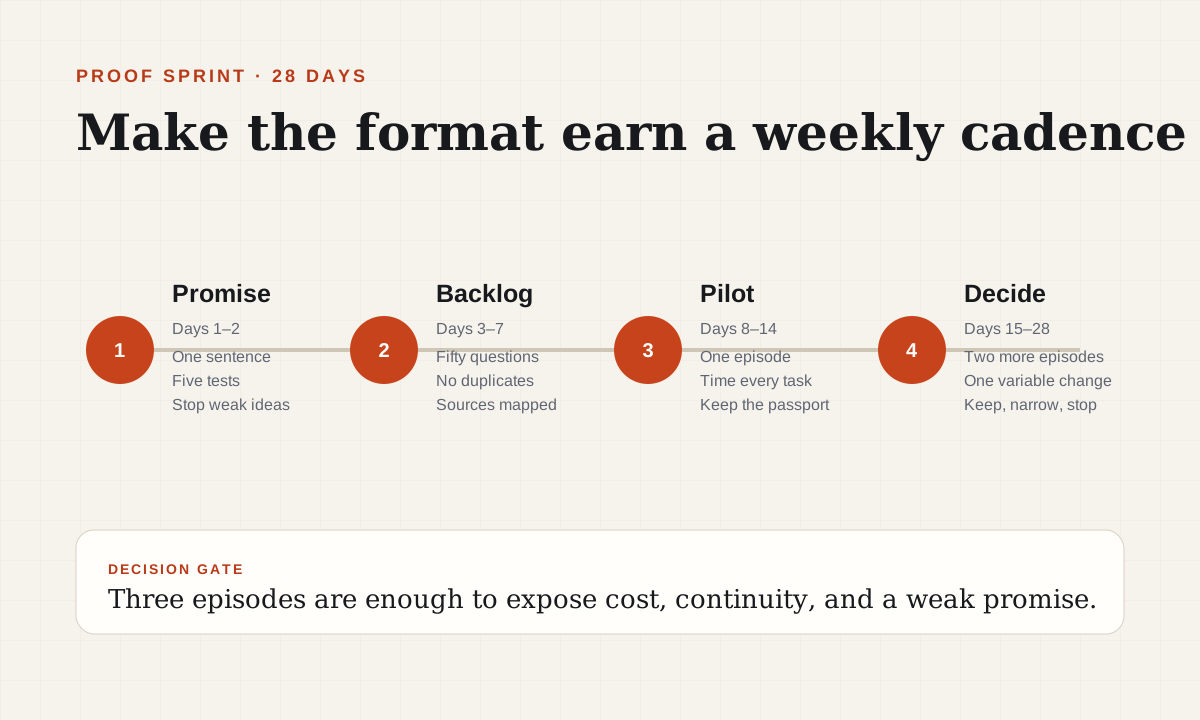
Use the first 28 days as a proof sprint
Do not launch a daily operation in week one. Make four weeks earn the right to become a production line.
- Days 1–2: write the promise and five tests. Reject any premise that fails a rights or proof check.
- Days 3–7: name fifty questions, remove duplicates, and choose the first five based on usefulness and available evidence.
- Days 8–14: produce a pilot. Record the time spent on research, scripting, visuals, recording, editing, and compliance review.
- Days 15–21: produce two more episodes from the same passport. Change one variable at a time.
- Days 22–28: audit all three episodes for clarity, originality, rights, retention, and production time. Decide whether to keep, narrow, or stop.
The final question is not “can it be automated?” It is “which repeated task remains worth doing?” Automate only after the manual version has a measurable standard. Otherwise the pipeline will mass-produce the weakest part of the format.
Audit originality, AI disclosure, and audience rules
YouTube’s monetization policies say creators should make original, authentic content and should not publish mass-produced, generic, or repetitive material. That is a stronger standard than “not stolen.” A hundred videos made by swapping one noun in the same template can still be a channel-level risk.
Realistic generated or meaningfully altered scenes may require disclosure during upload. The relevant test is whether a viewer could reasonably mistake generated material for real footage, a real place, a real event, or a real person. Music-led generated content and realistic AI scenes need special care.
“Made for kids” is a separate legal classification, not a CPM tactic. A channel aimed at children must set the audience correctly, and that decision affects what features and advertising can operate. Treat it as a compliance decision, not a personality decision.
Before publishing, keep four fields in the episode passport:
- every third-party asset and its license;
- every generated or altered scene and the disclosure decision;
- the audience classification and why;
- the original contribution and the source used to verify it.
This is intentionally conservative. Platform rules and enforcement can change; the channel should preserve enough evidence to revisit a video without guessing.
A completed fifty-episode ladder you can adapt
Here is the idea made concrete for a narrow knowledge lane: small-business cash-flow explainers. The topics below are not a request to copy another channel. They are a test of whether one promise can generate enough distinct, evidence-led episodes.
Episodes 1–10: the first money errors
- Revenue is not cash
- The first profitable month that hides a cash problem
- How one late invoice changes payroll
- The hidden cost of a discount
- Why a full order book can run out of cash
- Deposits and the contracts you can afford
- Margin versus cash on hand
- Why a busy week can end with no money
- How one hire changes the break-even point
- The five numbers to check every Monday
Episodes 11–20: suppliers and inventory
- When a supplier delay becomes a customer problem
- The real cost of buying inventory too early
- How minimum order quantities lock up cash
- One-product concentration risk
- How returns distort a good sales week
- Shipping-cost surprises and quoted prices
- Warehouse space as a variable cost
- Why a stockout can be cheaper than overstock
- Negotiating payment terms instead of a discount
- A supplier scorecard that includes cash timing
Episodes 21–30: decisions with proof
- A break-even model for a second location
- When to hire a contractor instead of staff
- The cash case for raising prices
- How a customer concentration problem appears in invoices
- Lease terms that change working capital
- Equipment purchase versus rental
- A worked example of a cash-flow forecast
- How to test whether a promotion made money
- When debt solves timing and when it hides a loss
- Reading an aged receivables report
Episodes 31–40: common owner questions
- Which bill should be paid first?
- How much cash should remain after payroll?
- What to do when sales fall for a month?
- When a customer asks for longer terms
- How to price a deposit correctly
- How to handle refunds and chargebacks
- What a line of credit should and should not fund
- How to separate owner spending from business cash
- Why a growing channel needs a cash calendar
- How to prepare for a slow season
Episodes 41–50: original tests
- Interview one owner about their worst cash week
- Rebuild a simplified cash forecast from an anonymized invoice set
- Compare three payment-term offers
- Run a one-week paid-versus-organic promotion test
- Diagram how a refund becomes a working-capital problem
- Audit a fictional storefront for hidden cash risks
- Compare two hiring plans at the same revenue
- Explain one runbook for a late invoice
- Create a monthly owner review meeting
- Publish a six-month update on what the proof sprint changed
This ladder passes the duplicate test because every row asks a different operational question. It preserves one promise. It also creates natural links between the early explanations, the later worked examples, and the final first-hand tests.
What to do this week
Pick one lane and write the promise in one sentence. Generate fifty questions before choosing a name. Mark each question with its proof object and rights risk. Produce three episodes from the same passport. If the third episode still feels like the same channel without feeling like the same video, you have enough evidence to schedule a weekly cadence.
If not, narrow the promise or change the format. Do not add more tools to a format that has not earned a repeatable place in the audience’s routine.
Sources and claim notes
These links support the platform and policy statements named in this guide. The frameworks and production checks are original editorial analysis.
- YouTube channel monetization policiesOriginality, authentic content, and inauthentic or mass-produced content.
- Disclosing use of GenAI contentWhich realistic generated or altered content requires disclosure.
- Determining if your content is made for kidsAudience classification and the difference between general and child-directed content.
- Creating helpful, reliable, people-first contentGoogle's guidance on original information, added value, sourcing, and people-first pages.