The useful AI channel question is not whether a tool can make a video. It is whether the channel can preserve a recognizable promise, inspectable proof and responsible decisions after the tools change.
Beginner conversations about AI channels are full of practical anxiety: Is it worth starting? Why do some new channels grow quickly? Will AI metadata get the channel flagged? What can be automated without making the channel generic? The questions are more useful than another list of tools.
The first AI YouTube channel question is not “which tool?”
The real decision is what remains valuable when the generation interface changes. An AI YouTube channel needs a repeatable job, a visible evidence standard and a human release process. Tools can help produce drafts, voice tracks, captions and graphics, but they do not define why a viewer should return.
YouTube’s monetization policy asks for original, authentic content and warns against mass-produced, generic, repetitive or manipulative material. The policy also says reviewers may look across the channel’s main theme, most viewed videos, newest videos, largest watch-time videos and metadata. That makes channel-level repetition a production issue, not a prompt issue.
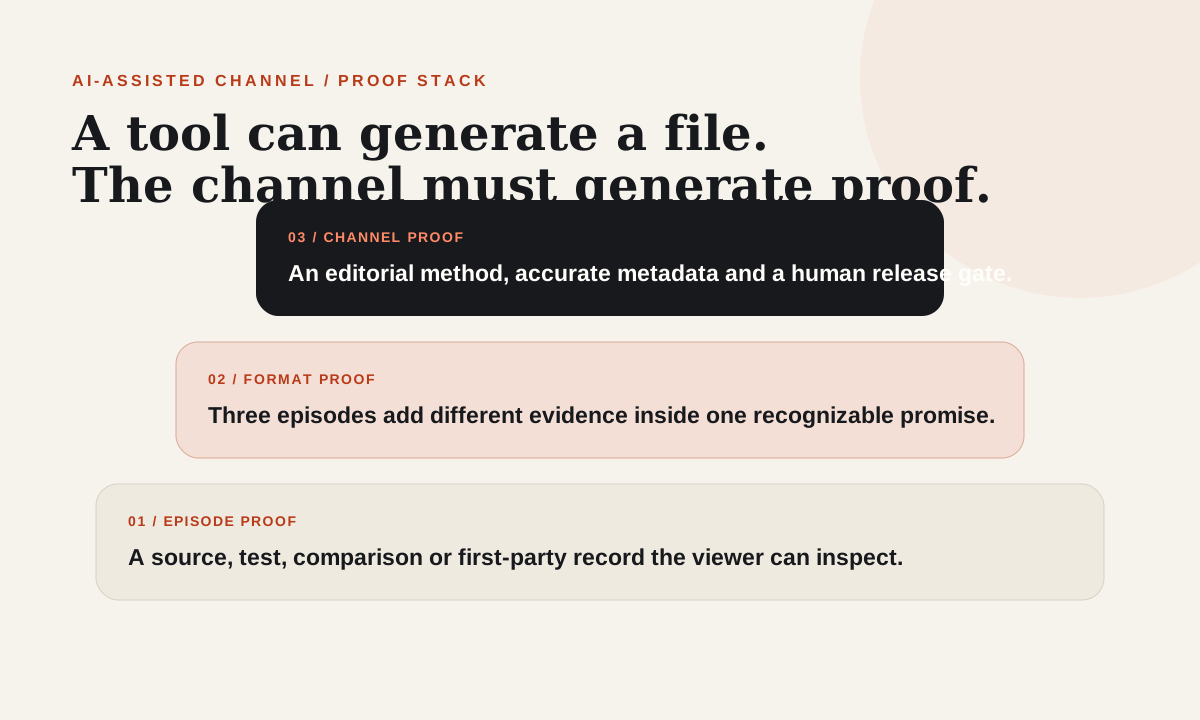
Use three layers of proof before scaling:
Episode proof
A source, test, comparison, worked example or first-party record that the viewer can inspect.
Format proof
Three episodes that supply different evidence while preserving one recognizable promise.
Channel proof
A visible editorial method, reliable metadata and a cadence that a person can actually review.
The real beginner questions cluster into seven decisions
A US-English Google search for beginner discussions about AI channels surfaced recurring questions rather than one clean keyword. The themes were audience authenticity, monetization, differentiation, disclosure, metadata, quality and time investment. The table below paraphrases the question type and answers it directly without treating a discussion thread as a factual authority.
| Beginner question | Direct answer | Required evidence |
|---|---|---|
| Can an AI channel build a real audience? | Yes, if the format provides a useful job beyond showing generated assets. | A repeatable promise and viewer-visible proof |
| Is an AI-based channel worth starting? | Only after a pilot proves that research and review can be repeated. | A three-episode production test |
| Why do new AI channels sometimes grow quickly? | A visible format, existing demand or strong packaging may travel faster than a generic tool stack. | Your own packaging and topic comparison; not a copied viral example |
| Do AI channels actually make money? | An AI-assisted channel still has to satisfy monetization, originality and advertiser policies. | Policy review and channel-level originality |
| Do AI titles and descriptions get a channel flagged? | Generation alone is not the test; deceptive, repetitive or manipulative use is the risk area. | Accurate metadata and source-supported claims |
| How much should be automated? | Automate repeatable production steps while keeping rights, contribution, disclosure and release approval human. | A control matrix |
| How can the channel avoid sounding generic? | Give every episode a distinct decision, proof object and editorial judgment. | A channel-level repetition audit |
The questions share one hidden demand: proof. Beginners are not only asking whether AI tools work. They are asking whether the resulting channel has enough identity, rights clearance and human judgment to survive review.
A 15-question bank for planning the first episodes
Use the question bank as an idea filter. Each question must produce a different answer and a different piece of evidence.
- What exact problem does the viewer expect this channel to solve?
- Which visual or documentary object can prove the answer?
- What can the viewer inspect that a generic script cannot provide?
- Why would this episode be useful without the AI voice?
- Which claims need an official source?
- Which generated scenes could a viewer mistake for real footage?
- Will any real person appear to say or do something through AI?
- Does generated music become the main focus?
- Who is the intended audience, and is the content directed at children?
- What makes this episode different from the previous three?
- Which part did a person verify or decide?
- What would the channel publish if the preferred model disappeared tomorrow?
- Which repeated template element is becoming too obvious?
- What correction or limitation should appear on screen?
- What is the next useful question the episode earns the right to answer?
This bank is intentionally more demanding than “give me 50 AI channel ideas.” It tests whether the idea can continue after the novelty of generation wears off.
Decide AI disclosure from the finished result
YouTube requires disclosure when generated or altered content appears realistic. Its examples include making a real person appear to say or do something they did not do, altering footage of a real event or place, generating a realistic scene that did not occur and creating music that is the main focus of the video.
The tool name is not the decision. An animated diagram and a synthetic scene of a real city are different production events. Keep a record for every generated or meaningfully altered asset:
- Asset: the exact shot, image, voice or music file.
- Method: generated, edited or only cleaned up.
- Realism: could a viewer mistake the result for a real person, place or event?
- Decision: disclose or do not disclose, with the reason recorded.
- Evidence: prompt, generation date, source file and final shot reference.
YouTube states that disclosing AI content alone does not limit a video’s audience or monetization eligibility. The release gate should treat disclosure as an accurate factual record, not a trick to avoid.
Automate production work and keep editorial control
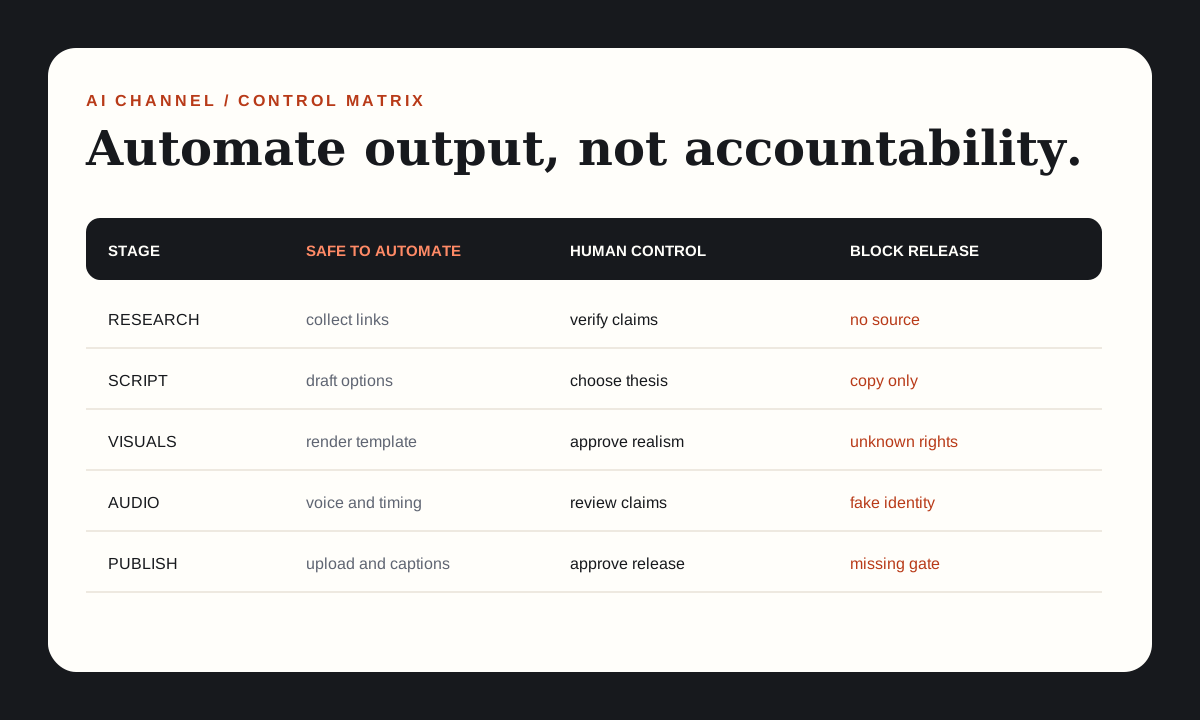
Use a control matrix before selecting tools. The goal is not maximum automation. The goal is a production system where every high-risk decision has an owner.
| Stage | Safe to automate | Keep human | Block release |
|---|---|---|---|
| Research | Collect links, transcripts and candidate questions | Verify source quality and claim boundaries | No source for a factual claim |
| Script | Draft transitions and alternative headlines | Choose thesis, evidence and original contribution | Script is only a summary of other pages |
| Visuals | Render diagrams, resize canvases and build templates | Approve meaning, realism and disclosure | Unknown asset rights |
| Audio | Generate draft narration and timestamps | Check pronunciation, claims and tone | Voice implies a real person without basis |
| Publish | Create drafts, captions and metadata variants | Classify audience and approve final release | Missing rights, disclosure or audience decision |
Run a three-episode pilot before expanding
The first pilot should test the production system, not the model’s novelty. Produce three short episodes with one shared promise and three different proof objects.
- Episode one: a source-led explanation with one official document or policy map.
- Episode two: a comparison or worked example built from an original table.
- Episode three: a first-person production log that records timing, rework and unavailable values.
After the pilot, compare the three files. Is the visual grammar recognizable? Do the scripts make different decisions? Can every external asset be traced? Could a reviewer identify which parts required human judgment? If the answer is no, adding more automation will only accelerate the weakest pattern.
The pilot also creates a practical time and cost record. If end-to-end time or cash cost was not tracked, write unavailable; do not replace it with a guess.
Fix packaging before blaming distribution
An AI channel can look technically finished while failing at the first choice: what the viewer sees. The package needs one concrete promise, one recognizable proof cue and one honest reason to watch now.
Title
Name the viewer question or decision, not the AI tool used to make the file.
Thumbnail
Show the proof object, comparison or transformation the episode can actually deliver.
Opening
Answer before background. The first few seconds should make the claim and the evidence visible.
Do not copy a viral channel’s title and replace one noun. Use your own question bank, source set and production record to define the package. The viewer should be able to predict the kind of evidence the next episode will contain.
Continue only when the human contribution is visible
The strongest sign that an AI channel is becoming a real channel is not the number of tools connected. It is the presence of decisions that cannot be inferred from a generic prompt: which source is trustworthy, what evidence changes the answer, which claim is too broad, which scene looks real and which topic is deliberately rejected.
Publish three episodes. Keep the evidence packet. Audit the channel for repetition. If the format still has one recognizable promise and each episode adds a different inspectable object, continue. If the only difference is the prompt or voice, narrow the format before adding volume.
Sources and claim notes
These links support the platform and policy statements named in this guide. The frameworks and production checks are original editorial analysis.
- YouTube channel monetization policiesOfficial policy on original, authentic content and the channel-level areas reviewers may inspect.
- Disclosing use of GenAI contentOfficial requirements for realistic generated or meaningfully altered content.
- Do people actually build real audiences from AI-generated videos?Live beginner question surfaced in a US-English Google result on 29 October 2026; used as a question source, not as a factual authority.