The useful question is not whether cameras are required. It is whether your format can replace the presenter’s trust shortcuts with evidence, recognition and a reason to return.
A face is one possible shortcut for several jobs: identity, credibility, continuity, emotion and community. Remove it and those jobs do not disappear. They move into the production system.
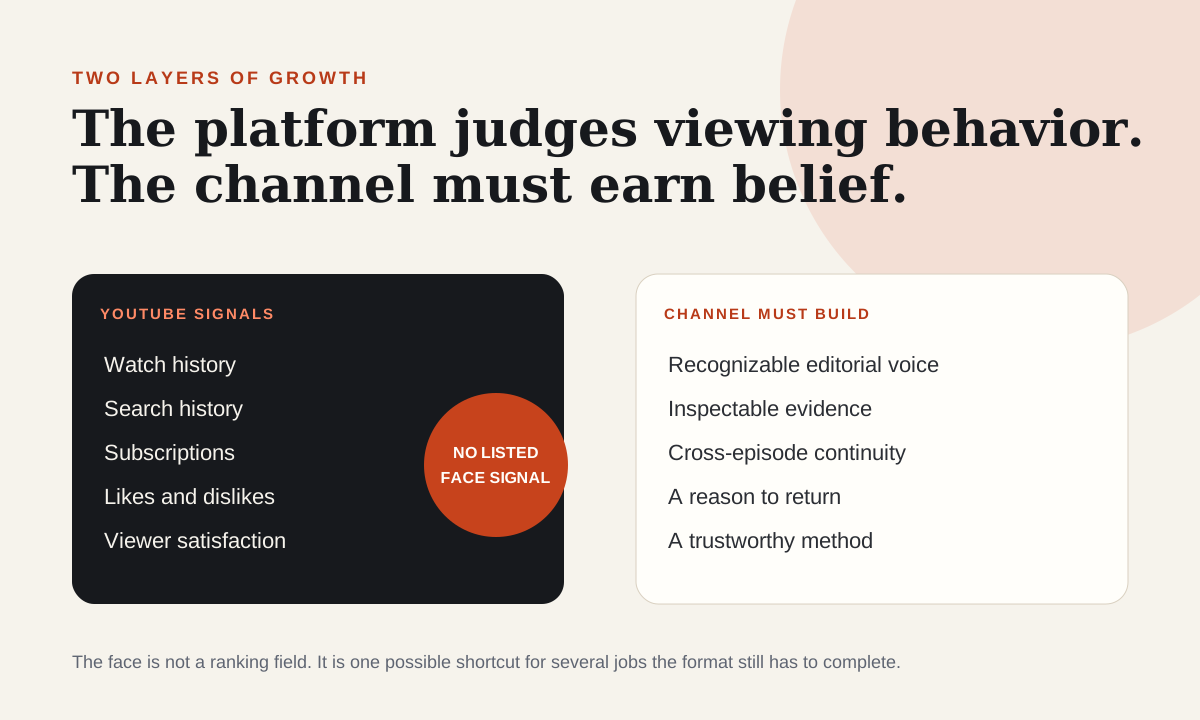
YouTube does not state that a face is required for growth
YouTube’s official search and discovery guidance says its system has no opinion about the type of video a creator makes and does not favor a particular format. The company’s recommendation overview lists watch history, search history, subscriptions, likes, dislikes, negative feedback and viewer satisfaction as primary signals.
The recommendation page contains this exact sentence:
“Videos that are made with AI can be recommended as broadly as videos made without AI.”
The official guidance on generative-AI disclosure contains this exact sentence:
“Disclosing AI content alone won’t limit a video’s audience or impact its eligibility to earn money.”
Those statements do not promise equal results. They do show that YouTube does not state that appearing on camera is a requirement for recommendation, and that disclosure by itself does not remove eligibility to earn money.
If you still need the broader lane map, start with the faceless youtube channel ideas pillar page. That page carries the supplied head-term figure of 590. This page answers a narrower question: what changes when the presenter disappears?
What a presenter normally provides
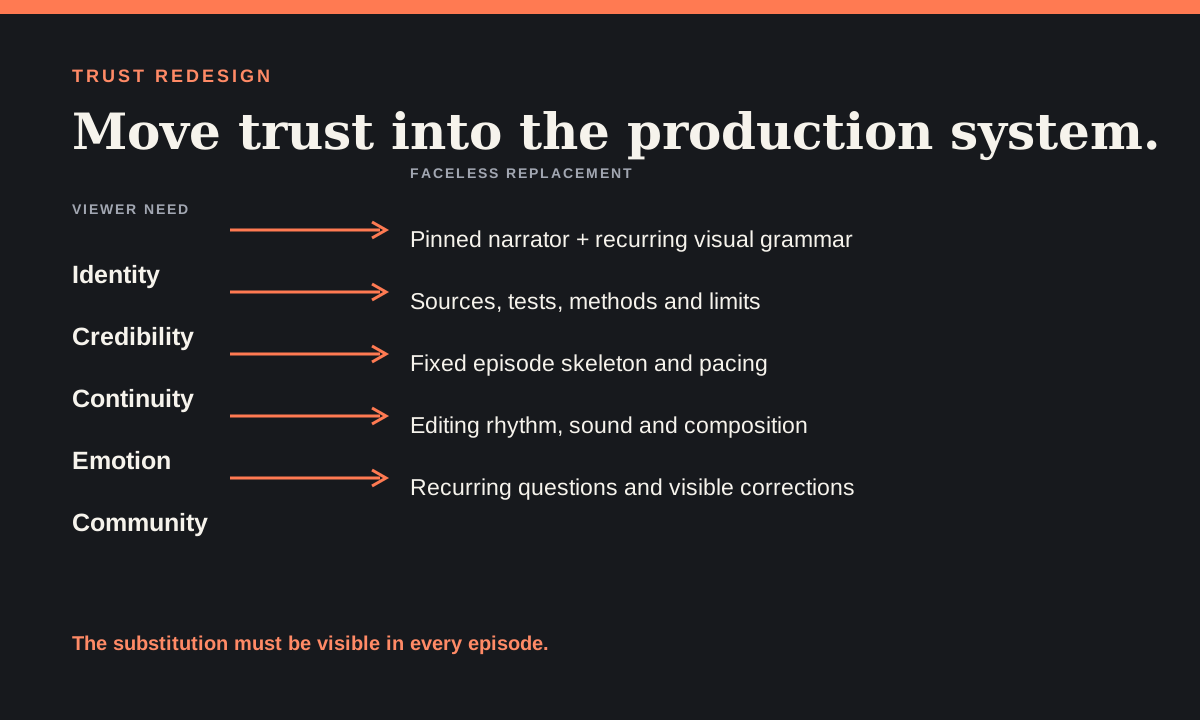
A presenter gives viewers several shortcuts at once. They can identify the speaker, read emotion, judge sincerity, recognize continuity between videos and form a parasocial relationship. Those cues are not proof of quality, but they reduce the effort required to understand who is talking and why the viewer should care.
Without a presenter, the production must supply clearer cues.
| Viewer need | Face-led shortcut | Faceless replacement |
|---|---|---|
| Identity | A familiar presenter, gestures and verbal habits | A consistent narrator, editorial judgment and visual motif |
| Credibility | Résumé, personal experience and visible reactions | Inspectable sources, tests, methods and explicit limitations |
| Continuity | The same person and setting | Recurring formats, pacing, evidence cards and chapter logic |
| Emotion | Facial expression and vocal delivery | Music, editing rhythm, composition and restrained narration |
| Community | Direct interaction around the creator | Recurring audience questions, visible corrections and follow-up episodes |
A generic AI voice leaves a hole where personality used to be. The stronger replacement is a recognizable point of view: what the channel notices, what evidence it accepts, where it admits uncertainty and which question it promises to answer next.
The silent-screen test makes this visible. Mute the episode and cover the channel name. Can a viewer still tell what question the episode is wrestling with? If the images only support narration, the episode’s identity still lives inside its voiceover.
Formats that become harder without a face
The hardest formats are those in which the main product is the presenter’s immediate credibility or relationship with the audience.
- Personal development, life advice and coaching that depends on emotional presence.
- Live reactions, arguments, commentary and relationship-driven coverage.
- High-stakes professional advice where the viewer must evaluate the speaker’s qualifications.
- “Work with me” videos whose main benefit is companionship.
- Reporting that depends on the creator’s private access, observations or on-camera investigation.
These formats can still work without a face, but they need stronger substitutes: documented qualifications, independently verifiable sources, case evidence, a clear review process and a deliberate community loop. Without those additions, the missing presenter feels like missing substance.
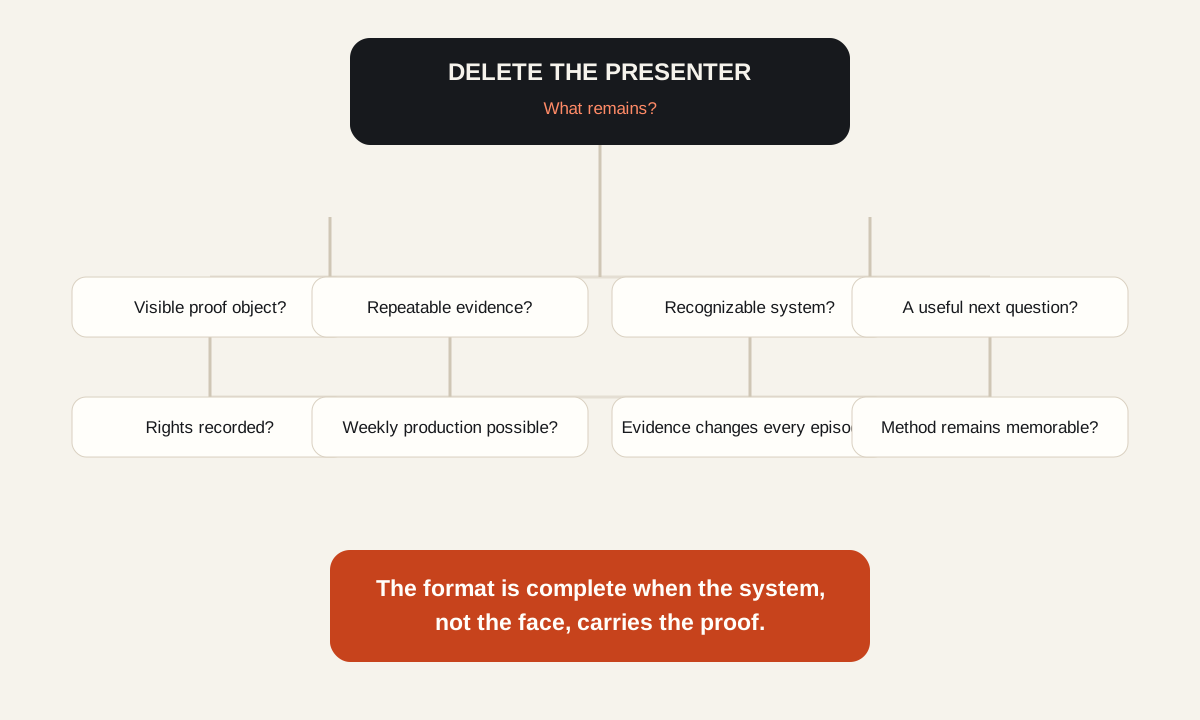
Delete the presenter from the concept and inspect what remains. “Stock images plus narration” is not enough to form a program. A body of evidence, a comparison, a model, a test or a visible production process can carry a channel because another creator cannot reproduce it without doing the same work.
Formats that often become easier without a face
Faceless production has an advantage when the subject itself can occupy the screen.
- Historical or current events explained with documents, maps and timelines.
- Software and workflow teaching through screen recordings.
- Product and method comparisons supported by tests.
- Data stories built from original charts and decision tables.
- Processes, objects, places and field samples that can carry the narrative.
In these formats, the camera can stay on the evidence. Viewers do not have to trust a stranger before seeing the material that supports the claim. The process itself creates credibility.
Screens, documents, maps, tests and comparison tables can function as evidence protagonists. They are not decorative B-roll. The format becomes stronger when those objects change meaningfully from episode to episode and reveal something the narration could not establish by itself.
Evidence-based formats let proof appear in the opening frame. The viewer can inspect a comparison, source or process before deciding whether to trust the narrator. That gives a camera-free channel a renewable trust mechanism.
Run a faceless growth audit before choosing a topic
Do not start with a channel name, logo or batch of scripts. Take one specific topic and answer these questions honestly.
- Completeness After the presenter is removed, can a viewer still understand the problem this episode solves?
- Evidence Is there an object, record, test, comparison or document that can be inspected?
- Variety Can the evidence change from episode to episode, or will the channel repeat the same generic chart?
- Recognition With the title hidden and the sound off, is the channel still recognizable?
- Question chain Does this episode naturally create the next useful question?
- Rights Can the origin and rights status of every image, clip, quotation, voice and sound be recorded?
- Cadence In a busy week, can one person still finish the research, script, review, production and publishing?
If the evidence is weak and the only distinction is a presenter’s performance, the idea probably belongs in a face-led format.
The face-removal completeness test asks whether the program is still complete after the face is gone. That is more useful than asking whether a niche is “competitive,” because the common failure is not competition alone. It is an incomplete format.
A second check is the substitution test. Replace the narrator, editing rhythm and color system. If the episode still feels mostly the same, the channel has not established a distinctive system. If the episode loses its evidence trail, pacing or point of view, the system is doing meaningful work.
Replace personality with a repeatable content system
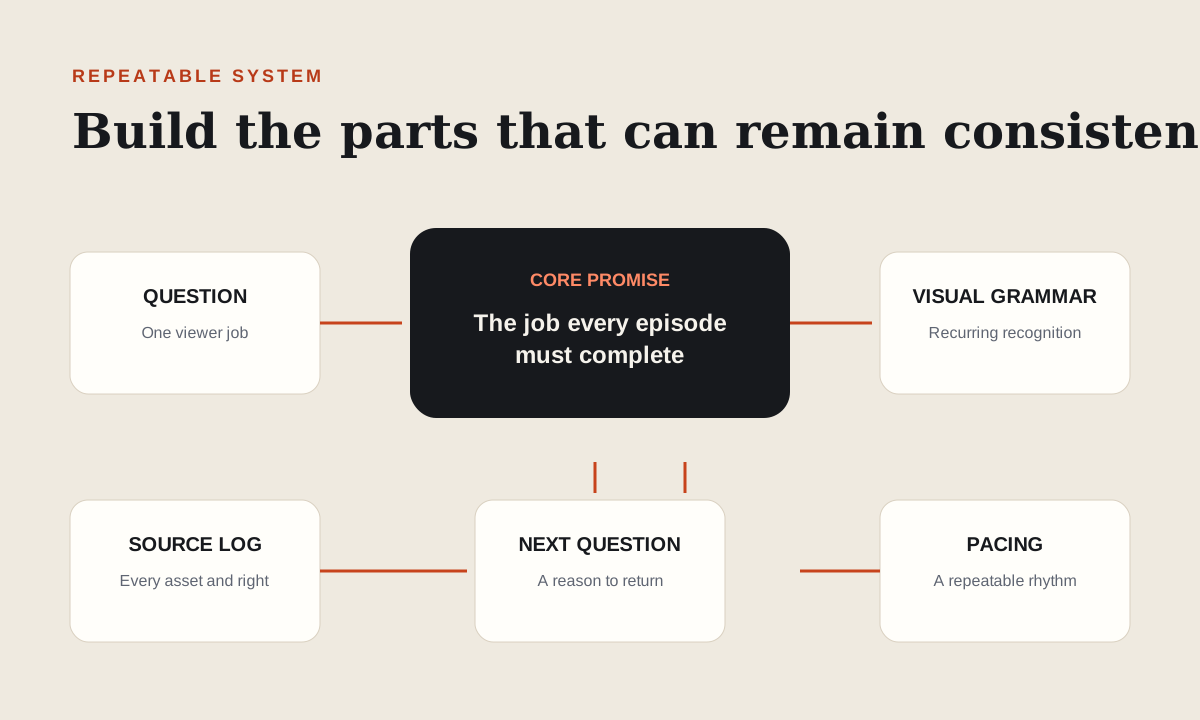
A faceless channel needs a promise that can survive repeated production. The promise should define the recurring job the audience wants done, the evidence standard used to answer it, and the adjacent topics the channel deliberately refuses to chase.
“A business channel” is too broad. “Each episode explains one small-business cash-flow mistake with a public case and one number an owner can check” gives a writer, researcher, editor and viewer a shared target.
The channel also needs a visual grammar. The goal is to make recurring decisions predictable: where the question appears, how evidence is displayed, how complexity is diagrammed, how chapters transition and which changes signal a new format.
A real channel identity survives a simple test: mute the audio, cover the title, look at a few frames and see whether the editorial system is still recognizable. Without that recognition, the account is only a shared login for unrelated uploads.
Why some faceless channels appear to grow faster
The first advantage is subject-native visual evidence. Software demonstrations, data explanations, map-based stories and physical tests can fill the frame without performance. The material carries attention.
The second advantage is modular production. A stable episode skeleton lets research, scripting, source checking, graphics, narration, editing and publishing improve separately. The channel does not reinvent the entire show every time.
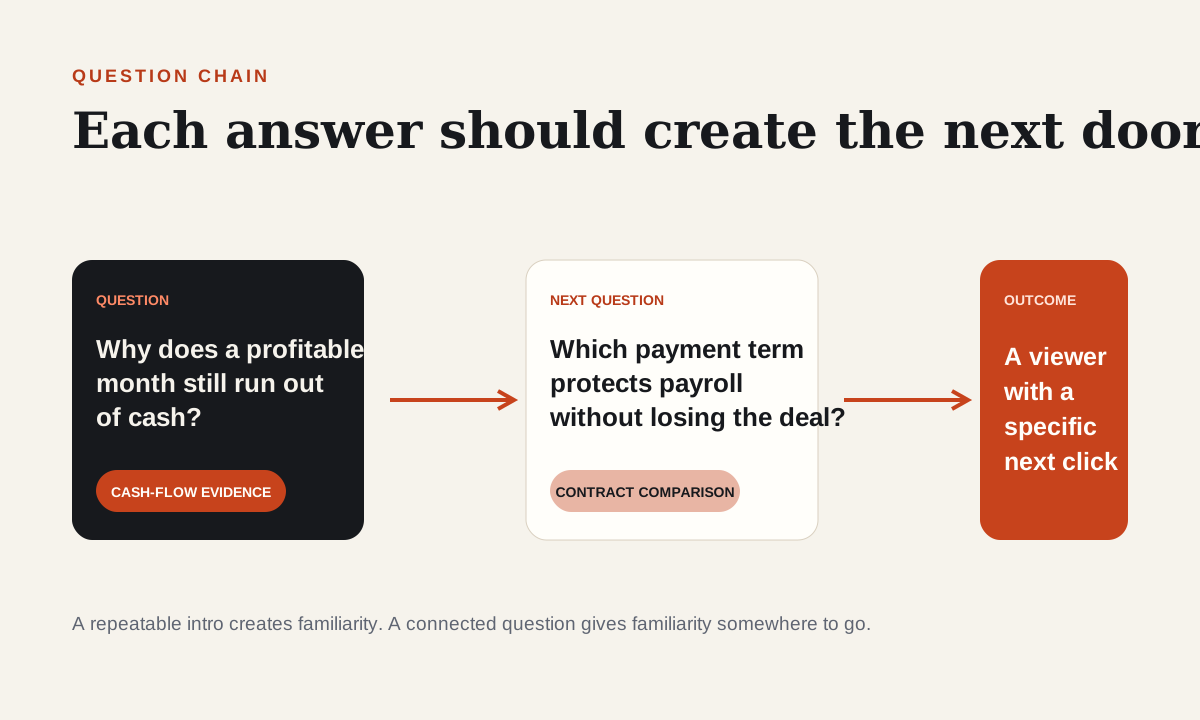
The third advantage is a question chain. Viewers return because the previous episode left them with a specific question that the channel has earned the right to answer next.
YouTube’s official guidance also identifies topic interest, competition and seasonality as external factors while emphasizing viewer behavior and satisfaction. The channel still has to earn the click, the continued watch and the next visit.
Build the season around connected questions. If an episode about a small-business cash-flow mistake ends with a question about supplier payment terms, the viewer has a concrete next episode to open. A repeated intro only reminds people that both videos belong to the same account.
What we tested—and what we dropped
The most defensible contribution is not another list of niches. Publish something the reader can inspect: an original test, a documented workflow, a comparison with explicit criteria, a source map or a transparent production log.
In the first FacelessLanes production test, the explainer rendered at 1920 × 1080 and ran for 29.94 seconds. The visual fit passed on the first check, but the captions still required a separate timing-and-copy review before publication.
During the final editorial pass, replacing the unsupported version of the opening answer after checking the official source took 23 seconds. The broader argument stayed, but the first screen had to become narrower and more precise.
We also dropped a proposed article on “best faceless YouTube niches” after the first outline. It kept collapsing into a re-ranking of the same broad niche lists and could not add an evidence object beyond what the existing pillar page and the competitor pages already offered.
The strongest proprietary asset is often the production evidence: how long a task took, which assets were discarded, where continuity broke, which opening failed to answer the question and what operating rule survived revision. Competitors can reuse a topic. They cannot reproduce your decision trail without doing the work.
The useful question is not whether faceless YouTube works
Faceless channels can be harder or easier to grow depending on what the format originally used to create trust. If the topic provides visual proof and a repeatable question chain, the channel can scale without a face. If the value depends on personality, presence and private experience, viewers will notice what is missing.
Before starting, ask one concrete question: after the face is removed, what remains that is worth returning for?
If the answer is evidence the audience can inspect, a method they can recognize and a next question they want answered, the channel is ready for a production plan. If the answer is a stock-footage montage and a generic voice, it is still an idea list—not a channel.
Sources and claim notes
These links support the platform and policy statements named in this guide. The frameworks and production checks are original editorial analysis.
- How YouTube recommendations workYouTube lists the primary recommendation signals and states that AI-made videos can be recommended as broadly as videos made without AI.
- Disclosing use of GenAI contentYouTube states that disclosure alone does not limit audience or eligibility to earn money.
- Search & discovery tipsYouTube states that its system does not favor a particular video format and ranks videos using performance and personalization.
- YouTube channel monetization policiesYouTube's monetization policy text on originality, authentic content and inauthentic content.