The opening is the one part of an automated YouTube channel that should not become invisible infrastructure. It must connect the viewer’s promise to evidence before the reusable template starts carrying the episode.
Automation is useful because it can repeat approved work. An opening is different: it must prove that this episode is worth watching now. If the template decides the hook, every upload begins with the same rhythm, the same vague promise and the same evidence-free setup.
What should be automated in an automated YouTube channel?
Automate the repeatable production work around the opening: collecting source material, placing approved title cards, rendering the same typography, generating timed captions and preparing metadata. Keep the opening decision itself human until a pilot has shown that the template can preserve meaning.
The automate youtube channel question is often framed as a tool-stack question. That is too late. The first production decision is what the viewer sees before the channel has earned another minute of attention. A reusable system should help produce that answer, not invent a generic one.
This page uses a deliberately narrow test: in the first eight seconds, the episode must show the question, one proof object and the unique artifact. The number is an editorial constraint chosen to force a compact opening. It is not a claim that YouTube applies an eight-second rule.
If you are still mapping the channel lane, start with the faceless youtube channel ideas pillar. This page owns a smaller production job: how to make the opening survive automation.
What YouTube actually measures around the opening
YouTube’s audience-retention report defines intro percentage as the percentage of the audience still watching after the first 30 seconds. The report says a high intro percentage can mean that the first 30 seconds matched the thumbnail and title and kept the audience interested. It also suggests changing the first 30 seconds and testing different approaches.
That is useful, but it does not prescribe a universal eight-second hook. It gives a review window and two questions: did the opening match the package, and did it hold attention?
YouTube’s search and discovery guidance adds that performance depends on viewer behavior, including whether someone chooses to watch, how long they stay and whether they report enjoying the video. The same guidance says the system considers average view duration, average percentage viewed, likes and post-watch surveys. None of those signals can tell the creator what the episode’s first visual should be.
The practical consequence is simple. Do not automate a supposedly viral hook from a formula and call it strategy. Define the opening’s evidence job, render it consistently and then use retention data to review the decision.
Use the question-proof-artifact opening framework
The opening can be reduced to three visible jobs:
Question
Name the exact decision the viewer wants resolved. Do not begin with the channel name, a tool or a generic statement about the topic.
Proof
Put an inspectable object on screen: a source, captured task, comparison, calculation or first-hand record.
Artifact
Show the thing the viewer will leave with: a checklist, decision rule, corrected workflow or worked example.
Call this the QPA opening. It gives an automated production system a compact contract. The question supplies relevance, the proof supplies credibility and the artifact supplies a reason to continue.
A generic template can place these elements. It cannot decide whether the question is narrow, whether the proof actually supports it or whether the artifact is new. Those choices remain part of editorial approval.
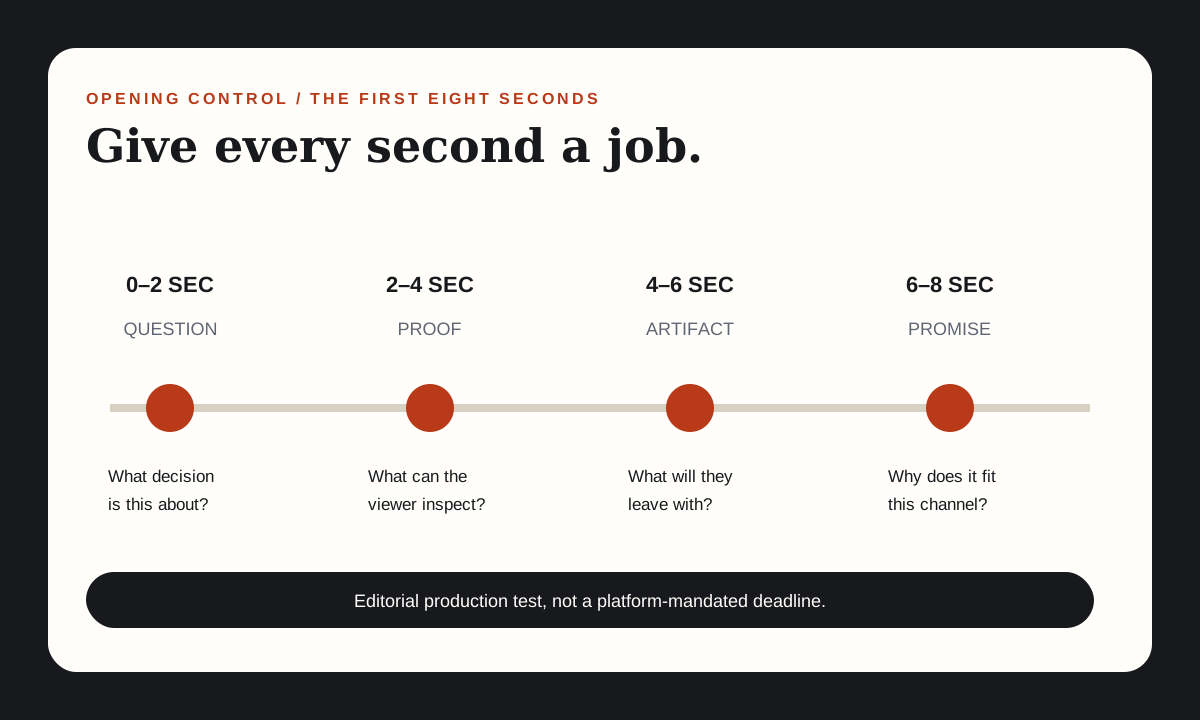
Build an eight-second opening strip
A useful timing plan is more specific than “start with a hook.” Each second should have a job.
| Time | Viewer job | Production instruction |
|---|---|---|
| 0–2 seconds | Recognize the exact question | Use a concrete sentence, not a category label or channel introduction. |
| 2–4 seconds | See why the question is answerable | Reveal the source, test, captured process or comparison behind the episode. |
| 4–6 seconds | Understand the unique deliverable | Name the artifact the episode will build or resolve. |
| 6–8 seconds | Hear the channel promise | Connect the artifact to the recurring promise without recap or background. |
This strip is not a demand to speak four sentences. One sentence can carry the question while the other two jobs appear as typography or motion. The important rule is that the viewer does not need the next thirty seconds to discover why this episode is different.
Make the proof object specific enough to inspect
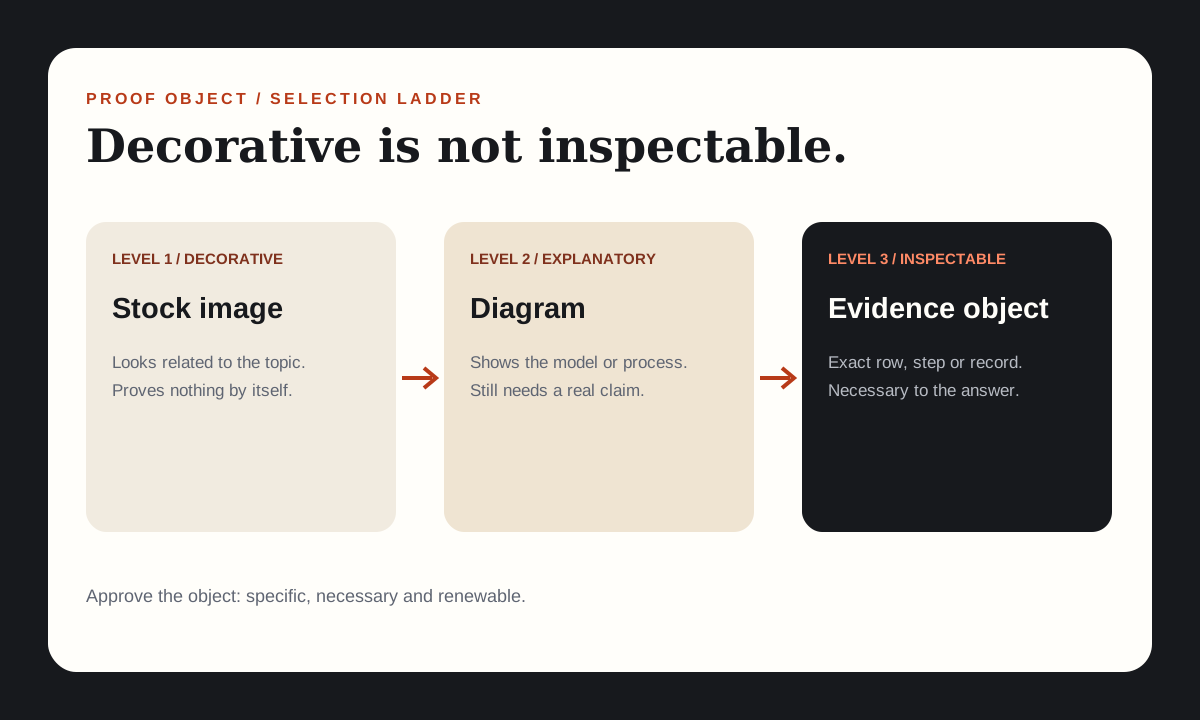
A proof object is not a decorative chart or a screenshot placed behind narration. It changes what the viewer can verify.
For a research-led episode, the proof might be a source comparison with the decisive row highlighted. For a recorded-process episode, it might be the failing state before a repair and the output after it. For a modular explainer, it might be a worked example that applies the recurring model to a new case.
Use three questions to approve the object:
- Specific: Can a viewer point to the exact line, step or number that supports the claim?
- Necessary: Would the opening be weaker if the object were removed?
- Renewable: Can the next episode produce a different object without changing the entire format?
This is where automation helps. A template can render labels, annotations and comparison frames consistently. The human operator decides which object belongs in the opening and checks that its caption accurately describes what the object shows.
Name the unique artifact before showing the episode
“You will learn more” is not an artifact. A useful episode leaves behind something identifiable: a decision table, a corrected process, a ranked set of constraints, a source map or a completed example.
Write an artifact line before the script becomes longer. Examples:
- “You will get the three-question test for deciding whether a workflow needs a presenter.”
- “You will see the exact row that changes the sourcing decision.”
- “You will leave with a five-field evidence packet for the next upload.”
The artifact also prevents bait. If the title promises a complete plan, the opening must eventually deliver a complete plan; an animated checklist that is never explained is decoration, not value.
Make the artifact visible twice: once in the opening as a preview and once in the body as a complete object. A preview without a payoff is a broken promise. A payoff without a preview asks the viewer to trust an unseen structure.
Diagnose four opening failures before changing the template
| Failure | What the viewer sees | Correction |
|---|---|---|
| Channel-first intro | Logo, channel name and background before the question | Move the brand cue after the answer is visible. |
| Tool-first proof | A screen recording of software without a claim to verify | Show the input, decision and output that make the tool relevant. |
| Bait mismatch | A dramatic promise followed by a broad topic overview | Narrow the title or make the opening deliver the promised object. |
| Template sameness | The same kinetic text and stock montage in every episode | Keep the visual grammar but replace the evidence object. |
Do not respond to every opening problem by asking a model for another hook. Diagnose which job is missing. If the viewer cannot name the question, rewrite the question. If the viewer cannot see proof, change the visual evidence. If the artifact is vague, the underlying episode idea may still be vague.
This diagnostic is more useful than a score based on adjectives such as “curiosity,” “energy” or “authority.” Those words describe a desired reaction, not the production object that creates it.
Worked example: audit our own automated opening
Use the previous FacelessLanes explainer as a concrete audit. Its opening says that an automated YouTube channel does not need a face but still needs proof, identity and accountable review. The first visual answer is followed by a three-workflow map, and the episode then shows how each workflow creates a different on-screen proof object.
The opening passes the question test because it addresses a specific production decision rather than explaining “YouTube automation” in general. It passes the proof test when the workflow map becomes visible: the viewer can compare research-led, recorded-process and modular-evidence paths. The unique artifact is the three-pilot test and the constraint matrix, which remain useful after the video ends.
The first version still has a limitation worth recording: the opening can sound abstract before the map appears. A future revision could show one selected comparison row sooner instead of describing the three paths first. That is a concrete editorial hypothesis to test, not a claim about performance.
The point of the audit is not to praise the template. It is to show the operating loop: make the opening’s jobs visible, identify the weakest job, change one variable and retain the evidence for the next review.
Separate reusable opening controls from generated choices
A useful automated system stores constraints, not finished creativity. Build a small opening control sheet for every episode:
| Control | Automated | Human-approved |
|---|---|---|
| Question card | Place approved text in the recurring layout | Choose the exact question and reject vague wording |
| Proof frame | Load the source, capture or comparison into a safe area | Verify the annotation and its factual claim |
| Artifact card | Apply the label and transition | Confirm the episode actually delivers it |
| Audio timing | Generate narration timing and captions | Check pronunciation, emphasis and meaning |
| Release | Render the final export | Review title, thumbnail, claims, rights and audience |
This is how the same system can produce a recognizable show without producing the same opening. The component order can stay stable; the evidence and judgment must change.
YouTube’s monetization policy says channels should avoid mass-produced, generic or repetitive content. A reusable opening is not a problem by itself. A reused claim with a substituted topic is. Keep the system honest by requiring a unique proof object in every episode record.
Review the opening without inventing numbers
After publication, read the available retention report instead of guessing from views alone. YouTube notes that retention data usually takes one to two days to process. Its key-moments report becomes available for videos that meet its stated eligibility conditions, so a new short video may not have the full intro diagnostic immediately.
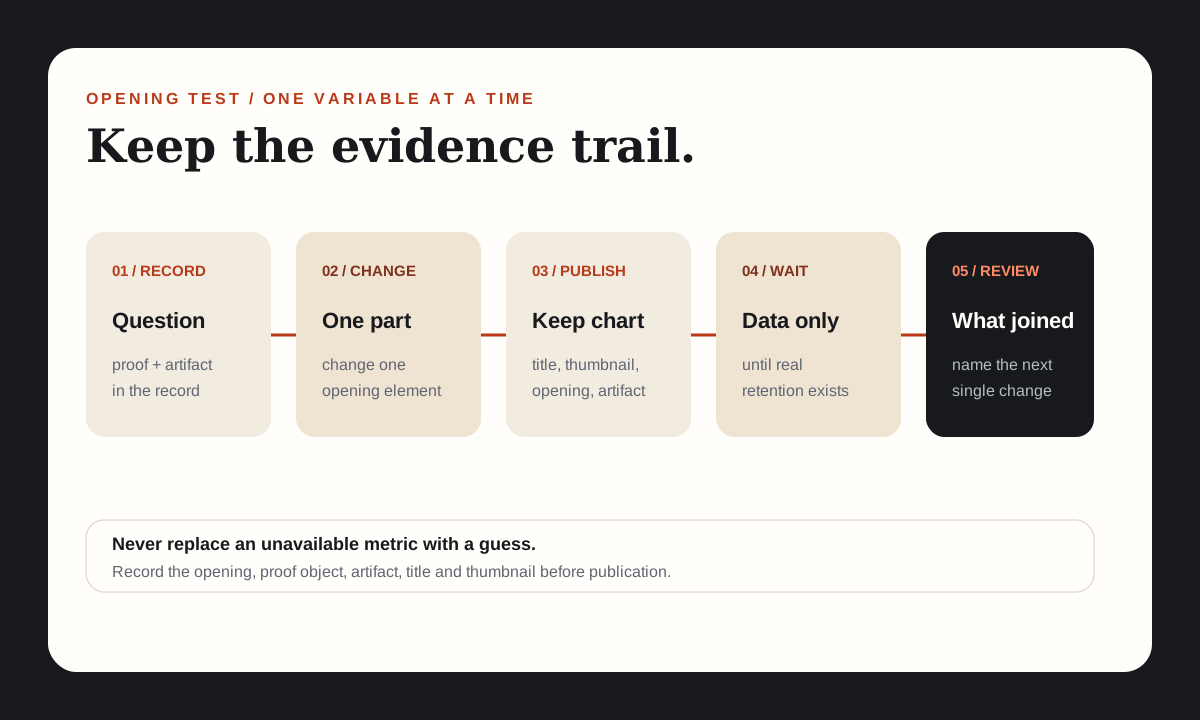
When data is unavailable, write unavailable. Do not replace it with a predicted retention percentage or a made-up “hook score.” Review the actual chart when it exists and ask one controlled question: did the changed opening element change where viewers stopped?
For each pilot, record the exact opening text, the proof object, the artifact, the thumbnail/title promise and the date. Then change only one element in the next test. If the title changes, the proof object changes and the narration style changes at the same time, the review cannot tell which decision mattered.
The production rule is strict but simple: no evidence object, no automated upload. The packaging can become efficient only after the editorial object is real.
Sources and claim notes
These links support the platform and policy statements named in this guide. The frameworks and production checks are original editorial analysis.
- Measure key moments for audience retentionOfficial definition of intro percentage after the first 30 seconds, plus guidance to change and test the opening.
- Search & discovery tipsOfficial description of viewer-performance signals, including average view duration and average percentage viewed.
- YouTube channel monetization policiesOfficial policy against mass-produced, generic or repetitive monetized content.
- How to automate YouTube video production in n8n with AILive Reddit result surfaced in a US-English Google search on 31 October 2026; used as a question and workflow source, not a factual authority.