An automated YouTube channel is not a single business model. The useful decision is which production workflow can preserve evidence, identity and accountable review for the specific format you intend to publish.
Most automated-channel advice starts with a tool stack and ends with a promise that uploading can become hands-free. That skips the important production question: after scripts and renders are automated, what remains on screen that helps a viewer understand, verify or remember the episode?
Does an automated YouTube channel need a face?
No published YouTube rule in the sources checked here says that a channel needs a visible presenter. The official monetization policy instead asks for content that is original and authentic and says it should not be mass-produced, generic, repetitive or manipulative. Those are content standards; they are not camera instructions.
That distinction matters. A face can make identity, expression and continuity easier to read, but it is only one way to carry those jobs. A faceless automated YouTube channel still needs a recognizable editorial point of view, a reason to trust each claim and a person who approves the result.
This guide therefore compares workflows by what they make visible and what they make expensive. It does not declare a universal winner. A format that suits screen-recorded software teaching may fail when applied to relationship-led commentary, while an evidence-led explainer can travel without a presenter because the evidence occupies the screen.
If you are still choosing the broad channel lane, start with the faceless youtube channel ideas pillar. This page answers the narrower production question: which repeatable workflow should the automated channel use?
Separate the three jobs a presenter normally does
Removing a face from a video does not remove the jobs that the face was performing. Treat those jobs separately before comparing software.
Identity
The viewer needs to know whose editorial judgment they are following and what changes between episodes.
Evidence
The viewer needs an object, test, document, screen or comparison that supports the answer.
Accountability
Someone must verify claims, rights, disclosure, audience classification and the final release.
A synthetic presenter can imitate identity, but it can also create new risks: an invented person, a misleading endorsement or a realistic scene that needs disclosure. YouTube requires creators to disclose realistic generated or altered content in specific cases, including content that makes a real person appear to say something they did not, alters real footage, creates a realistic scene that did not occur, or makes generated music the main focus.
The safer replacement is not pretending that a synthetic person is the source of authority. It is showing the work: the record, the test, the captured process, the source comparison and the uncertainty that remains. Accountability stays with the human operator.
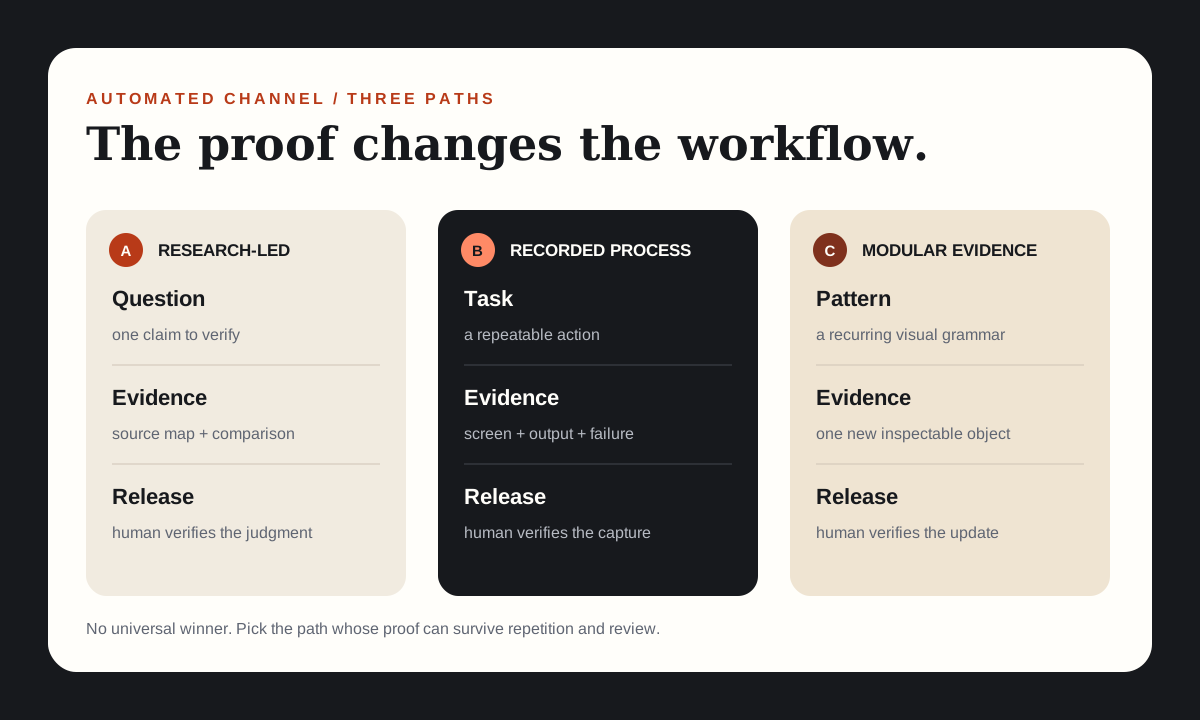
Workflow A: Research-led explainer
In the research-led workflow, an automated system collects candidate sources, extracts claims and drafts an outline. A person decides the question, verifies the sources, rejects unsupported claims and writes the editorial judgment. The renderer then turns that approved argument into typography, charts and narration.
This workflow fits questions where the answer already lives in documents or public records but the viewer needs help comparing them. Examples include policy explainers, market-structure guides, historical timelines and technical comparisons. The proof object is the source map, comparison table or annotated document.
The workflow is weak when the draft simply paraphrases the same top results every competitor uses. Automation makes that failure easier because it can generate fluent paragraphs from a thin evidence base. The correction is to require one original decision layer: an explicit comparison method, a worked example, a rejected alternative or a documented test.
| Production block | What can be automated | What stays human |
|---|---|---|
| Question | Cluster similar questions and retrieve candidate pages | Choose the one question this episode owns |
| Evidence | Collect links, dates and quotations | Verify meaning and decide which claim is strong enough |
| Script | Draft, shorten and format sections | State the thesis, limits and original conclusion |
| Visuals | Render a consistent source table or decision map | Check that the visual proves the spoken point |
| Release | Upload files, captions and metadata | Approve rights, AI disclosure, audience and publication |
Workflow B: Recorded-process channel
The recorded-process workflow makes the work itself the show. A person or scripted automation performs a repeatable task in software, a worksheet or a physical workspace; the screen capture or camera becomes the evidence. Narration and graphics explain what changed and why.
This is a strong fit for software tutorials, spreadsheet walkthroughs, design systems, repair procedures and documented experiments. Viewers can watch the action happen rather than accept a narrator's summary. The episode also creates proof of production that can be shown in the first seconds: an input file, a failing test, a finished comparison or a visible before-and-after state.
The main cost is dependency on the real process. If the recording is staged, sped through important decisions or repaired after the fact without disclosure, the format loses its advantage. Create a clean evidence trail: save the source files, name the steps, show the failed attempt when it explains the lesson and keep the final output inspectable.
The workflow is less suitable when the subject cannot be shown. A video about private emotional experience, confidential consulting work or an event you did not attend cannot manufacture authentic process footage. In those cases, either change the format or accept that a presenter-led interview may be the more honest structure.
Workflow C: Modular evidence channel
The modular-evidence workflow treats every episode as a new combination of reusable, inspectable parts: a recurring question card, a source stack, a comparison table, a map, a timeline and a closing decision rule. Automation can assemble the parts, but the parts must change in response to the episode's evidence.
This workflow fits data stories, explainer series and recurring audits where the visual grammar is part of the channel's identity. It can produce a recognizable show without stock footage or an artificial presenter. The risk is template sameness: if a new episode only swaps labels in the same diagram, the channel becomes mass-produced even when every sentence is technically unique.
Use an asset rule before rendering: every episode needs at least one evidence object that could not have appeared unchanged in the previous episode. That object can be a new comparison, an annotated record, a changed decision tree or a first-hand test. The reusable frame supplies recognition; the new object supplies value.
This is the workflow most closely tested by the FacelessLanes production system. Its public pages use a direct answer, a decision framework and code-native diagrams, while the video turns the central decision into a timed visual sequence. The reusable system is the page shell and visual grammar, not a recycled article.
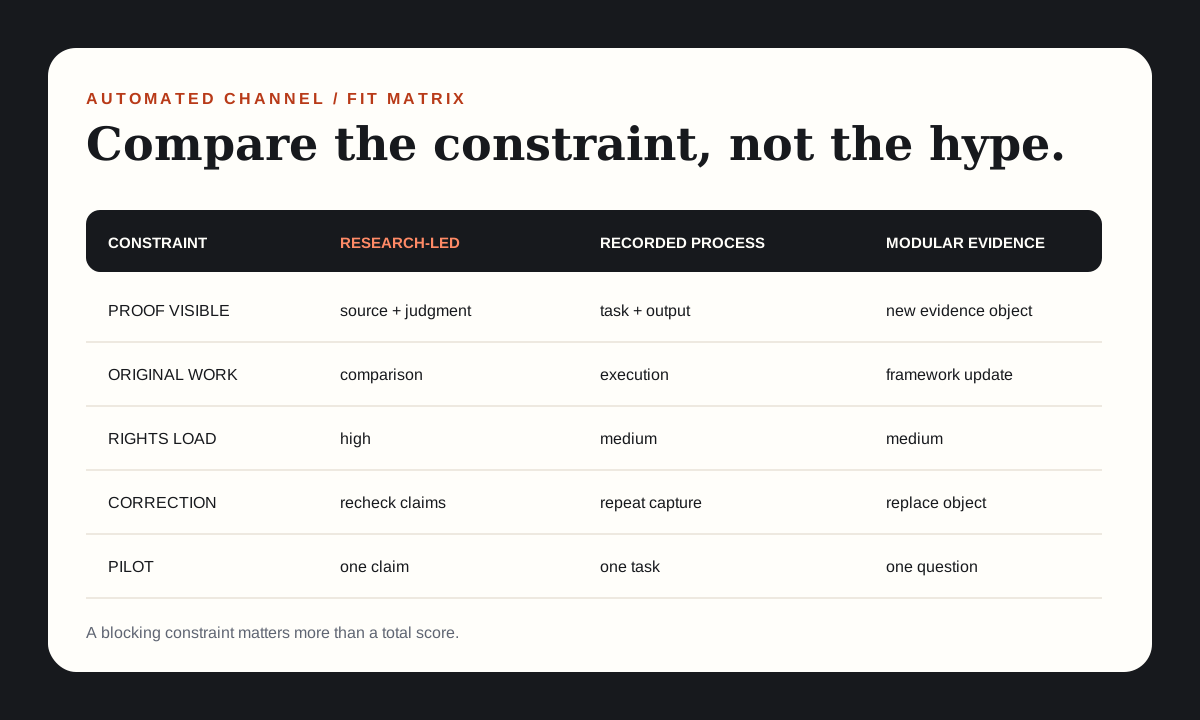
Compare the workflows by production constraints
A tool demonstration cannot show which workflow is better for your channel. Compare them against the constraints that determine whether the channel can survive repeated publication.
| Constraint | Research-led | Recorded process | Modular evidence |
|---|---|---|---|
| On-screen proof | Source map, quotation, comparison | Captured task and output | Charts, maps and recurring decision objects |
| Original contribution | Source synthesis plus a new judgment | Original execution or test | Original framework and updated evidence |
| Rights burden | Text and image licences need review | Software and on-screen material need review | Data, fonts, images and templates need review |
| Correction cost | Recheck claims and regenerate scripts | Repeat the recorded step | Update the evidence object and rebuild |
| Best first pilot | One narrow claim comparison | One task with a visible failure point | One recurring question with a new evidence object |
The comparison does not produce a universal score. It produces a fit decision. If the proof cannot be recorded, the recorded-process workflow is not available. If the episode introduces a different evidence object each time, the modular workflow may preserve identity without repetition. If the unique contribution is a careful source judgment, the research-led workflow may be the cleanest production path.
Run a three-episode workflow pilot
Do not compare workflows by imagining a perfect month. Produce three short episodes under the same rules, then inspect the artifacts.
- Episode one, control: use the workflow you expect to prefer. Keep the question narrow enough to verify in one sitting.
- Episode two, evidence shift: use a different proof object, such as a captured process, source comparison or worked example. Keep the channel promise unchanged.
- Episode three, correction: deliberately document one failure, rejection or revision. That may be an unsupported claim, an unusable recording or a visual that did not explain the point.
After the third episode, answer five questions. Did a viewer see the proof before the explanation became abstract? Could a person other than the narrator identify the channel's editorial standard? Did the workflow create new evidence or only rearrange familiar information? Which rights or disclosure decision required review? Could the same process run again next week without a heroic amount of manual repair?
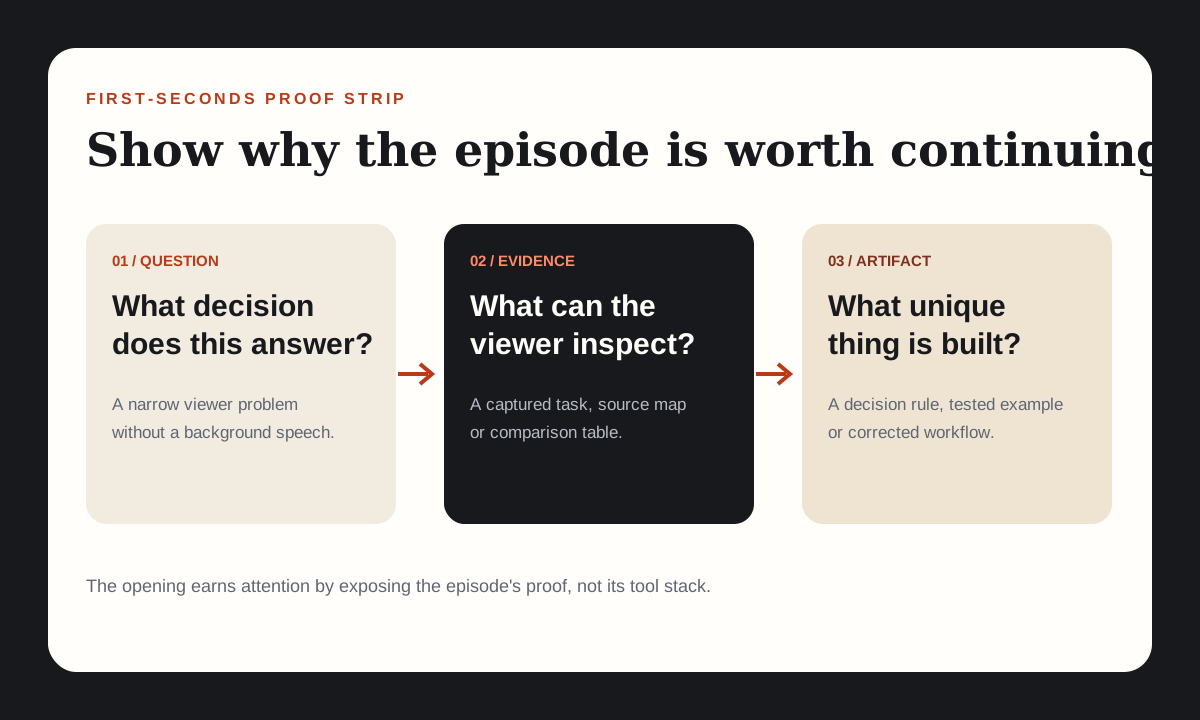
Use the first eight seconds as a packaging check, not a promise about the algorithm. The opening should make three things visible: the exact question, one piece of proof that the question is real or answerable, and the unique artifact the viewer will receive if they continue. If the opening can only say what tool made the video, the format is not yet differentiated.
Worked example: choose a workflow for a packaging explainer
Suppose the proposed channel explains how small ecommerce sellers compare shipping options. The promise is: each episode turns one shipping decision into a repeatable comparison a seller can use. The channel is automated in the sense that research collection, script formatting, diagrams, narration and captions run through a template.
A research-led episode could compare two published carrier policies and produce a claim matrix. A recorded-process episode could show a spreadsheet being filled from rate cards and expose one hidden assumption. A modular-evidence episode could reuse a calculation card and a decision matrix while introducing a new worked package profile.
Which workflow fits? The recorded-process version requires access to a repeatable workspace and shows the calculation directly. The modular version can run every week if each episode has a different rate scenario. The research-led version works only if the policy comparison adds a judgment that cannot be found in a simple carrier summary.
This worked example can be decided without knowing search volume, difficulty, traffic or expected revenue. Those values are unavailable in the source material and should not be invented. The operational decision is made from evidence and production capacity: can the channel show the comparison, update it honestly and review the output before release?
Keep disclosure, rights and release decisions human
Automation can collect, draft, arrange, render, transcribe and schedule. It should not silently decide whether a generated scene needs disclosure, whether a source permits the reuse or whether the episode is ready for public release.
YouTube requires AI disclosure for realistic generated or altered content in the circumstances described in its policy. The same policy says disclosure alone does not limit a video's audience or its eligibility to earn money. That does not make disclosure optional; it separates the disclosure decision from speculation about distribution.
Before publication, keep four pieces with the episode: the source list, the identity of every third-party asset and its permission, the AI-use decision, and the audience classification. Add a final playback check of the exported file, captions, title, description and channel setting. The person who approves release should be able to point to those records without asking a model what it remembers.
The release rule is simple: if the evidence packet is incomplete, the render is a draft rather than an upload. This preserves the benefits of an automated YouTube channel without turning speed into an excuse for unverified or repetitive output.
Choose the workflow that makes the next episode easier to verify
The best workflow is not the one with the fewest clicks. It is the one that makes the next episode easier to research, prove, correct and recognize. A research-led channel should become faster at source judgment. A recorded-process channel should preserve cleaner evidence. A modular-evidence channel should make each new evidence object more useful than the last.
Start with one narrow promise and produce three short pilots. Pick the workflow whose proof stays visible after the narrator disappears, whose rights decisions can be documented and whose output a person can approve without reconstructing the whole process from memory.
That is the practical answer for an automated YouTube channel: automation is a production capability, not the value proposition. The channel earns trust when viewers can inspect what the system helped make, understand why it matters and see that a responsible person still decided to publish it.
Sources and claim notes
These links support the platform and policy statements named in this guide. The frameworks and production checks are original editorial analysis.
- YouTube channel monetization policiesOfficial guidance on original and authentic content, and on inauthentic, mass-produced, generic or repetitive material.
- Disclosing use of GenAI contentOfficial requirements for realistic AI-generated or meaningfully altered content and the audience or monetization boundary of disclosure.
- Creating helpful, reliable, people-first contentGoogle Search guidance on original information, added value and content created for people.
- Can a faceless or automated YouTube channel be monetized?Live Reddit question surfaced in a US-English Google result on 30 October 2026; used as a question source, not as a factual authority.