The best current faceless channel idea for a beginner is not a long topic list. It is a repeatable systems explainer in which one person can turn public records and maps into a new inspectable episode each week.
A useful faceless channel idea is not a topic label with enough search demand. It is a production promise that one person can keep without relying on a visible presenter. This page uses a current benchmark, an original weekly-proof process and verifiable purchase prices to choose one direction and show why the other two remain references rather than immediate entry points.
Systems explainers win because the proof can be rebuilt every week
A systems explainer answers how a visible outcome is produced: why a service works, why a price changed, why a route exists or why an organisation behaves in a particular way. The answer can be carried by documents, maps, ownership chains, timelines and calculations. None of those needs a presenter’s face.
The selection standard for this page is simple: one person must be able to produce a materially different proof object within one week. A proof object is something the viewer can inspect without trusting the narrator, such as a highlighted regulation, a map with a decision boundary, a reconciliation table or a dated public record.
Systems explainers satisfy that standard because the research and the visual are the same work. A source passage can become an annotated excerpt. A comparison can become a decision table. A route, supply chain or jurisdiction can become a map. The next episode can change the question without replacing the entire production system.
The format also has a clear failure condition. If the creator only narrates a generic topic overview and adds stock footage, the episode has no proprietary proof. Each episode needs at least one object that makes the specific answer inspectable.
Use a five-step weekly proof loop
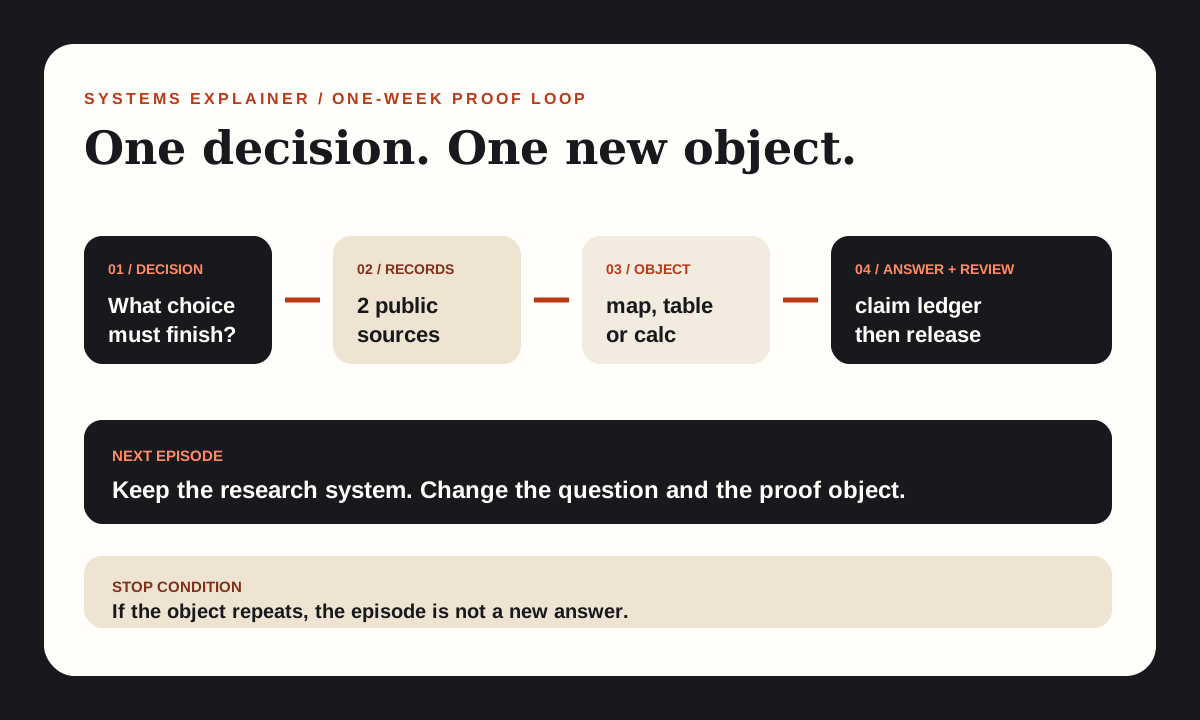
The production unit is one bounded question, not a topic category. The loop below keeps the research, script, visual and review tied to the same evidence:
- Choose one decision: write the viewer’s question as a decision they can finish after the episode.
- Collect two public records and one measured source: preserve the exact page, line, date and URL for each.
- Build one original proof object: produce a map, calculation, timeline or source comparison that is necessary to the answer.
- Write around the object: explain what changes, what stays unresolved and why the surrounding system behaves that way.
- Release only after review: check the claim-to-source table, rights, captions and final playback.
This loop is deliberately narrow enough to run in a week. It also creates a reusable archive. A creator can index each proof object by sector, geography, source type and decision. A later episode can revisit the same system with a new record, but it should not repeat the earlier answer with different nouns.
The current benchmark separates a viable lane from a difficult reference
The table below uses a public YouTube snapshot checked on 13 November 2026. Subscriber counts came from public channel metadata. Exact view counts and upload dates came from public channel feeds. “30-day views” means the current cumulative views on videos published during the previous 30 days, not a claim about the channel’s total historical traffic.
| Direction | Head-channel scale / 30-day new-upload views | Average views per video | Typical duration / update frequency | First-video purchases: verified prices only |
|---|---|---|---|---|
| Systems explainers — enter now | 4,900,000 subscribers; 2,793,159 accumulated views on three uploads published in the trailing 30 days | 1,135,974 average across the latest 15 uploads | 19.4-minute average; 14.1–23.8-minute range; three uploads in 30 days, or one every 10 days in this sample | DaVinci Resolve — $0; diagrams.net — $0 |
| Hands-only process tests — format reference | 2,830,000 subscribers; 234,669 accumulated views on one upload published in the trailing 30 days | 696,439 average across the latest 15 uploads | 22.2-minute average; 14.9–30.4-minute range; one upload in 30 days | DaVinci Resolve — $0 |
| Simple 2D animation — difficulty reference | 25,800,000 subscribers; 19,535,799 accumulated views on five uploads published in the trailing 30 days | 6,562,860 average across the latest 15 uploads | 13 minutes 49 seconds average; five uploads in 30 days, or one every six days; 6,635 drawings under a declared eight-drawn-frames-per-second planning assumption, before revisions | Clip Studio Paint PRO one-time license — $63.00; DaVinci Resolve — $0 |
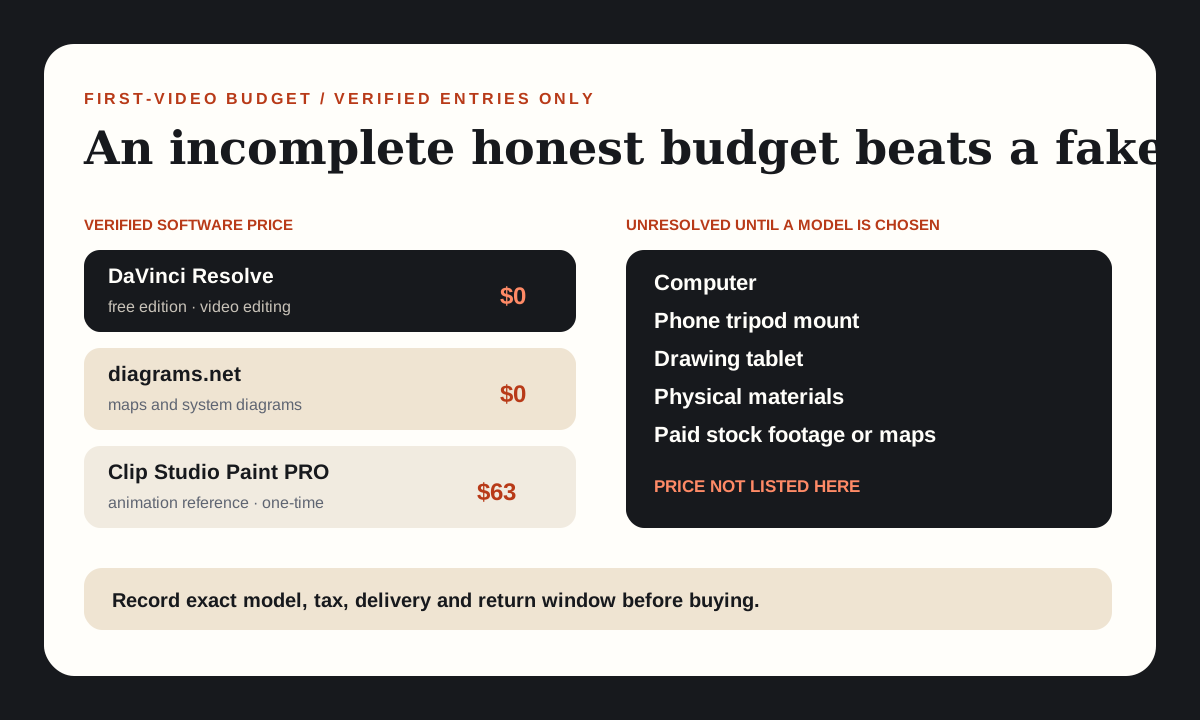
The remaining computer, phone mount, physical material, stock-footage and drawing-tablet prices were not available from public pricing and are therefore excluded rather than treated as zero.
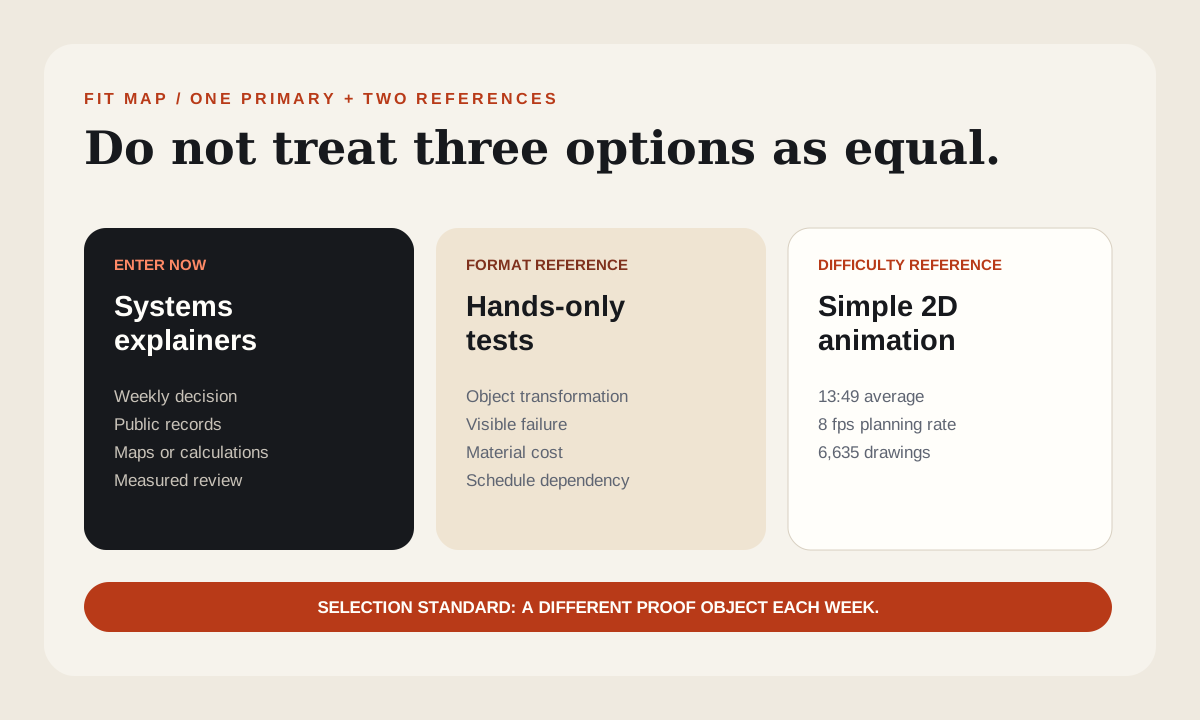
This is why the table is not a three-way tie. Systems explainers show repeatable output at a manageable research cadence. Hands-only production proves what “no face” can look like, but the sample’s one upload in 30 days shows how difficult the cadence can be. Animation demonstrates the strongest attention in the sample, but the drawing count exposes a production burden that a beginner should not confuse with an easy entry point.
Hands-only experiments belong in the reference column
A hands-only experiment is still valuable. It shows how a process can remain understandable when the viewer watches a tool, material or object change state. It removes the dependency on facial expression and makes the evidence visible from the first shot.
The problem is throughput. The current reference sample averages 22.2 minutes and published one video in the trailing 30 days. A real experiment can fail, require replacement materials or need extra recording sessions after the object changes unexpectedly.
A beginner can use this format as a production lesson: show the starting object, the intervention and the final state. Do not use it as proof that every process can be completed on a weekly schedule. If the material, workshop or repair task controls the calendar, the channel controls the creator rather than the reverse.
Animation is the difficulty reference, not the beginner promise
Simple 2D animation makes an invisible mechanism visible. That is a powerful answer surface, and the sample records strong demand. The same sample also shows why the format should not be sold as an easy first channel.
Across its latest 15 public videos, the average runtime is 13 minutes 49 seconds. At a declared planning rate of eight drawn frames per second, that average requires 6,635 drawings before revisions. The number is not a YouTube rule; it is a transparent workload check derived from the observed duration and a stated production parameter.
A beginner can reduce the first episode to one minute and test the method. That does not turn the format into a systems explainer. It becomes a different promise with a different schedule. Keep animation as a reference when evaluating motion design, continuity and visual explanation, not as the immediate answer unless the drawing capacity is already available.
Start with the purchases that have a verifiable price
Do not call an owned computer, borrowed camera or untracked material a zero-cost production. The only defensible $0 entries in this plan are software with an official free product. DaVinci Resolve has a free edition for editing. diagrams.net is free for the chart and system-map work. Those are useful starting purchases because they lower the cash entry point without pretending the rest of the stack is free.
The animation reference adds a one-time Clip Studio Paint PRO license listed by its publisher at $63.00. That licence does not include a drawing tablet or computer. A phone mount, physical materials, paid footage and hardware remain separate purchases, and their prices are not declared here because no specific models have been selected.
Use a purchase ledger before the first episode. Record the item, exact model, price, tax, delivery, return window and whether it is reusable. If the price is not found from a public listing, write “unavailable” and keep the item unresolved. An honest incomplete budget is more useful than a complete-looking $0 claim.
Plan five episodes around five different decision objects
A five-episode pilot should test whether the systems format can produce distinct evidence without changing its promise. The episodes below are examples of a production pattern, not a recycled niche list:
- Rule map: compare one public rule with the workflow it changes.
- Price bridge: trace a consumer price through two published inputs and one assumption.
- Route comparison: place two possible paths on a map and explain the constraint that decides between them.
- Ownership chain: follow one service or asset through the organisations that control it.
- Correction episode: revise an earlier claim after a newer public record changes the conclusion.
Each episode must produce a different object. A new colour, title card or AI image is not a new proof object. If two planned episodes would use the same table with different words, merge them or change the question.
This pilot also produces a market-learning record. Track how long it takes to find sources, build the object, verify claims and finish the edit. Do not replace missing time with an invented average. Use the measured records to decide whether to continue, narrow the system or move to a different format.
Keep the answer useful when the face is absent
YouTube’s search and discovery guidance says the system does not favour one video format and considers viewer behaviour. The platform does not require a face. The production still has to earn attention through a clear question, a useful answer and a reason to keep watching.
The systems format handles trust with four visible checks. The viewer can identify the exact question in the first screen, inspect the public record, follow the map or calculation and see which conclusion remains uncertain. The narrator can then explain the relationship instead of claiming personal authority.
YouTube’s monetization policy adds a second constraint: content should be original and authentic, materially varied and more than generic or repetitive output. A stable template is allowed; interchangeable content is not. Reusing a map layout is fine when the record and decision change. Reusing the same conclusion with substituted labels is not.
Before release, ask one final question: if the narration were removed, would the screen still show why the answer changed? If not, the proof object is not strong enough yet.
Enter systems; keep the other formats as tests
The best faceless YouTube channel idea right now is a systems explainer because it gives one person a weekly evidence loop: choose a decision, collect public records, build an inspectable object, publish the answer and retain the source trail.
Hands-only experiments are useful when testing physical evidence and visible transformation. Animation is useful when testing motion and mechanism, but its drawing workload must be measured rather than hidden. Neither reference should replace the selection standard.
Start with five systems episodes. Measure the proof object, the source trail and the production time for each. Continue only when the answer remains visibly different from episode to episode and the creator can sustain the weekly unit without borrowing another channel’s identity or material.
Sources and claim notes
These links support the platform and policy statements named in this guide. The frameworks and production checks are original editorial analysis.
- YouTube search and discovery tipsOfficial guidance on viewer behavior and the absence of a preferred video format.
- YouTube channel monetization policiesOfficial standards for original, authentic, materially varied content and against generic or repetitive production.
- DaVinci ResolveOfficial product page for the free edition and paid Studio edition.
- diagrams.netOfficial site for the free diagram editor used for maps and system diagrams.
- Clip Studio Paint pricingOfficial pricing page listing the one-time licence from US$63.00.