A niche becomes a defensible choice when five completed episodes show different questions, different evidence objects, manageable rights and visible correction without collapsing into one template.
Niche lists often replace a decision with a number: demand, difficulty, CPM or competition. Those numbers may be useful when their sources are available, but they do not prove that you can produce the tenth episode. Five completed episodes expose the production truth.
Score completed work, not the promise of a niche
A niche sounds viable when it is still an idea. It becomes testable when five episodes exist.
The test is deliberately small enough to finish and varied enough to reveal whether the format repeats. Each episode must answer a different viewer question, use a different inspectable proof object and survive one correction or limitation. The channel promise stays fixed.
YouTube’s search and discovery guidance says the system does not favour one format and ranks videos using performance and individual viewer context. That means a niche is not “best” because it belongs to a favoured category. It has to earn repeated viewer attention through useful execution.
This method does not substitute unavailable demand, competition, advertising or traffic values. Those records remain unavailable until a valid source measures them. The five-episode score evaluates production evidence instead.
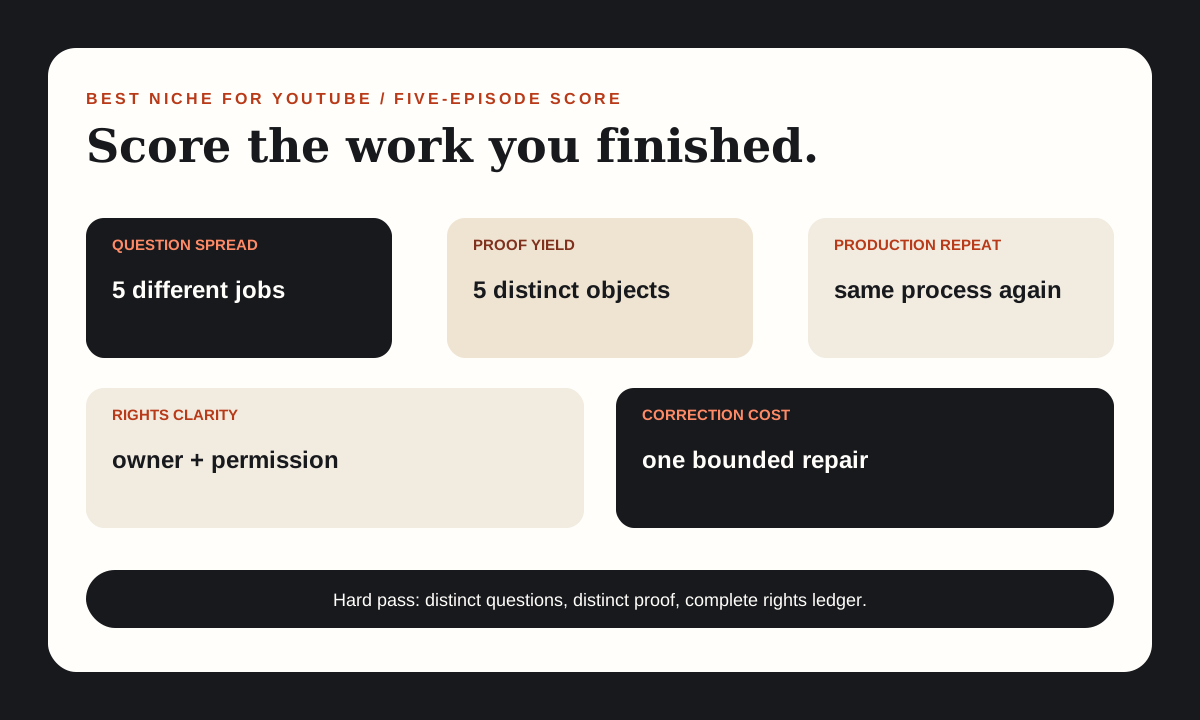
Use five dimensions with a hard pass condition
| Dimension | Question | Pass evidence |
|---|---|---|
| Question spread | Are the five questions genuinely different? | No title is a synonym for another |
| Proof yield | Does every episode contain a different inspectable object? | Five distinct source, test or worked-example records |
| Production repeat | Can the same process run again next week? | A reusable checklist with bounded manual review |
| Rights clarity | Can every asset be traced to an owner and permission? | A complete source ledger for all five |
| Correction cost | Can one wrong claim be fixed? | A documented correction path that does not rebuild the channel |
Treat the first two dimensions as hard conditions. A niche with one repeated answer in five different titles has not produced a library. A complete rights ledger is also a release condition, not a bonus point.
Production repeat and correction cost can be reviewed relatively: write down what took longest, what was rejected and what would change in episode six. Those observations are more useful than a guessed “competition score.”
Prove question spread before writing a content calendar
Write ten questions before choosing a niche, then publish five. A question is distinct when it changes the decision, evidence or artifact.
“Best AI tools,” “top AI tools” and “AI tools to use” are not three questions. “Which AI disclosure decision applies to a realistic synthetic scene?” and “How do you test whether an AI-generated episode is repetitive?” are different.
Keep a question ledger. For each row, record the viewer decision, the proof object, the source and the next related question. This makes duplication visible before it becomes another upload.
If the channel can produce only three distinct questions, use one page or one short series instead of pretending it has a 50-episode lane. The honest container protects the niche from forced repetition.
Require one new proof object per episode
A proof object is something a viewer can inspect: a source comparison, captured process, calculation, map, test result or first-party record. It is not a decorative image that happens to sit behind the narration.
Across five episodes, the objects should differ in substance. A new colour or heading does not make a new object. A new dataset row, changed assumption or recorded failure does.
Specific
The viewer can point to the exact line, step or result.
Necessary
Removing the object makes the answer impossible to verify.
Renewable
The next episode can produce a genuinely different object.
If the proof objects stop changing, stop adding episodes and narrow the question. This is a production decision, not a judgment about whether the niche is popular.
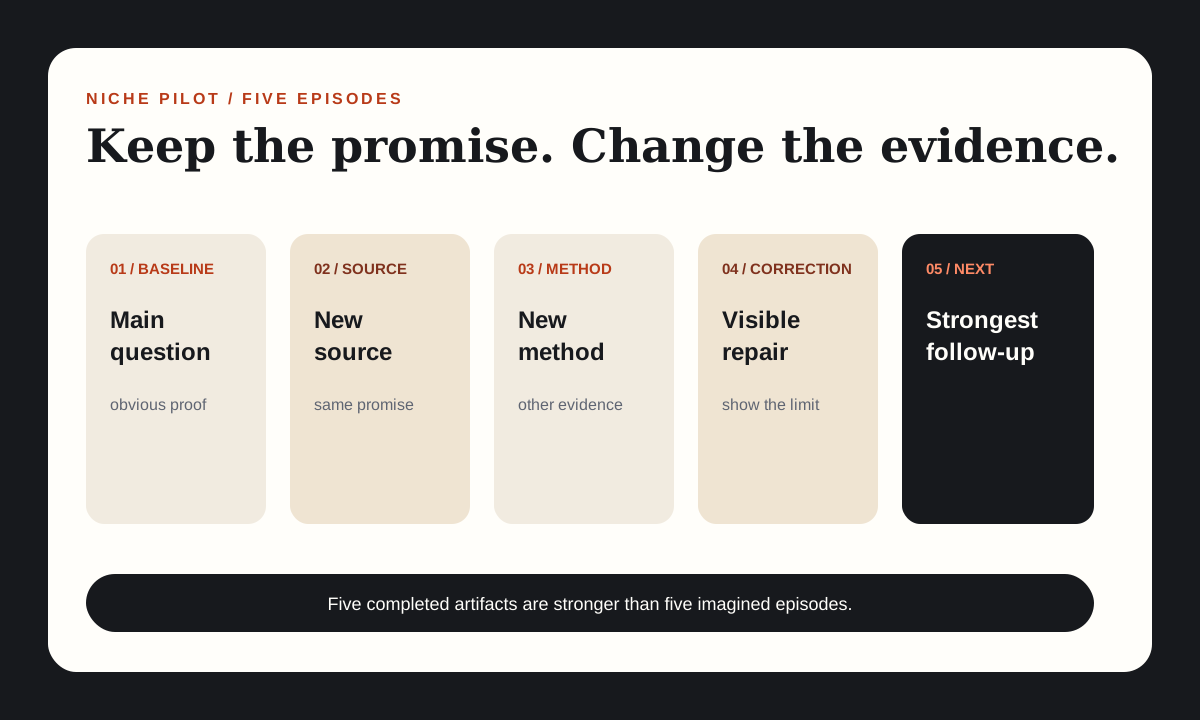
Run the five episodes as a controlled ladder
- Episode 1 — baseline: answer the main question with the most obvious proof type.
- Episode 2 — source shift: keep the promise and change the evidence source.
- Episode 3 — method shift: use the other major proof surface, such as a calculation or captured process.
- Episode 4 — correction: document a failed test, rejected claim or limitation.
- Episode 5 — next question: use the strongest question generated by the first four and make the evidence visibly different.
The sequence is not a miniature content calendar. It is a diagnostic. Episode four is especially important because it reveals whether the production can admit and repair uncertainty without destabilising the promise.
After five, place the titles and thumbnails side by side. If a new viewer can identify the shared job but also see why each episode is different, the niche is ready for more testing. If only the nouns changed, it is not.
Treat rights as a pass-or-hold field
A niche can appear easy to produce because there is abundant material online. Abundance does not grant reuse permission. Every image, clip, voice, music track and quotation needs an owner and a rights basis.
YouTube’s monetization policy asks creators to make original, authentic content and warns against mass-produced, generic, repetitive or manipulative material. That turns reuse and repetition into channel-level production issues, not just citation issues.
For every pilot, keep a source ledger. Mark each item as original, licensed, public record or unavailable. If an item has no recorded permission, the correct outcome is hold. Do not infer permission from public visibility.
Test whether the niche can survive a correction
Every factual channel eventually needs a correction. The question is whether the format can make one without rebuilding its identity.
Use the fourth episode to expose a limitation in the first three. Record what changed, why it changed and which claim is now narrower. A correction is not a branding failure; it is evidence that the production method has a review step.
If a correction forces a complete redesign, the format may be too fragile. If the channel can update one proof object, retain the source history and publish the revised answer, the niche has a durable correction mechanism.
Worked example: score a narrow explainer lane
Suppose the candidate niche is “AI tools for beginners.” That is too broad for a strong faceless pilot. Narrow it to “how a beginner chooses, documents and audits an AI-assisted workflow.”
The five episodes could cover: choosing a task by evidence, recording the original source, running a small workflow test, documenting one failed output and revising the workflow. The proof objects are a task map, source ledger, test log, failure record and revised checklist.
That lane passes question spread and proof yield because the artifacts change. The rights burden remains manageable when the channel creates its own screenshots, diagrams and records. The correction cost is bounded because the ledger identifies which artifact must be revised.
The same method applies to any candidate. The score is not a forecast. It is a count of what the production has already demonstrated.
Choose the niche the next five episodes can prove
The best niche for YouTube is the one that generates a connected series of answerable questions with inspectable evidence. Popularity can help only when the production can sustain it.
Produce five episodes, score the five dimensions, preserve the rights ledger and document one correction. Continue if the pilot produces five distinct proofs without breaking the channel promise. Narrow the niche if the answers repeat. Stop if the evidence cannot be produced without borrowing content or relying on a presenter the format does not have.
Five completed episodes are a stronger decision input than another ranking of labels.
Sources and claim notes
These links support the platform and policy statements named in this guide. The frameworks and production checks are original editorial analysis.
- Search & discovery tipsOfficial guidance that YouTube does not favour one format and ranks using performance, personalization and viewer behavior.
- YouTube channel monetization policiesOfficial standards for original and authentic content and against inauthentic, repetitive or mass-produced material.
- Disclosing use of GenAI contentOfficial disclosure requirements for realistic generated or meaningfully altered content.
- Struggling to find a niche and content ideas as a new YouTuberLive Reddit question surfaced in a US-English Google search on 5 November 2026; used as a question source, not a factual authority.