The best faceless niche is not the broadest topic with the most enthusiastic listicle. It is the topic whose recurring questions can be answered with evidence a camera-free production can actually show.
“Best niche” lists often rank labels: finance, true crime, history, AI or productivity. A label cannot tell you whether the format will work without a face. The useful decision is whether the subject repeatedly gives the channel something viewers can see and verify.
What makes a YouTube niche “best”?
For a faceless channel, “best” means repeatable proof fit. Each episode needs a question, a result and an object that supports the result. A software lesson has the application screen and output. A data explainer has a calculation and comparison. A repair channel has the failed object and the corrected state. The visual evidence changes, but its job remains stable.
YouTube’s search and discovery guidance says the system has no opinion about the type of video a creator makes and does not favour any particular format. That removes a false shortcut: there is no official signal saying presenter-led niches are automatically preferred. It does not remove the production job. A camera-free channel has to replace the identity and credibility cues that a presenter might provide.
The best niche therefore has three properties: a recurring audience problem, a proof surface that can carry most episodes and a production cycle that one accountable operator can sustain. Interest in the topic is useful only when those three conditions survive.
Map the niche to a repeatable proof surface
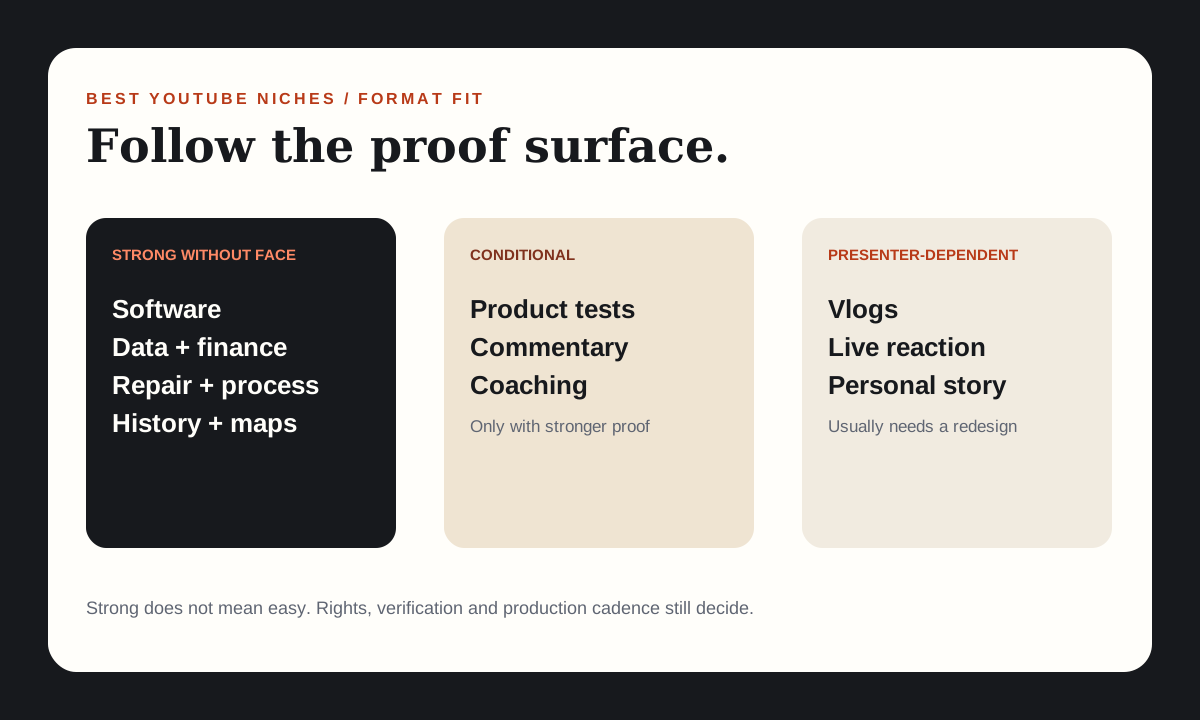
Use the fit categories below as a first filter, not a guarantee. A format can move categories when the production changes.
| Niche shape | Repeatable proof without a face | Main hidden cost | Fit |
|---|---|---|---|
| Software and workflow teaching | Screen capture, input, decision and output | Keeping recordings current when tools change | Strong |
| Data, finance and calculations | Visible assumptions, formula and result | Errors are costly; verification must be explicit | Strong |
| Repair, build and physical process | Before state, stages and corrected object | Camera work and workspace access | Strong |
| History, geography and document explainers | Maps, timelines, records and source comparisons | Image rights and source quality | Strong |
| Product or tool comparison | Same task run under controlled conditions | Purchasing, time and fair-test design | Conditional |
| Commentary and reaction | Clips plus a transparent editorial method | The reaction is often the value and reuse rights are harder | Harder |
| Personal coaching and life advice | Frameworks, cases and documented outcomes | Trust depends heavily on credentials and personal context | Harder |
| Vlogs and relationship-led stories | First-person access and experience | The face is usually the format, not decoration | Weak without redesign |
A conditional niche can still be the best choice if the creator can add the missing proof. For product reviews, run the same test rather than narrating features. For commentary, create an original analysis layer rather than only responding to another clip. For coaching, show a method and its limits instead of implying authority through tone alone.
Replace the presenter with a three-layer trust stack
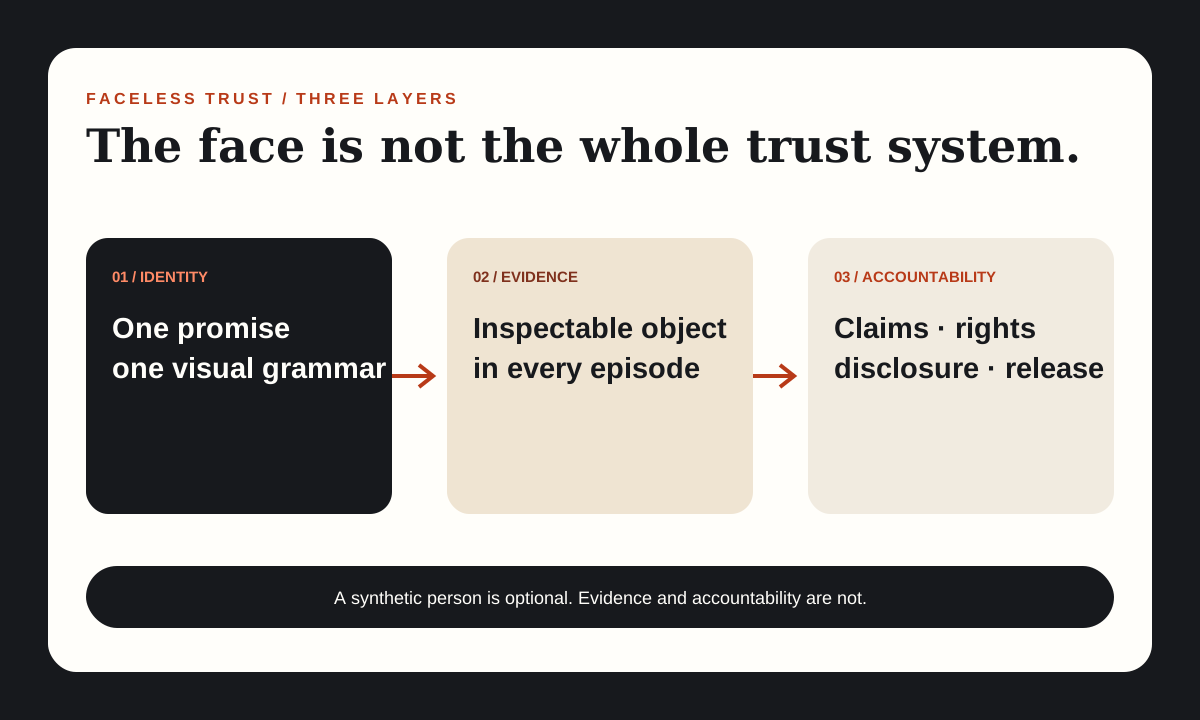
A presenter can communicate identity, evidence and accountability at once. A faceless format should make those layers explicit.
Identity
A repeatable editorial promise and visual grammar make the channel recognizable across topics.
Evidence
Every episode contains a source, test, process or artifact that can be inspected.
Accountability
A person verifies claims, rights, disclosure, audience classification and release.
The stack also constrains what “faceless” should mean. A synthetic presenter may create a recognizable identity, but it introduces disclosure and impersonation questions. YouTube requires disclosure for realistic generated or altered content in specified cases, including realistic scenes and material that makes a real person appear to say or do something they did not.
You do not need to solve identity by manufacturing a person. You can do it with a strong stated promise, visual continuity and a visible evidence method. That is usually more auditable, and it keeps the focus on what the episode adds.
Run five fit tests against one specific niche
- Question repeat: Write ten viewer questions that are genuinely different, not synonyms for one question.
- Proof repeat: Attach one inspectable object to each question. If seven objects are the same generic chart, the format is thin.
- Sound-off: Can the visual evidence communicate the core change without narration?
- Rights: Can the channel make each episode from owned, licensed or public-record material?
- Correction: When a claim is wrong, can the channel show what changed without remaking the entire format?
These tests are intentionally different from market-size rankings. They test whether the production can create a durable library. A topic that feels exciting but cannot produce ten different proof objects fails before publishing begins.
The outputs should be files, not feelings: a question list, an object list, a rights note and a correction rule. Store them with the niche decision so the next episode does not depend on memory.
Use a decision tree before choosing the niche
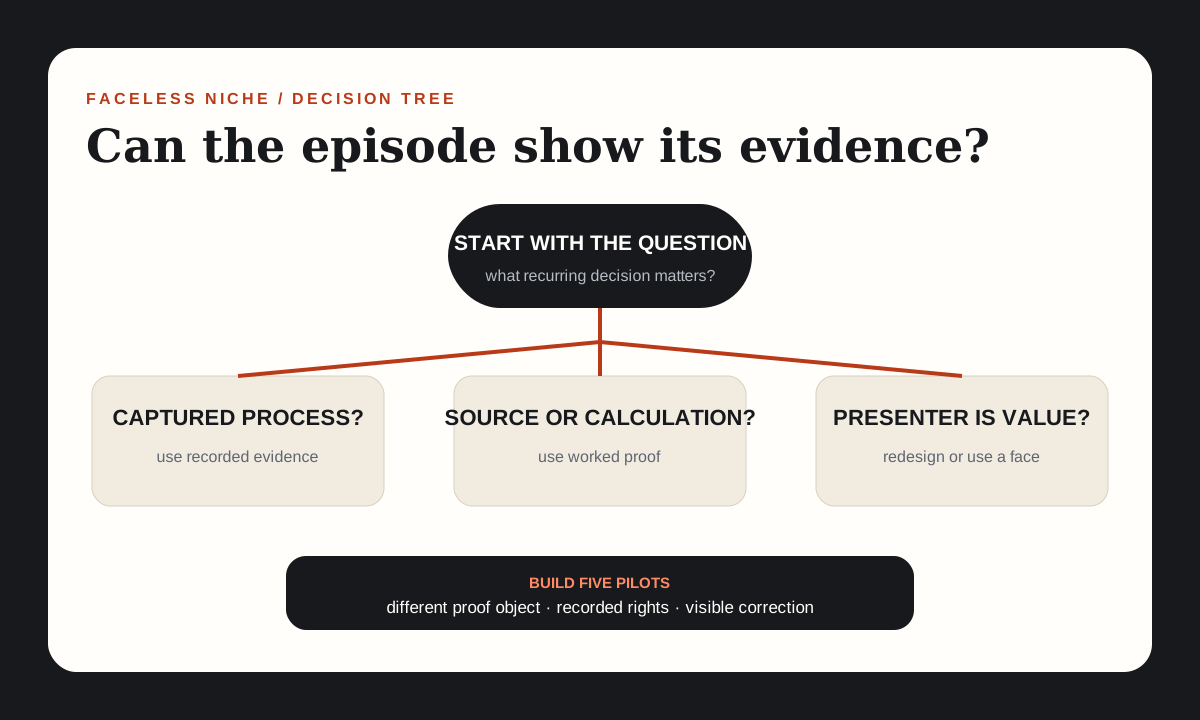
Start with the format's central value. Ask whether the viewer gains most from seeing a process, understanding evidence or experiencing a person. The first two usually adapt naturally to faceless production. The third may still work, but it needs a different substitute for presence.
| Question | If yes | If no |
|---|---|---|
| Can the recurring answer be shown in a captured process? | Use recorded evidence. | Continue. |
| Can it be supported by a source or calculation? | Use comparison or worked-example proof. | Continue. |
| Does the audience primarily value the creator’s live presence? | Faceless may be the wrong production choice. | Continue. |
| Can a written evidence packet preserve the key claims? | Build the pilot. | Do not scale. |
The decision tree does not prohibit any topic. It prevents the wrong production promise: claiming that a face is irrelevant when the format has not replaced the trust job the face was performing.
Worked example: three niche candidates, one evidence budget
Imagine one operator has the same amount of production time for three candidates: personal finance explanations, software tutorials or celebrity commentary.
| Candidate | What can be shown | Original contribution | Main release risk |
|---|---|---|---|
| Personal finance | A worked calculation and changed decision | Original assumptions and sensitivity test | Advice boundaries |
| Software tutorials | A screen-recorded process and output | Selected task and verified result | Tool or version change |
| Celebrity commentary | Reaction and edited third-party clips | Interpretation, unless analysis is substantially original | Rights, reuse and timeliness |
Personal finance and software tutorials create reusable proof relatively directly. Celebrity commentary may attract attention, but the production carries more rights work and the original contribution must be clear. The point is not that one niche is universally better. It is that the same evidence budget produces different durability.
A fair comparison should use the same number of episodes, the same review standard and the same record keeping. That is the point where a niche test becomes evidence rather than preference.
Check the niche’s rights and audience boundaries before scaling
Some niches look easy because their source material is abundant. Abundance is not permission. Reviews of films, sports, games or other creators may need close attention to clip rights and how much new meaning the commentary adds. A document-based niche still needs a source ledger.
Audience classification is separate. If children are the intended audience, or the subject matter is directed at children, record that decision and understand how it affects features and monetization. Do not choose a children’s niche merely because it looks easy to make faceless; the audience decision is a legal and product decision, not a set of keywords.
YouTube’s monetization policy also asks for original and authentic content and warns against mass-produced, generic, repetitive or manipulative material. A repeatable format can comply; a strategy built around template swapping cannot be saved by a strong niche label.
Choose the niche with a five-episode pilot
Do not choose a niche from ten imagined perfect videos. Produce five short pilots using one repeatable promise.
- Episode one answers the main question with the expected proof type.
- Episode two changes the source or example while preserving the promise.
- Episode three uses the other major proof surface, such as a calculation or captured process.
- Episode four documents a correction, failed test or limitation.
- Episode five shows the strongest next question produced by the first four.
At the end, inspect the evidence table. Does every episode contain a different object? Can a new viewer identify the channel without the title? Did the rights and audience records survive every release? Could the same process repeat next week without relying on borrowed material?
Continue when the answers are yes. Narrow the promise when the evidence objects repeat. Change the production approach when every episode depends on presenter presence. Do not use an invented growth forecast to settle a question that the artifacts can answer directly.
Pick the niche that makes evidence easier to produce
The best YouTube niches for a faceless channel are the ones where the audience cares about the result more than the face delivering it. That requires a repeatable proof surface, a clear editorial identity and a person who remains accountable for every claim.
Start with one candidate, list ten questions and attach a different inspectable object to each. If the list becomes stronger, the rights are manageable and the format can survive correction, that niche has earned a pilot.
If not, the honest decision is to change the format or accept that the idea belongs in a presenter-led channel. That is a better outcome than automating a promise the production cannot prove.
Sources and claim notes
These links support the platform and policy statements named in this guide. The frameworks and production checks are original editorial analysis.
- Search & discovery tipsOfficial guidance stating that YouTube does not favour a particular video format and ranking depends on performance, personalization and viewer behavior.
- Disclosing use of GenAI contentOfficial disclosure requirements for realistic generated or meaningfully altered content.
- YouTube channel monetization policiesOfficial standards for original, authentic content and inauthentic, mass-produced or repetitive material.
- Best niche for faceless, digital-only YouTube content?Live Reddit question surfaced in a US-English Google search on 4 November 2026; used as a question source, not a factual authority.