A faceless content creator can be recognizable without pretending to be a real person by separating the channel brand, narrator role and evidence contribution.
“Faceless” describes what the audience sees, not whether the channel has an accountable operator. A channel can use an original visual system, synthetic narration and a memorable name without inventing a founder, credentials or life story. The distinction matters because identity creates recognition while deception creates impersonation and trust risk.
Faceless does not mean ownerless
A faceless content creator is still a publisher. Someone chooses the audience promise, approves the evidence, decides what is original and releases the finished episode. Hiding the presenter’s face does not remove those responsibilities; it only changes how the channel presents them.
YouTube’s impersonation policy does not forbid anonymous or faceless channels. It forbids unauthorized impersonation that may mislead viewers, including deceptively copying another person’s or channel’s branding, using someone’s voice or likeness without authorization, or using AI to falsely imply that a real person owns or authorizes the content.
The practical boundary is therefore not “show a face or disappear.” It is “do not make a false claim about who is behind the work.” A channel called FacelessLanes can describe its editorial job without pretending that an invented person named Lane is answering questions.
This page owns the identity question inside the wider faceless youtube channel ideas guide. The visual identity article covers recurring design assets. This page asks who the channel says it is and what it refuses to fake.
Separate brand, narrator and contribution
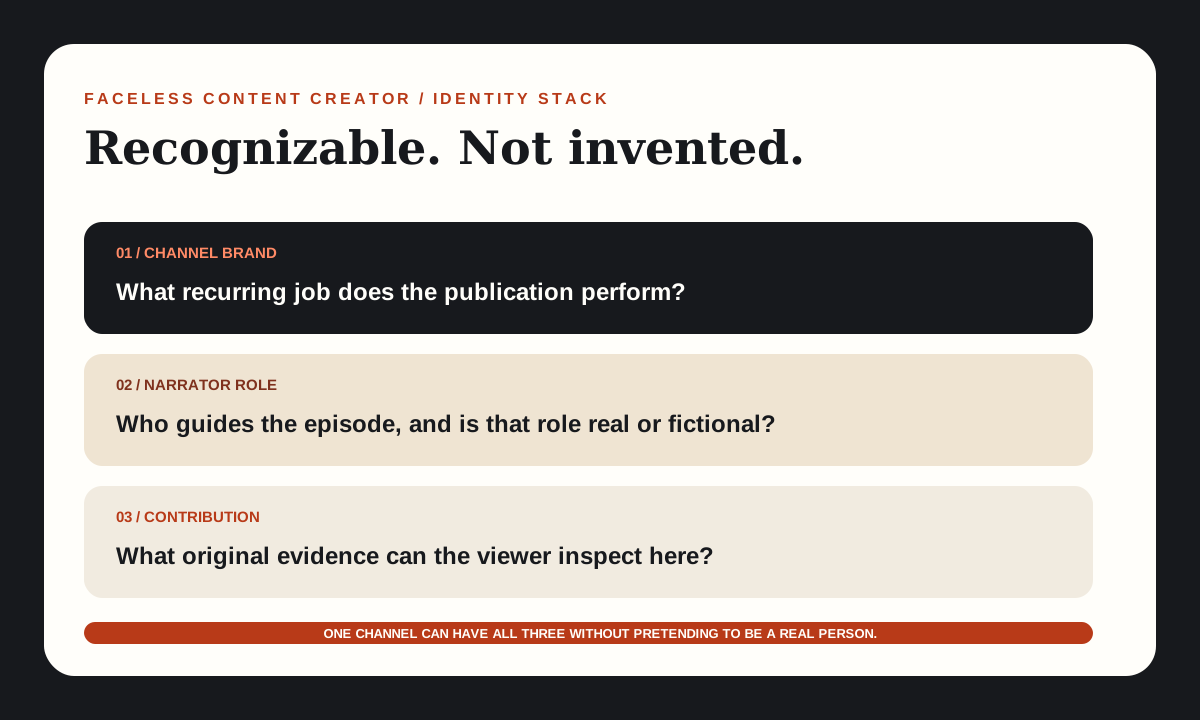
A truthful identity has three layers. Mixing them is how a channel accidentally turns a useful brand voice into a fake person.
| Layer | Question it answers | Truthful example | Unsafe substitution |
|---|---|---|---|
| Channel brand | What recurring job does this publication perform? | “We test repeatable production decisions for beginner faceless channels.” | Copying another channel’s name, banner and handle. |
| Narrator role | Whose voice guides the audience through the episode? | “Narrated by a synthetic voice for this editorial explainer.” | Calling the voice a named real employee or credentialed expert. |
| Contribution | What evidence or artifact makes this episode more than a restatement? | A source ledger, worked test and decision matrix. | Changing a few words in someone else’s script and presenting it as original. |
The channel brand can stay stable across hundreds of episodes. The narrator role can be partially stable, with recurring cadence and visual cues. The contribution must materially change with the question. If the brand grows while the contribution repeats, the identity is becoming a costume rather than an editorial system.
Write a one-sentence owner statement before writing a character script: “This channel publishes [type of work] for [audience], using [production methods], and a person reviews [specific gates] before release.” The sentence should be true even if the audience never learns the operator’s legal name.
Do not manufacture a human biography
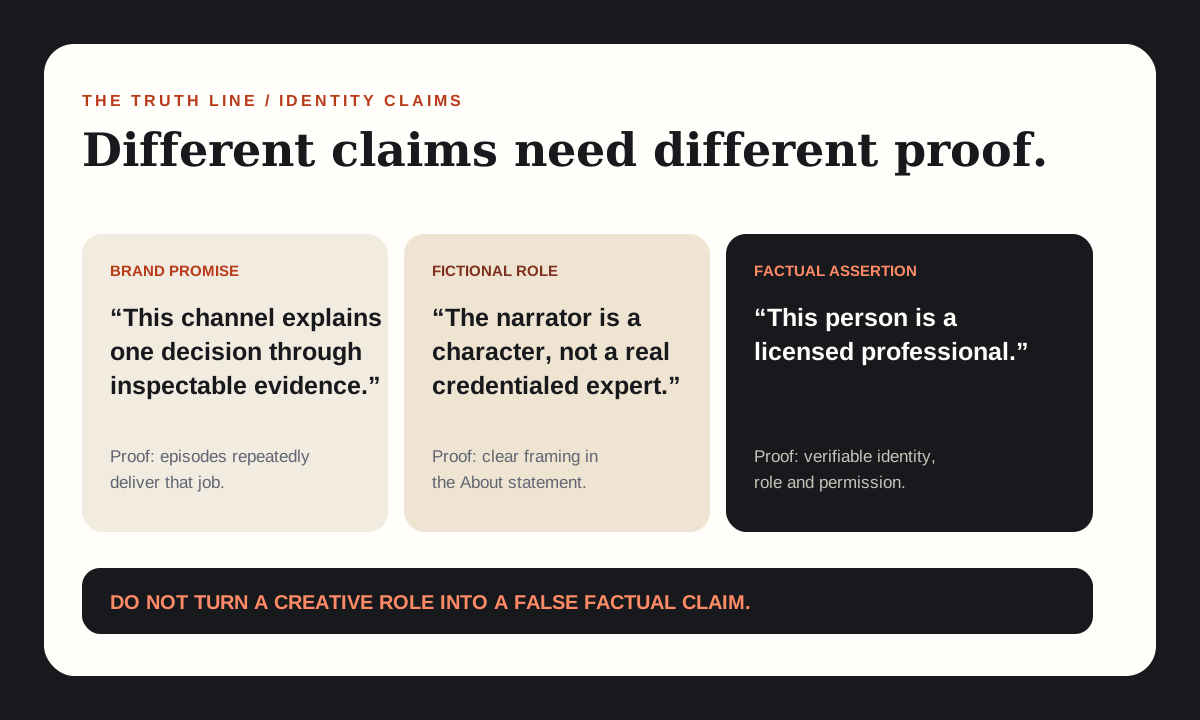
A fictional narrator can be a legitimate creative device when the audience can recognize the fiction. A fake biography presented as fact is different. The risky move is not the use of a character; it is the claim that the character is a real person with real experience or authority.
Avoid phrases that create unsupported credentials: “As a former surgeon,” “Our team of certified engineers,” or “This is Maya, a real researcher,” unless those statements are true and can be supported. Do not attach a generated face and voice to an invented résumé. Do not imply that a brand account is the official channel of another creator or company.
YouTube’s AI disclosure policy requires creators to disclose realistic generated or altered content in specified situations, including making a real person appear to say or do something they did not do, altering footage of a real event, generating a realistic scene that did not occur and creating music that is the main focus. Disclosure is not the same as permission to impersonate. The upload-process disclosure does not cure a false claim of ownership or authorization.
The safer editorial rule is simple: if a character contributes useful perspective, label the role as fictional or illustrative. If the content requires an actual professional, either involve an accountable professional or do not claim professional authority.
Write an About statement that removes ambiguity
A strong About statement tells the viewer what the channel does, how it makes episodes, what it wants from the audience and where a limitation exists. Keep it specific enough to be checked.
FacelessLanes publishes source-led guides for beginners building faceless YouTube channels. Episodes use original research notes, code-generated visuals and synthetic narration. A human operator reviews claims, rights and final publication. When a value is unavailable, the episode says so.
This statement does not expose a private home address or legal identity. It does answer the questions a viewer reasonably needs to interpret the content. It also distinguishes synthetic narration from a human presenter without presenting the tool as the author of the editorial judgment.
Use the same standard in video descriptions. A short production note is enough when it is accurate. Avoid vague language such as “professionally produced” if that could be read as a claim about credentials. Name the methods and the review boundary instead.
Ownership
Who is responsible for approving the episode?
Method
Which recurring production method does the channel use?
Evidence
What can the viewer inspect in this episode?
Limits
What is unavailable, simulated or outside the channel’s expertise?
Make evidence carry the recognizable personality
A presenter often supplies continuity through voice, expression and memory. A faceless creator needs another continuity surface. The strongest substitute is a recognizable evidence format: the same kind of question card, source comparison, worked calculation or end-of-episode decision sheet.
This is not permission to repeat the same content. The visual grammar stays stable while the object changes. A software channel may always show input, action and verified output. A policy channel may always connect claim, source and release consequence. A finance channel may always show assumption, calculation and decision effect.
The identity becomes memorable because the viewer knows what kind of proof to expect. It also becomes more difficult to mass-produce accidentally, because every episode must produce a new evidence object.
Create a “creator signature” with four fields: recurring promise, proof type, narrator role and ethical line. The ethical line is the thing the channel refuses to fake. For this site, the line is: no invented citation, performance number, expert or person behind the work.
When a new episode looks visually consistent but has no new proof, the identity has drifted into decoration. Review the question and evidence before adding another branded frame.
Use a synthetic voice without inventing an expert
A synthetic narrator can make a faceless workflow repeatable. It does not make the channel an expert by itself. The voice is a delivery mechanism, while the source quality and editorial review determine whether the audience should trust the answer.
Do not give the narrator a fabricated profession, employer or personal history. If the narrator is a fictional character, make the role clear where a reasonable viewer could otherwise mistake the character for a real person. If the episode uses a realistic synthetic scene, use YouTube’s AI disclosure setting when the policy requires it.
Voice design should still serve comprehension. Keep pronunciation consistent, write sentences for listening rather than page layout, and make the captions editable. A memorable voice helps recognition. It does not replace evidence.
Keep the original script, narration settings, captions and final media file with the episode records. Those artifacts let the operator correct a pronunciation error, update a claim or explain how the episode was made without reconstructing the process from memory.
Worked example: a fictional archivist who is clearly fictional
Suppose a history-style channel wants a recurring character called “The Archivist.” The character never appears on camera and reads source summaries in a calm voice. This can be a recognizable format, but only if the fiction is not used to claim credentials.
A safe profile might say: “The Archivist is a fictional narrator used by this channel to read original scripts. The channel is operated by a human editor and cites the documents shown in each episode.” The episodes can still have a consistent world, visual grammar and voice.
An unsafe version would present The Archivist as a real museum curator with decades of access and a named academic degree that nobody can verify. The audience would be encouraged to trust authority that does not exist. If the channel actually has a curator, it should document that relationship and approval.
A second example is an explainer channel with no character at all. Its identity can be “the channel that shows the decision table.” The narrator can say “we” because the publication makes an editorial decision, while a separate About note explains that a human operator reviews releases. There is no need to invent an employee page to make “we” meaningful.
Both examples point to the same test: can every identity claim be separated into a brand promise, an illustrative device and a factual assertion? Only the factual assertion needs credential evidence. The illustrative device needs clear framing when confusion is plausible.
Run an identity audit before publishing the next episode
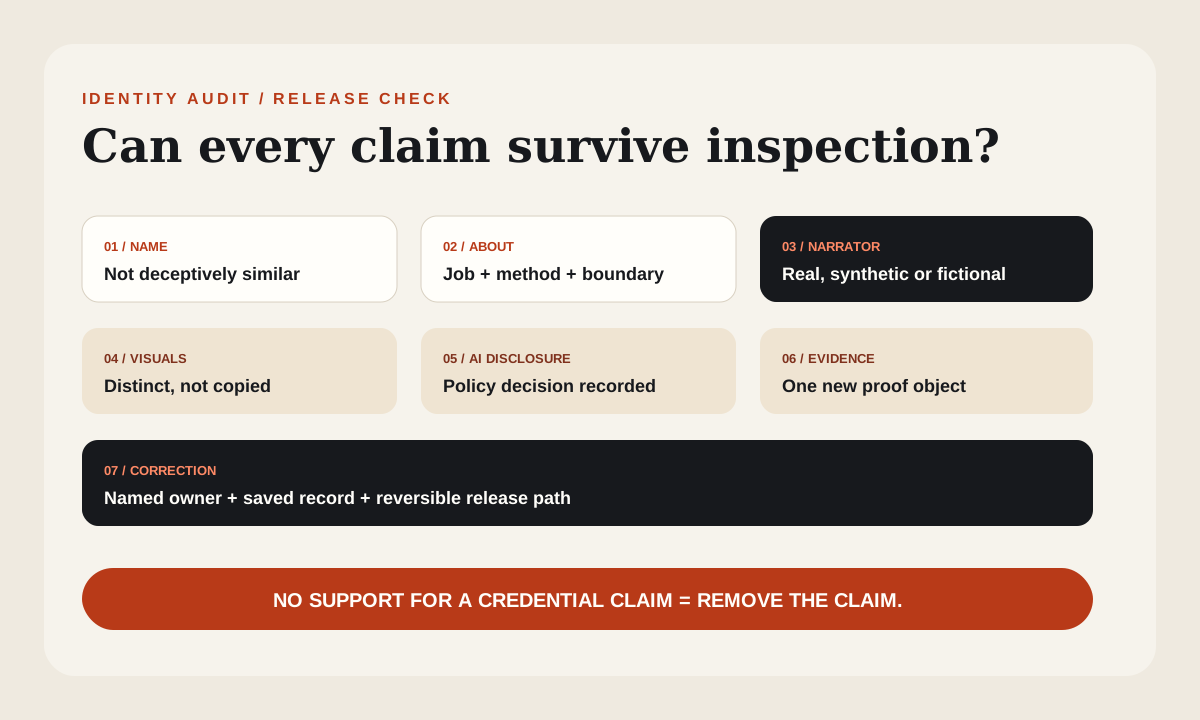
Audit these seven items at channel level, then check them again in each episode:
- Name: It does not copy or deceptively resemble an existing creator, channel or company.
- About: It explains the publication job, production method and human review boundary without inventing credentials.
- Narrator: A fictional or synthetic narrator is not presented as a real credentialed person.
- Visual identity: It is distinct and does not copy another channel’s recognizable branding.
- AI disclosure: Realistic generated or meaningful alteration is disclosed when YouTube’s policy requires it.
- Evidence: The episode contains a new inspectable proof object, not only a recoloured template.
- Correction: A claim or narration error can be fixed through an identifiable owner and record.
This audit is deliberately operational. It does not ask whether an audience will “like” the character. It asks whether the channel has made a claim that can survive inspection.
The live question that motivated this page came from a recent r/NewTubers discussion titled “Successful faceless YouTube creators: What actually…” The search result describes someone building a faceless documentary-style channel and asking people with experience to explain what actually worked. That is the right level of question: not how to fake a person, but how to build a durable format without one.
Build recognition through truthful repetition
A faceless content creator can be consistent, characterful and memorable without making the viewer believe an invented human is behind the channel. State the publication job, keep the narrator role honest, disclose required AI use and let a recurring evidence format carry recognition.
Before the next upload, rewrite the About statement, review the narrator and visual identity for impersonation risk, and add one proof object that could not be copied from another page. Keep the ethical line visible in the production checklist.
The durable identity is not the hiding of a face. It is the repeated promise that the viewer can see what the channel contributed, understand how it was made and trust the place where uncertainty is stated.
Sources and claim notes
These links support the platform and policy statements named in this guide. The frameworks and production checks are original editorial analysis.
- Impersonation policyOfficial policy against unauthorized impersonation, deceptive branding and falsely implying that a person or entity owns or authorizes a channel.
- Disclosing use of GenAI contentOfficial requirements for disclosing realistic AI-generated or meaningfully altered content in the circumstances described by YouTube.
- Successful faceless YouTube creators: What actually…Live r/NewTubers question surfaced in a US-English Google search on 7 November 2026; used as a question source, not a factual authority.