A faceless YouTube automation system becomes reliable when every repeatable task has a defined tool, human checkpoint, retained artifact and accountable owner.
Automation can shorten a faceless episode without making the channel anonymous in the way that matters. A channel still needs an owner who can explain where a claim came from, who approved an asset and why a video was released. The useful question is therefore not “how much can AI do?” It is “which decisions may a tool execute, and which decisions must remain reviewable by a person?”
Treat automation as a chain of responsibility
A production pipeline is not one button. It is a chain of choices: choose a question, collect evidence, write a script, create visuals, narrate, edit, check rights, approve metadata and publish. A tool can perform any repeatable operation inside that chain, but the chain still needs an operator who can point to the decision that produced the final video.
That distinction matters because YouTube’s channel monetization policy says content should be original and authentic, and should not be mass-produced, generic, repetitive or manipulative. The policy review may examine a channel’s main theme, newest videos, most-viewed videos and metadata. Automation that only increases output while leaving every decision invisible creates a harder review problem.
YouTube’s spam policy is equally specific. It calls out automated or synthetic mass-production that floods the platform with similar content, and scraped material that adds no commentary, education or unique editing. Tools are not banned by those rules. A workflow is exposed when it cannot show a meaningful contribution and an accountable review process.
The practical unit to design is therefore not the prompt. It is the handoff between stages. What enters the stage, what leaves it, who can reject it and what evidence remains after rejection?
Use an A-C-H ownership map before choosing tools
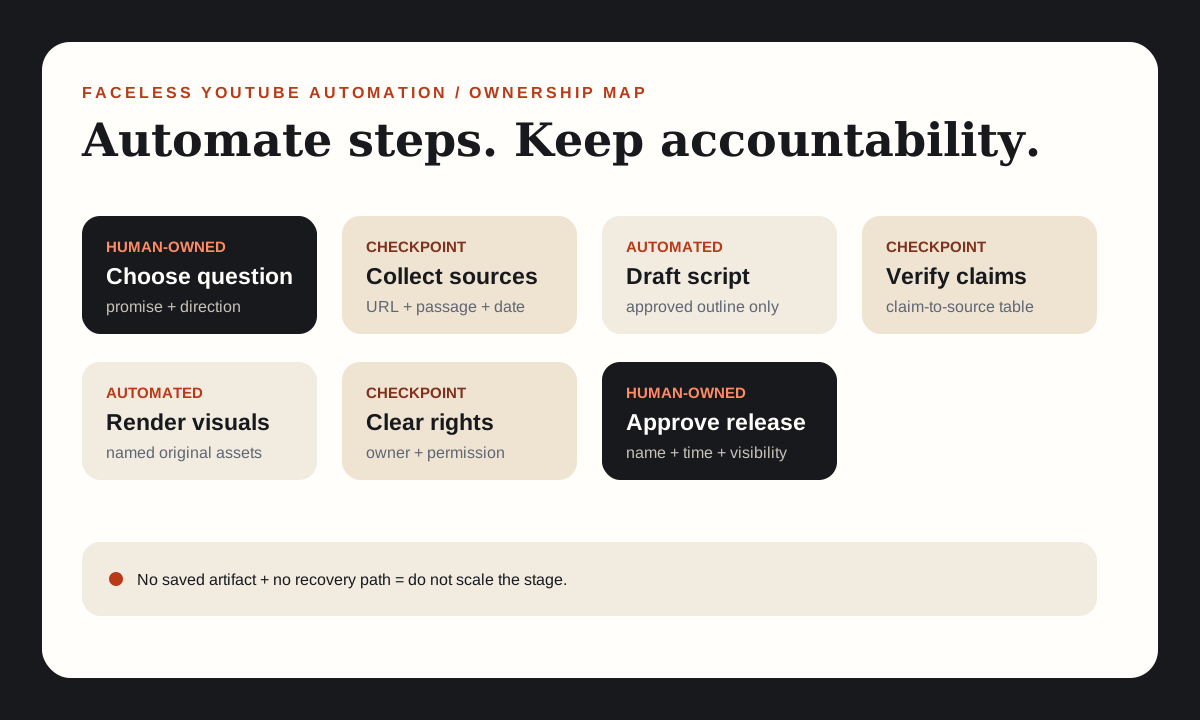
Label each production step with one of three ownership modes:
- A — automated execution. A bounded task with a clear input, deterministic output and low consequence if it must be rerun.
- C — checkpoint review. A tool may propose an answer, but a person compares it with the source, rights record or release rule.
- H — human-owned decision. A person must choose the topic promise, resolve a factual conflict, accept a rights risk or approve publication.
The letters are less important than the rule behind them: a task does not become accountable merely because software can complete it. “Generate a transcript” can be A. “Confirm that the transcript supports every factual claim” should be C. “Decide that an unresolved quotation is acceptable” should be H.
| Production stage | Mode | Required handoff | Accountable evidence |
|---|---|---|---|
| Question selection | H | Approved viewer question and page promise | Decision note linked to the question source |
| Source collection | C | URL, retrieval date and exact supporting passage | Source ledger |
| First draft | A | Approved outline and source ledger | Versioned draft |
| Claim verification | C | Every claim mapped to a source or marked unavailable | Claim-to-source table |
| Visual render | A | Approved script and asset manifest | Render settings and source files |
| Rights clearance | C | Owner and permission for every non-original asset | Rights ledger with unresolved items visible |
| Final release | H | Named approver, timestamp and visibility | Release record linked to the published URL |
The map is intentionally unglamorous. It exposes the stages people often hide inside a single “AI video” workflow, which is exactly where silent failures begin.
Pilot one narrow episode end to end
Do not begin by automating a month of uploads. Begin with one episode that exercises every stage and produces a complete release record. Choose a question with one answer, two inspectable sources and a visual format that can be built from your own diagrams or licensed assets.
Write down the expected input and output for each stage before connecting the tools. A narration step might accept an approved script and return a WAV file plus duration metadata. A renderer should accept named assets and produce a file whose resolution and duration can be checked. A scheduler should accept an approved video, captions and publication time, not infer approval from the existence of a file.
The pilot should also record friction. Mark every handoff that required a manual explanation, every output that had to be repaired and every place where a tool silently substituted a value. Those notes become the specification for the second episode. Without them, “automation” often means repeating the same emergency in a faster interface.
A successful pilot is not a fast pilot. It is one that leaves enough evidence to rerun the workflow after a file, model or account disappears.
Put release gates after generation, not inside a prompt
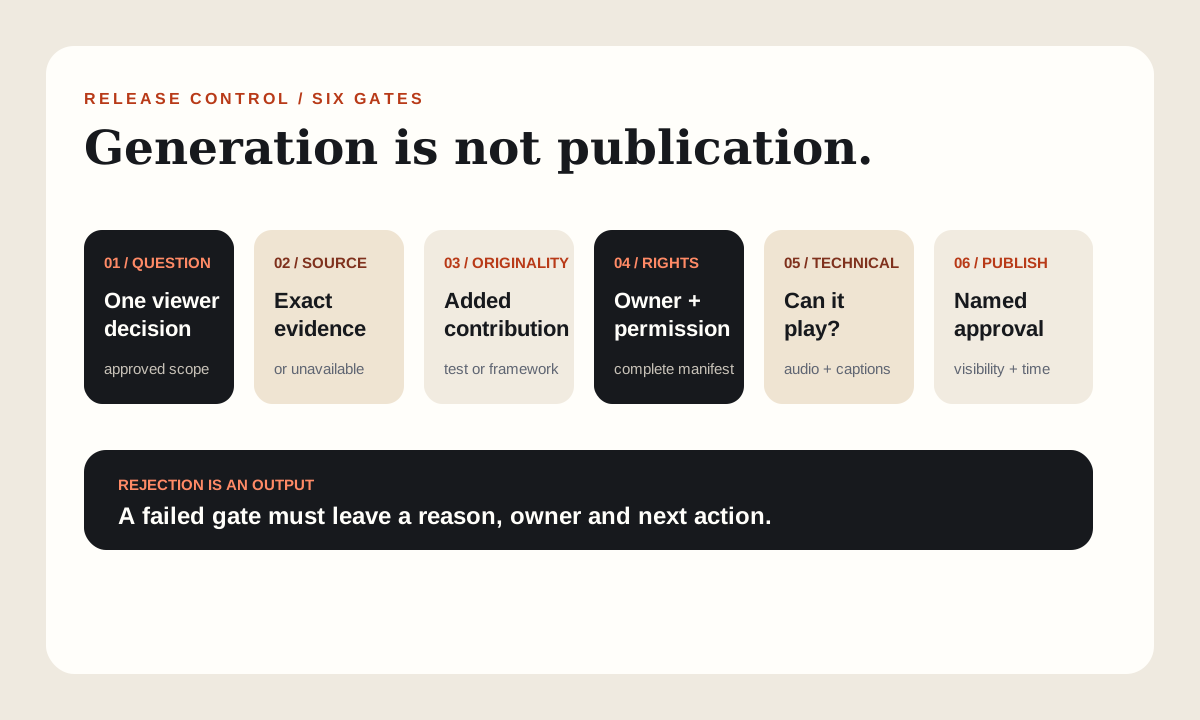
A prompt cannot be the final rights or fact-checking layer because prompts do not preserve an independent record of what happened. Put separate gates after generation:
- Question gate: the episode answers one specific viewer decision.
- Source gate: every factual claim links to a primary source, a clearly labelled first-party test or an explicit “unavailable.”
- Originality gate: the answer includes a framework, calculation, test or worked example that is not a paraphrase of the source.
- Rights gate: every image, clip, voice and track has an owner or a recorded permission basis.
- Technical gate: duration, resolution, captions, audio and thumbnail match the release manifest.
- Publication gate: one named person approves title, description, audience setting and visibility.
A gate should produce a record even when it rejects the episode. “Rejected because source two could not be retrieved” is useful evidence. A blank approval field is not.
This structure also creates a safer scaling order. Automate the generation steps that repeatedly pass their gates. Keep the difficult gates manual until their decisions become consistent enough to define a reliable rule.
Require an artifact trail for every completed video
An artifact is something another person can inspect without asking the operator to remember what happened. For each episode, keep at least six records: the approved question, source ledger, claim review, asset manifest, final media file and release record. The trail should connect those records to the same episode identifier.
This prevents a common automation failure: the finished file survives, but the reason behind a claim or asset does not. When a policy question, correction or copyright inquiry arrives, the operator can retrieve the relevant record instead of reconstructing the episode from memory.
A small file naming convention is enough. For example, use the episode slug followed by source, claims, assets, master and release. Store the files together. The naming rule matters less than the fact that every handoff has a durable output.
The source ledger should record the retrieval date because web pages change. The asset manifest should identify which elements are original, which are licensed and which are unresolved. The release record should identify the approver and visibility. These are operational facts, not performance claims.
Worked example: map a seven-stage faceless episode
Consider an explainer about choosing a first production workflow. The first draft asks a tool to organize an approved source ledger into a 700-word script. A person then checks every factual sentence and removes unsupported transitions. A diagram generator uses a fixed list of nodes supplied by the approved script. A voice tool reads the approved captions. A renderer combines named original assets. A reviewer checks rights and technical output. The publisher chooses the visibility.
The automation boundary can be written as:
Question -> H: choose the promise
Outline -> A: organize approved source notes
Claims  -> C: verify each sentence
Draft   -> A: format the verified script
Visual  -> A: render approved diagram nodes
Rights  -> C: match every asset to its record
Release -> H: approve metadata and visibility
This map does not require a particular model or editing application. It can move between vendors because the handoff is defined by content and evidence, not by one product’s menu. It also shows where a shortcut is dangerous. Replacing the claims checkpoint with “ask the model whether it is right” collapses verification into the same system that produced the draft.
For a beginner, the useful first automation is often the claim ledger, not the video generator. A structured table of sentence, source URL, supporting passage and status makes every later stage easier to audit. The generator can then be evaluated against a stable input.
Test recovery before increasing output
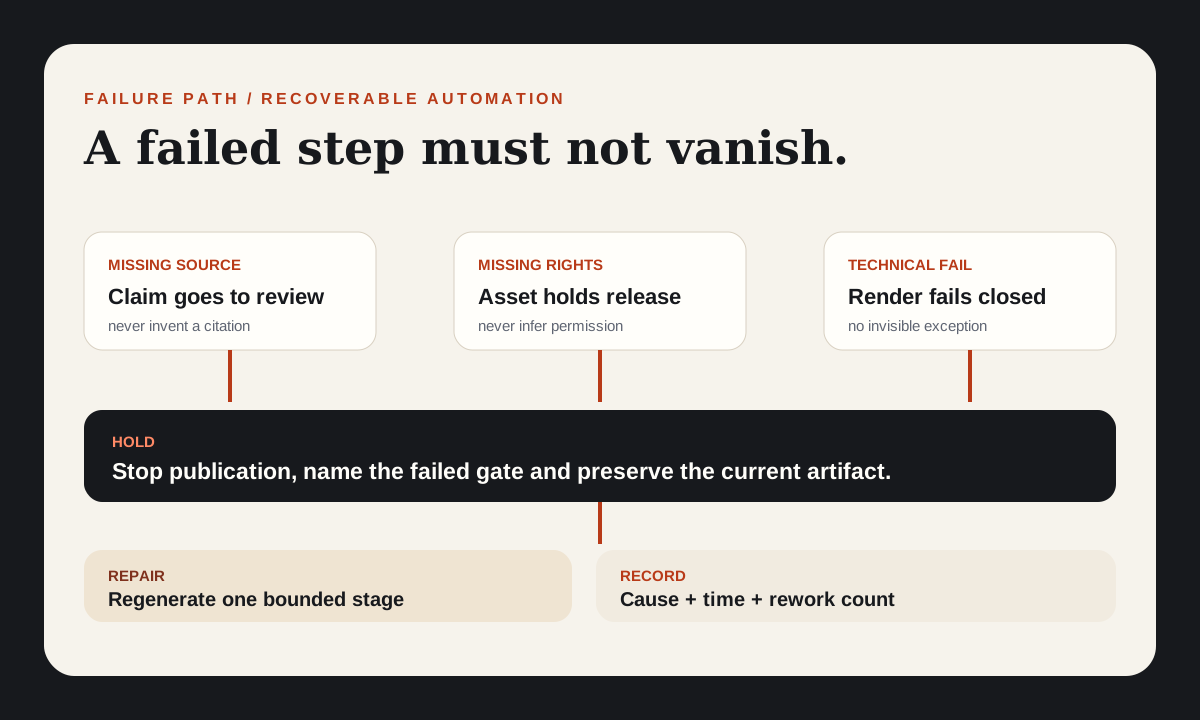
Automation plans often describe the happy path. A production system needs a failure path. Deliberately break one stage in the pilot: replace a source with an unavailable URL, remove a visual asset from the manifest, change the narration duration or reject a title during release review.
Then answer four questions without relying on memory:
- Which stage should detect the failure?
- What artifact proves that detection happened?
- Can the failed output be regenerated without rebuilding the entire episode?
- Who decides whether the episode is repaired, held or cancelled?
A missing source should send the claim to review, not trigger a fabricated replacement citation. A missing asset should stop the render, not allow an unlicensed stock image through. A failed captions check should hold publication, not become an invisible exception in a queue.
Record a recovery time and a rework count for the pilot. These are measurements of your own workflow, not predictions about channel performance. They reveal which stage is expensive to repair and which stage is safe to automate more deeply.
Scale only the stages that repeatedly pass
After several episodes, sort each stage by three observations: how often it passed without repair, how easy it was to trace a failure and whether the output stayed varied enough to preserve a meaningful editorial contribution. A renderer that produces different approved diagrams may be ready for higher volume. A script generator that turns every episode into the same rhythm may need a tighter template, more original input or a human rewrite checkpoint.
The live question source for this article shows why that distinction matters to viewers. A recent r/NewTubers discussion surfaced in a US-English search asks how people feel about creators running fully AI-generated channels. A separate r/NewTubers question asks whether faceless automation is making money. Those are different questions, but both point to the same trust problem: viewers and platform reviewers need to understand what the channel contributes.
The answer is not to hide the tools. It is to make the contribution inspectable. A human-owned workflow can show the chosen question, the added analysis, the original visual system and the release decision. It can also show where a tool assisted and where a person narrowed or rejected the output.
Scale when the evidence repeats: reliable inputs, consistent checkpoints, few silent substitutions and bounded recovery. Pause scaling when output becomes interchangeable or when the artifact trail cannot keep up with the number of files.
Name the first owner before naming the first tool
Faceless YouTube automation does not remove the need for a responsible operator. It changes where the operator spends attention. Repetitive file preparation can move to software. The operator’s irreducible work is to choose a useful promise, demand evidence, reject unclear rights and accept the consequence of publication.
Start with one episode and one A-C-H map. Add a release gate for every handoff that can change meaning, ownership or visibility. Keep the artifact trail next to the finished video. Test one failure before increasing the queue.
The workflow is ready to grow when a second person could follow the map, inspect the records and understand why the episode was published. That is a stronger definition of faceless automation than “the process ran without anyone touching it.”
Sources and claim notes
These links support the platform and policy statements named in this guide. The frameworks and production checks are original editorial analysis.
- YouTube channel monetization policiesOfficial standards for original and authentic content, including restrictions on mass-produced, generic, repetitive or manipulative material.
- YouTube spam policyOfficial rules against automated or synthetic mass-production, scraped content, engagement manipulation and misleading metadata.
- How do you feel about creators running fully AI-generated channels?Live Reddit question surfaced in a US-English Google search on 6 November 2026; used only as a question source.
- Is YouTube faceless and automation making money?A second live r/NewTubers question visible in the same 6 November 2026 search result; used only as evidence of audience language, not as a factual authority.