A content cluster is useful only when each URL owns a distinct question, a distinct answer and a distinct next step.
Website SEO for a faceless YouTube channel is not a second keyword list. It is an ownership map. The map decides which URL answers which question, which evidence belongs on that page and where the reader should go next.
Give every URL one search job
A faceless youtube website can cover channel ideas, planning, production, automation, rights, growth and audience questions without publishing the same article under five titles. The control is a page contract. Before drafting, write the one reader job the page will complete.
| Page field | What to write | Failure if missing |
|---|---|---|
| Reader job | The one decision or question the reader should resolve | The page drifts into several topics |
| Direct answer | A short answer placed before background | Two pages open with nearly the same explanation |
| Proof object | A table, test, map, source trail, checklist or first-party record | The page is only a rewrite of another page |
| Target phrase | The wording this page is designed to answer | Several pages compete for the same wording |
| Next step | The single most useful related page | Internal links become a list of unrelated suggestions |
Google's helpful-content guidance asks whether a page provides original information, substantial value beyond the obvious and enough depth to be worth recommending. A page contract makes those questions testable before publication. If the answer, proof and next step already belong to an existing URL, the correct action is to improve or link to that URL, not create another version.
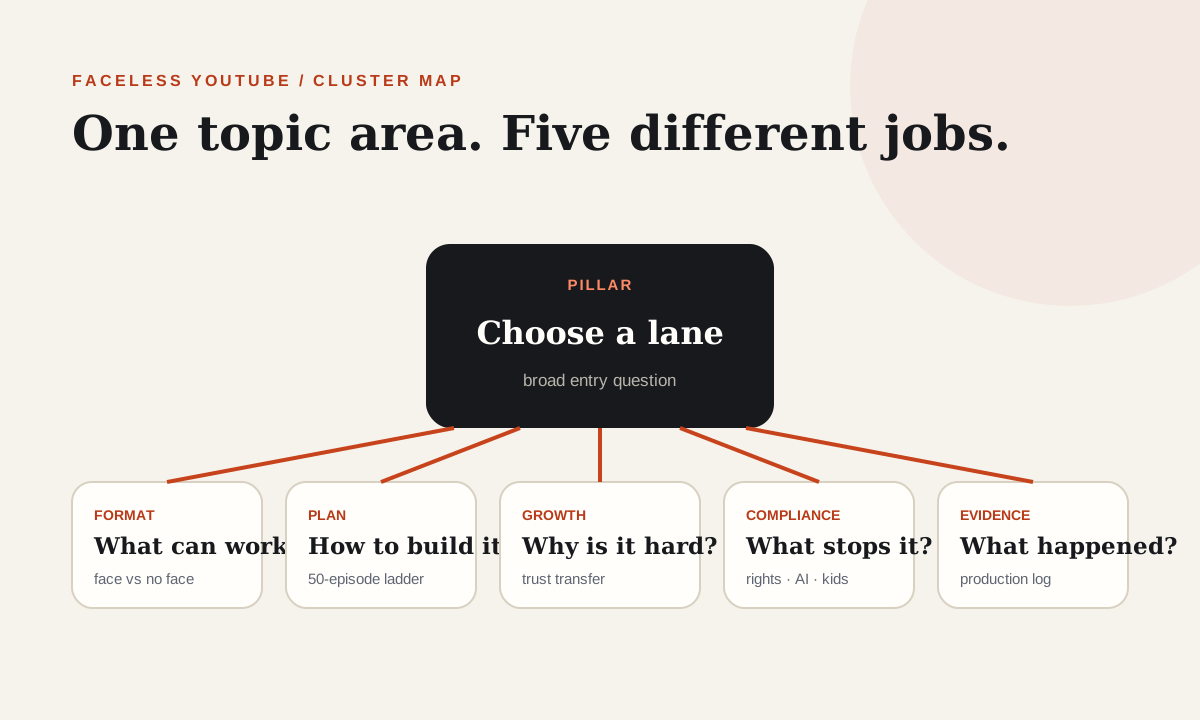
Start with a pillar and five different child jobs
The pillar should answer the broad entry question and explain the map. It should not absorb every downstream question. Child pages earn their place by taking one branch deep enough that the reader no longer needs the pillar to complete that job.
Market map
Which broad faceless lanes exist, and what trade-offs should a beginner understand before choosing one?
Format decision
Which format fits the promise, proof available, rights position and production capacity?
Production plan
How does one promise become a repeatable episode system?
Compliance standard
Which rights, AI, audience and originality decisions require evidence?
First-party record
What did the operator actually make, reject, rework and verify?
A page named “best faceless YouTube ideas” should not also teach a 50-episode production ladder, AI disclosure and a content-cluster map. Those are different reader jobs. A page can mention the related topic, then link to the page that owns it.
The pillar can carry the head phrase naturally, but the child page needs its own reason to exist. “More keywords” is not a reason. A unique proof object and a distinct next step are reasons.
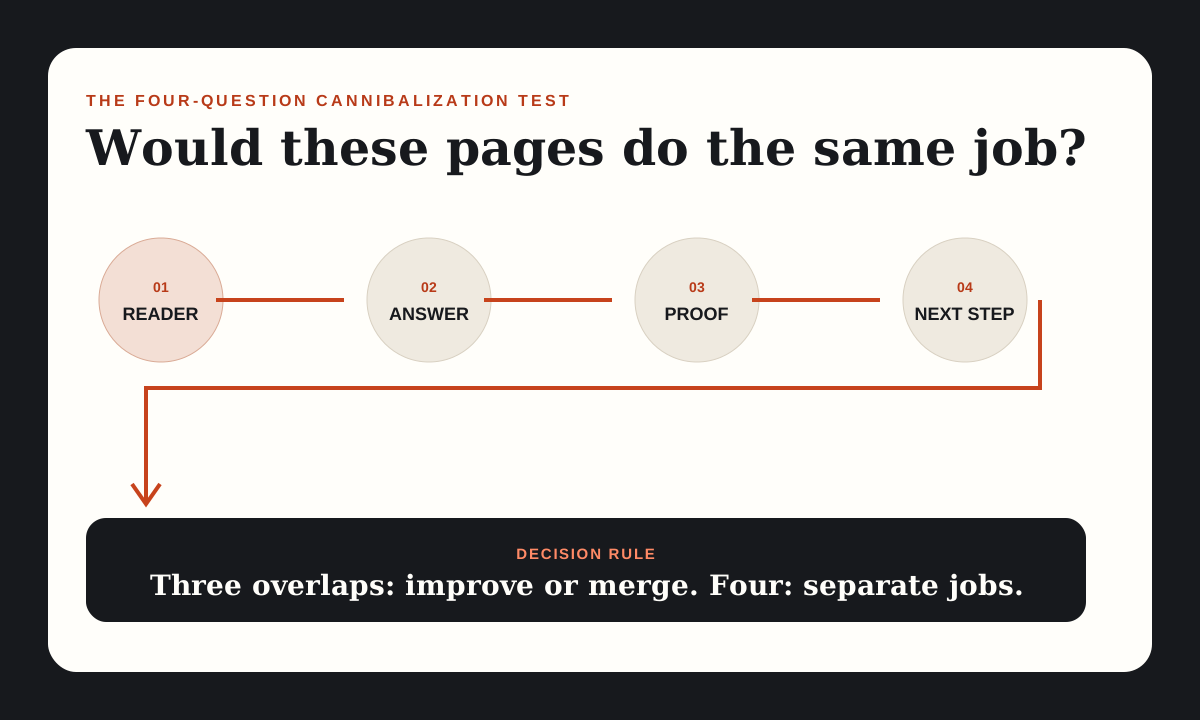
Run the four-question cannibalization test
Two pages are likely to overlap when they answer the same reader question with the same evidence and send the reader toward the same next action. Test a proposed page against the closest existing URL:
| Question | Same answer? | Same proof? | Same next step? | Decision |
|---|---|---|---|---|
| Would both pages open with the same direct answer? | Yes | Yes | Yes | Do not create; improve the existing page |
| Would the answer change because the proof changes? | No | No | Partly | Consider a section or FAQ on the existing page |
| Does the new page answer a narrower decision? | Different | Different | Different | Separate page may be valid |
| Would both pages need the same chart and source trail? | Yes | Yes | Different | Merge or split by decision, not by wording |
A practical rule: if three of the four core elements overlap—reader, answer, proof and next action—merge the page or add a section to the page that already owns the job.
This test prevents the common pattern where a site publishes “faceless YouTube ideas,” “faceless YouTube niches,” “best faceless channels” and “faceless channel examples” as four interchangeable lists. The wording varies. The reader receives the same answer and no additional evidence.
A canonical tag does not repair two identical reader jobs
Canonicalization helps Google identify the representative URL when duplicate or highly similar pages exist. Google explains that it may cluster similar pages and choose the page it considers most complete and useful. URL annotations are signals; Google can select a different canonical than the publisher prefers.
That makes canonical tags useful for genuine variants such as trailing-slash duplicates, filters, tracking parameters or a desktop and mobile URL. It is not a strategy for keeping two useful-looking articles that answer the same question.
The same boundary applies to sitemaps. Listing both URLs tells search engines that both exist. A sitemap does not make the overlap disappear. The editorial decision still has to happen first:
- Keep two URLs only when the reader job, answer and proof differ.
- Merge when the new page mainly paraphrases an existing one.
- Use a redirect after a merge when the old URL has no independent job.
- Use a canonical only for a true duplicate variant that should consolidate to one preferred URL.
Google states that duplicate content is normal and not automatically a spam violation. The practical problem is that similar pages can dilute user choice and make performance difficult to attribute. A clean ownership map is easier to maintain than a set of near-identical URLs hoping a technical hint will sort them out.
Write an internal-link contract
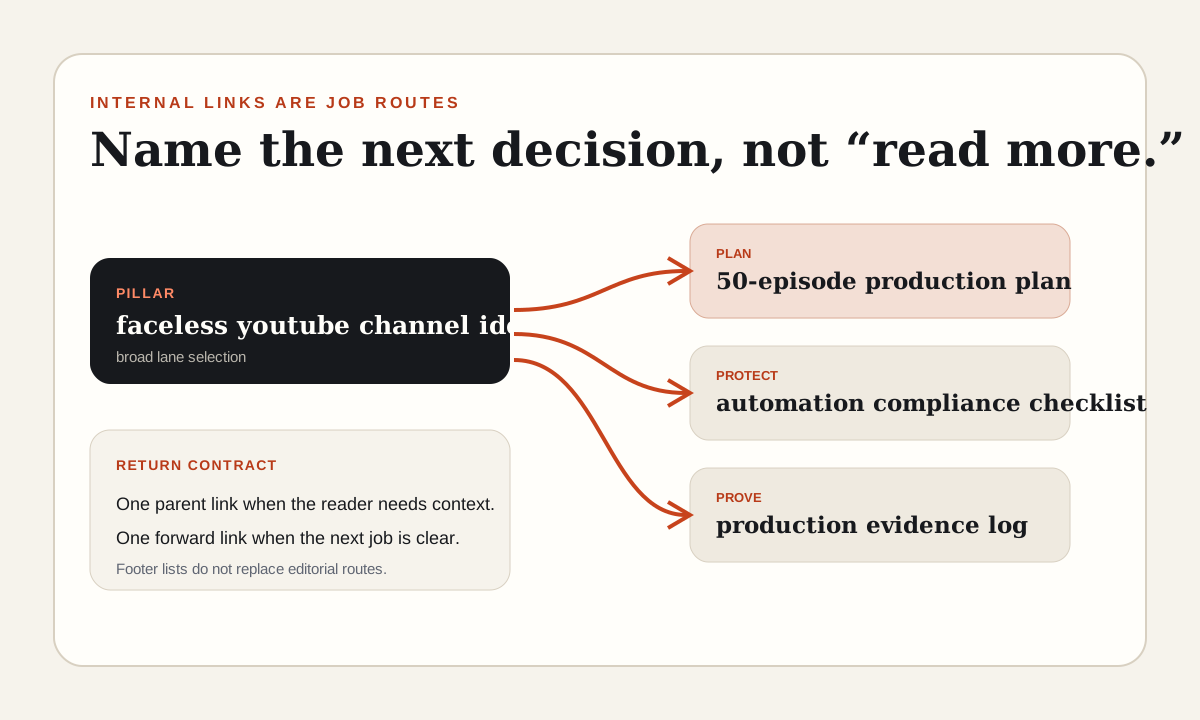
Internal links should describe the relationship between jobs. They are not a footer inventory. Give every page two roles:
- A clear path back to the pillar when the reader needs context.
- A small number of forward links to child pages that complete a related decision.
The anchor text should name the destination's job. “Read more” is difficult to audit because it does not reveal what page the link opens. Descriptive anchors also help a reader understand why the next page matters.
| Source page | Destination | Link purpose | Anchor pattern |
|---|---|---|---|
| Cluster map | Pillar | Return to the broad lane map | faceless youtube channel ideas |
| Pillar | Production plan | Build a repeatable episode ladder | 50-episode faceless YouTube plan |
| Planning page | Compliance checklist | Audit rights and AI decisions | YouTube automation compliance checklist |
| Growth page | Production evidence | Inspect a real production log | YouTube channel idea production log |
| Every child | Relevant sibling | Only when it advances the reader's next decision | Name the specific decision |
Avoid turning every mention of a topic into a link. A page with forty internal links has not built a cluster; it has created a navigation maze. Keep links tied to the reader's next decision.
Apply the map to a working faceless YouTube cluster
The current FacelessLanes cluster can be evaluated with the same contract. Each page has a different reader job even though the pages share a common audience.
| Page | Owned job | Proof type | What it should not absorb |
|---|---|---|---|
| Faceless YouTube channel ideas | Choose a broad lane and understand the economics before committing | Lane map, decision gates and an original five-gate check | A full production log or detailed rights audit |
| How to start a faceless channel | Turn one promise into a 50-episode production plan | Episode ladder, production passport and a completed sample | A general list of every possible niche |
| Are faceless channels harder to grow? | Decide whether the format has a trust problem | Trust-transfer table, format audit and platform statements | A complete automation policy manual |
| YouTube automation compliance | Run a release gate for rights, originality, AI and audience | Evidence packet, seven checks and a worked failed example | A full episode-planning ladder |
| Channel idea production log | See what the production evidence actually looked like | Three-cycle ledger, rework notes and unavailable fields | A broad list of topic categories |
This map is not an argument that every site needs exactly five pages. It is an argument that each URL must earn a separate job. A new page about “faceless YouTube examples” should prove which reader decision changes. If it only repeats the pillar with company names and screenshots, it is cannibalization.
Use a one-page ownership audit before every new article
Before adding a URL, fill one row in an ownership audit. This prevents the content plan from becoming a list of synonyms.
| Field | Pass condition |
|---|---|
| Primary reader | A specific beginner decision is named |
| Search job | The page can be summarized as one question |
| Direct answer | The answer is distinct from the closest existing page |
| Proof object | The page adds a checklist, map, test, worked example or first-party record |
| Nearest URL | The most similar existing page is identified |
| Overlap result | Fewer than three of answer, proof and next step overlap |
| Links in | The pillar or relevant parent page links to it by job |
| Links out | One return link and one forward decision link are named |
| Sitemap and canonical | Technical records match the editorial decision; they do not create one |
Review the audit after publication too. If two pages begin to converge, update the older page, move sections into the page that owns the job and retire the redundant URL. The cluster is a maintained system, not a launch-day diagram.
Decide whether the page deserves its own URL
Use the cluster map when a new topic appears in the question bank. First give the question to an existing page if that page can answer it with a section and a useful example. Create a separate URL only when the reader needs a different proof object and a different next decision.
The final rule is simple: one primary reader job, one direct answer, one distinctive proof object and one clear next step per URL. If a proposed page cannot state those four items without borrowing from another URL, it should be a section, an improvement or a merge.
A clean faceless YouTube content cluster is not a collection of pages with related phrases. It is a set of pages that each do a different job and make the next page easier to choose.
Sources and claim notes
These links support the platform and policy statements named in this guide. The frameworks and production checks are original editorial analysis.
- Creating helpful, reliable, people-first contentGoogle Search guidance on original information, substantial value and people-first publishing.
- What is URL canonicalizationGoogle Search documentation on similar pages, canonical selection and duplicate URL variants.
- How would you SEO a faceless YouTube channel?Live beginner question surfaced in a US-English Google result on 28 October 2026; used as a question source, not as a factual authority.