A faceless channel gets views when the package makes the question recognizable, the opening proves the payoff quickly and the library creates adjacent videos worth watching next.
The useful question is not whether a presenter would make distribution easier. It is where discovery can happen when the face is absent. The answer has to be tested at the topic-package level: what question is recognizable, what appears in the first seconds, what relationship connects one upload to the next and which surface actually delivered the view.
A face is not a distribution mechanism
YouTube says its recommendation system has no preference for a particular video format. The platform considers signals such as whether a viewer chooses a video, how long they watch and whether they report satisfaction. Those signals can be produced by screen-only explainers, animation, document analysis or hands-only demonstrations.
That does not mean every faceless video is equally discoverable. It means the missing variable is not “face.” The channel still needs a package that makes the incoming question clear, an opening that shows why the video can answer it and a reason for the viewer to continue into a related episode.
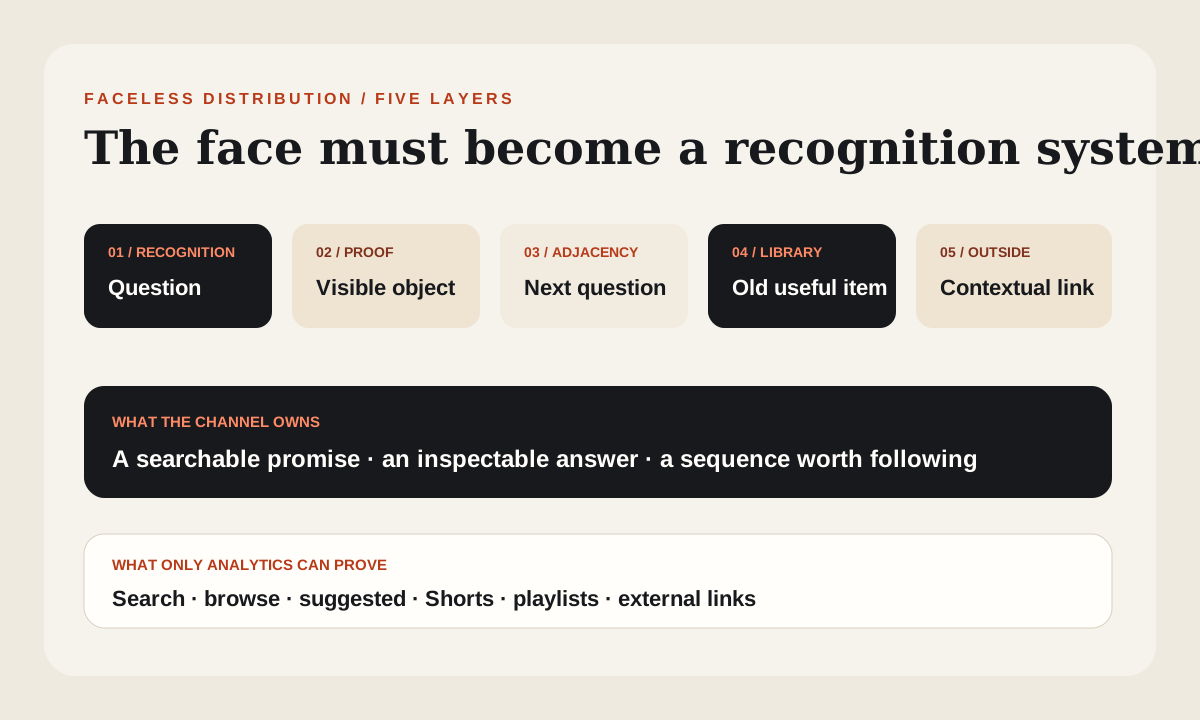
A visible presenter often supplies recognition and trust automatically. A faceless format has to make those jobs explicit. The title should expose a question rather than a category. The thumbnail should show the evidence object. The first seconds should reveal what will change or become understandable. The episode should make one next question obvious without scattering the viewer across unrelated topics.
Public view counts prove visibility, not traffic source
A public view count answers one question: this video has received this many views by the time of the snapshot. It does not reveal whether viewers arrived from search, browse, suggested videos, playlists, Shorts, subscriptions or an external website.
YouTube’s official Analytics dimensions separate those paths. They include YouTube search, subscriber feeds and homepage referrals, related-video referrals, playlists, end screens, Shorts, external URLs and several other routes. Only the channel owner can inspect the distribution for that channel.
This is the first discipline for a faceless channel. Do not invent a “search percentage” or claim that a successful old video is being recommended. Record the public facts, form a distribution hypothesis, then verify it in the owner’s Analytics after publishing.
Recent high-view uploads reveal three different distribution shapes
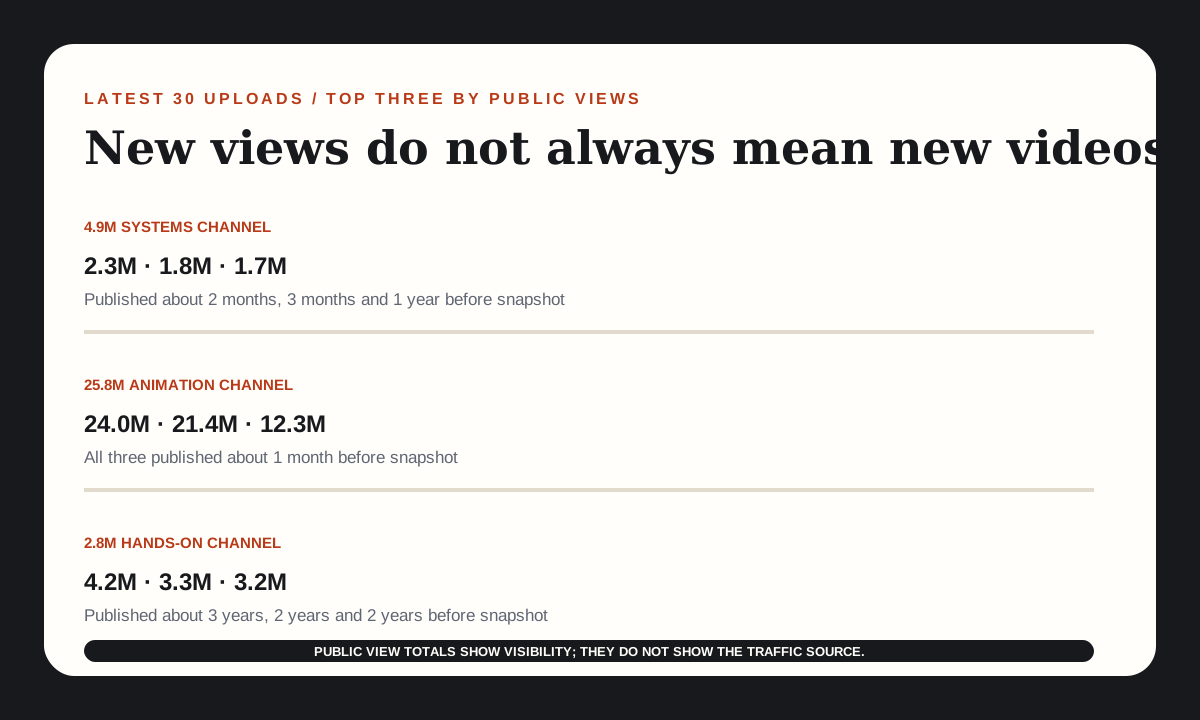
To avoid discussing views in the abstract, I checked the 30 latest public uploads on three channels at different scale. For each sample, I ranked those uploads by current public views and recorded when the top three were published. The check was performed on 14 November 2026.
| Observed sample | Top three items among the latest 30 uploads | Public age of those top three | Keyword-search spot check |
|---|---|---|---|
| 4.9M-subscriber systems explainer | 2.3M, 1.8M and 1.7M public views | 2 months, 3 months and about 1 year | An exact phrase query returned one matching item first in the public search snapshot |
| 25.8M-subscriber animation channel | 24.0M, 21.4M and 12.3M public views | All three were one month old | The phrase query returned the original item first and also surfaced multiple reaction uploads around it |
| 2.8M-subscriber hands-on channel | 4.2M, 3.3M and 3.2M public views | About 3 years, 2 years and 2 years | An exact phrase query returned one matching item first |
These are public search and view snapshots, not traffic-source reports. Their value is diagnostic: they show that faceless attention is not limited to new uploads. In the hands-on sample, the most-viewed items among the latest 30 uploads were already years old. In the animation sample, the top three were all about one month old. The systems sample sat between those extremes.
Those patterns point to three different distribution shapes: a durable library, a recent audience surge and a middle case where evergreen questions keep accumulating views. None proves the route by itself. Together they show why “post and hope” is not a distribution plan.
The search path starts with a question the viewer can phrase
For every sample, an exact phrase from the high-view item appeared to retrieve that item near the top of YouTube search in the live spot check. This is not proof that YouTube search supplied most views. It does show that the package was retrievable by the topic it promised.
The practical rule is to write the viewer’s question into the package without turning the title into a keyword pile. A useful title names the system and the outcome: what changed, why it works or what decision the viewer can make after watching. A category label is weaker because the viewer cannot tell which question the episode resolves.
Create three candidate titles before publishing. For each, ask what exact follow-up a viewer would type after seeing the thumbnail. If the answer is unrelated to the episode, the package is not a distribution asset.
The first seconds have a second job: confirm that the search promise is real. Show the document, system, map, calculation or object named by the package. A brand intro does not prove retrieval. A clear piece of evidence does.
Suggested-video growth depends on question adjacency
Related-video traffic does not require a face; it requires the next video to make sense beside the current one. Two episodes are adjacent when a viewer can move from one decision to the next without learning an entirely new world.
Build a question chain before making a list of uploads. The channel below is a new example, not a copy of any sampled channel:
- Why does this route exist?
- Which city pays for the route?
- Why did the cheaper alternative fail?
- What happens when the route reaches capacity?
- Which part of the plan is still unresolved?
These questions can share a map grammar and a source workflow, but each one needs a different decision object. The adjacency comes from the sequence, not from repeating the same conclusion with a different place name.
End screens, playlists and cards can expose the sequence, but they cannot manufacture relevance. If the next episode answers a question the viewer has just formed, the relationship is useful. If it answers a generic topic in the same category, the viewer has to restart the decision.
A faceless library can distribute old videos again
The hands-on sample is useful because its three largest current view totals inside the latest-30 upload list belong to videos published roughly two to three years ago. A new channel cannot copy that outcome by publishing the same count of videos. It can copy the condition: make episodes durable enough to answer a question that remains useful after the upload week ends.
Durability is not the same as “evergreen” content. A video can answer a repeated question while its evidence changes. A public rule, a map, a material test or a recorded repair can remain useful when the title describes the object rather than a temporary trend.
Keep the oldest proof objects linked to newer corrections. When a rule changes, add the correction to the same topic cluster instead of silently deleting the old answer. A library becomes a distribution asset when old and new evidence can support one another.
Do not assume old videos are being recommended. The public snapshot only says they remain visible at a high total. The owner’s Analytics must show whether those views currently arrive from search, related videos, playlists or external links.
Shorts and external links are different distribution jobs
A Short can expose one question, one visual proof and one reason to continue. It does not need to repeat the long episode. If the Short withholds the evidence and only leads to a link, it may create interest without proving that the longer video answers the promise.
External distribution has a similar rule. An article, newsletter or forum post should solve a small part of the question and link to the episode for the full evidence. A link without context is not distribution; it is a redirect.
Measure these routes separately. YouTube Analytics distinguishes Shorts, external URLs and embedded views, while YouTube search and related-video referrals sit inside the platform. A channel that adds every source into one “promotion” number cannot tell which distribution work should continue.
Measure the route instead of guessing from the total
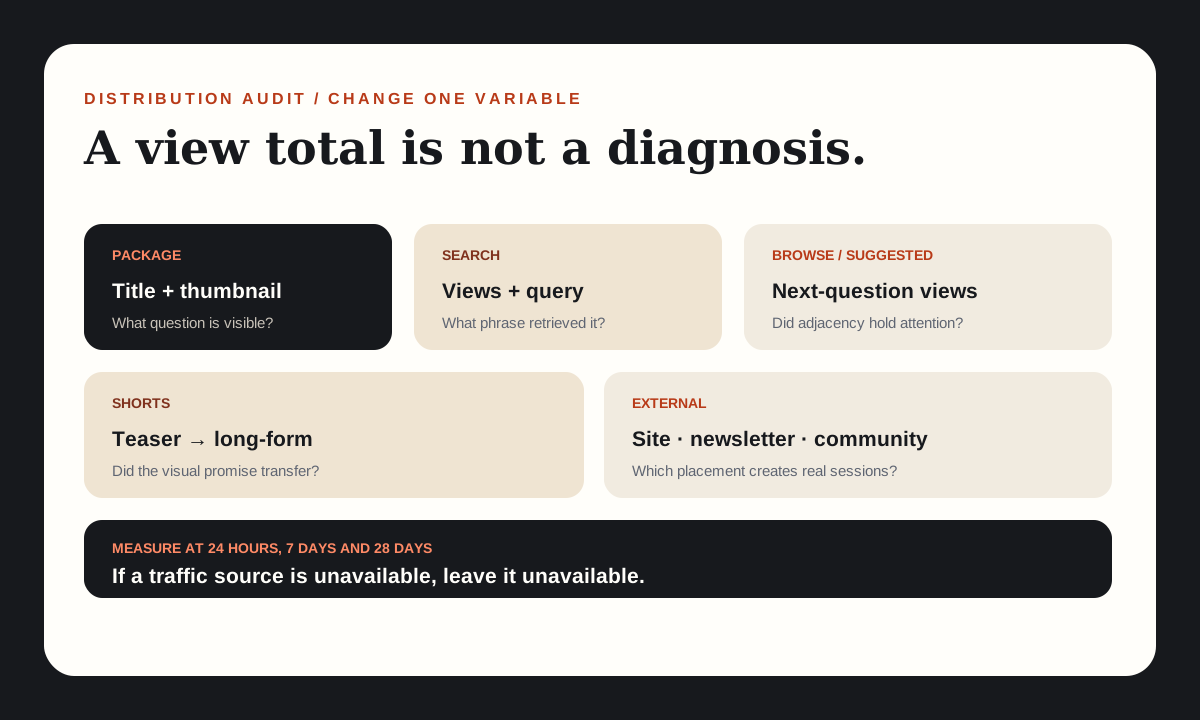
Build a distribution ledger for every new faceless episode. Record the package variants, publication date and the traffic-source values available in YouTube Analytics after 24 hours, seven days and 28 days. Leave a field unavailable when the report has not accumulated enough data.
| Field | What to record | Decision it supports |
|---|---|---|
| Package | Title, thumbnail proof object and opening promise | Which question was recognisable |
| Search | Views and search terms from YouTube Analytics | Whether the topic language matches demand |
| Browse and suggested | Home, subscription and related-video views | Whether the package and adjacent episode connect |
| Shorts | Short views, click-through and long-form views | Whether the teaser delivered the right audience |
| External | Source website or campaign label | Which off-platform placement produces useful sessions |
| Retention | Where viewers leave and whether they continue | Whether the first-screen proof is credible |
Do not change title, thumbnail, opening and traffic source at the same time. If one episode is moved from a broad label to a specific question, keep the proof object stable. If a Short changes, keep its destination episode stable. Change one distribution decision so the next review has one reason to inspect.
Use the public samples only to make hypotheses. A high-view old upload suggests durable-package research. A high-view one-month upload suggests launch distribution. Neither tells the creator which surface produced it.
Run five videos as a distribution experiment
The first five faceless episodes should test five routes without changing the channel promise:
- Search-led: package one episode around the exact decision phrase and show the proof immediately.
- Adjacency-led: make the next episode the obvious follow-up question and connect it through a playlist and end screen.
- Library-led: publish one update or correction to an older episode and connect the two records.
- Shorts-led: cut one proof moment into a short that leads to the full answer.
- External-led: publish an article or newsletter note that solves a small part of the question and links to the evidence.
A successful distribution test does not require all five routes to work. It requires the creator to know which route delivered the view, which promise the viewer understood and whether the viewer continued to an adjacent answer.
When the public view count rises but the route is unavailable, say unavailable. The number alone cannot explain itself.
The durable answer
Faceless YouTube channels get views when they make one question easy to recognise, prove the answer quickly and create meaningful next questions. Search can retrieve the package. Recommended and suggested paths can carry it into adjacent viewing. Old episodes can keep an evidence library visible. Shorts and external links can introduce the same promise on different surfaces.
The missing face does not remove those routes. It removes the automatic presenter cue. Replace that cue with a repeatable question, a visible proof object and an adjacent sequence. Then use the channel’s own Analytics to find what actually happened instead of filling the gap with a guess.
Sources and claim notes
These links support the platform and policy statements named in this guide. The frameworks and production checks are original editorial analysis.
- YouTube search and discovery tipsOfficial guidance on performance signals and that YouTube does not favour one video format.
- YouTube Analytics dimensions: traffic sourcesOfficial definitions for search, related-video, Shorts, external and other traffic-source values.
- YouTube channel monetization policiesOfficial standards for original, authentic, materially varied content.