A faceless channel is worth starting in 2026 only as a constrained evidence test with a measurable endpoint, not as a passive-income purchase.
The honest answer is a decision rule, not a promise. A faceless channel can be a durable publishing business, but the first question is not “how many videos can AI make?” It is “can this format produce original evidence repeatedly without a face, borrowed material or an unmanageably expensive correction?”
The answer is conditional: worth testing, not worth assuming
A faceless channel removes the need to appear on camera. It does not remove the work of finding a question, proving an answer, securing rights, editing and releasing the episode. It also does not guarantee that YouTube will recommend the result or accept the channel into the Partner Program.
The responsible decision is therefore staged. First, prove that the format can produce five distinct episodes. Then measure the work and distribution. Only after that should the creator buy more equipment, hire production help or schedule a larger volume.
This protects both money and time. A failed five-episode test is a bounded loss. A failed attempt to buy a channel-sized business before the first proof is a much larger commitment.
The platform still requires qualified activity before payment
YouTube’s current Partner Program page gives two main entry paths. A channel can qualify with 1,000 subscribers and 4,000 qualified public watch hours from long-form videos in the last 12 months, or with 1,000 subscribers and 10 million qualified Shorts views in the last 90 days. Meeting a threshold does not guarantee acceptance; YouTube then reviews the channel as a whole.
The arithmetic is useful. Four thousand watch hours equal 240,000 viewed minutes. The Shorts route divides 10,000,000 views across 90 days into an arithmetic equivalent of 111,112 qualifying views per day. That daily number is a way to understand the scale, not a rule that every day must hit that total.
The review matters more than the headline threshold. YouTube’s channel monetization policy asks for original and authentic content, not mass-produced, generic, repetitive or manipulative output. Its reviewers can inspect the channel’s main theme, newest videos, most-viewed videos, watch-time concentration and metadata.
A channel that reaches 1,000 subscribers but depends on one interchangeable template may fail the second gate. The costliest mistake is treating the subscriber number as the finish line.
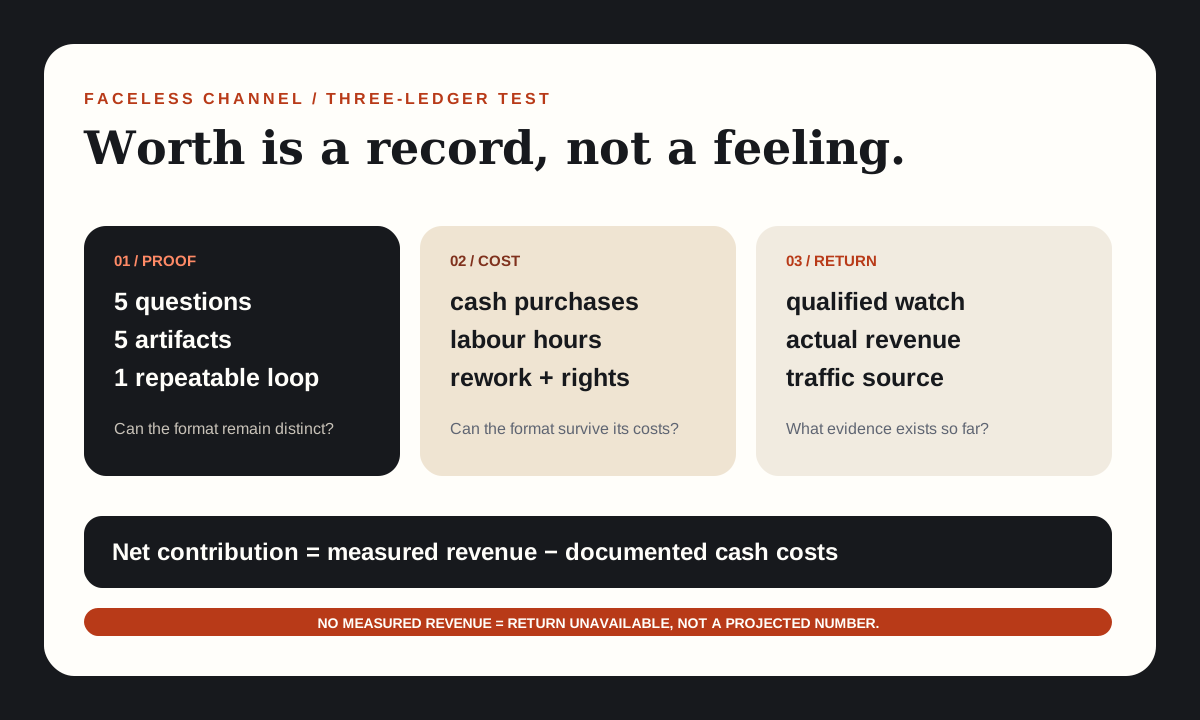
Use three ledgers to define “worth it”
“Worth it” is not one feeling. It is a calculation across three records.
| Ledger | What to measure | Decision it supports |
|---|---|---|
| Proof | Five completed episodes, five distinct questions and five inspectable evidence objects | Can the format sustain originality? |
| Cost | Cash purchases, unpaid labour hours, paid services, rework and rights costs | Can the model survive without hidden labour? |
| Return | Qualified watch activity, monetization status and actual revenue by source | Is there evidence of a viable business? |
Calculate the realised return only from values that exist:
Net contribution = measured revenue − documented cash costs
Return per production hour = net contribution ÷ documented production hours
If the channel has earned nothing yet, the return is unavailable. It is not minus a projected RPM. If the creator has not tracked hours, return per hour is unavailable. Those blanks are more useful than invented precision because they identify the next missing measurement.
Current question demand and proven profitability are different facts
A live YouTube search for this exact question on 15 November 2026 returned a current result set spanning recently published videos and videos more than a year old. That is evidence that people still ask the question and creators still answer it. It is not evidence that a new channel will earn money.
The same distinction applies to every public income claim. A title can say that a channel made a particular amount per month without revealing whether the figure was gross revenue, profit, ad revenue alone or a portfolio result. A public view count does not reveal a channel’s RPM, audience geography, sponsorship value or cost structure.
Use current activity to confirm that the topic is alive. Use the creator’s own tested format, measured costs and Analytics data to decide whether the venture deserves another month.
Run a five-episode pilot before buying scale
The pilot should answer four questions that a business plan cannot answer on paper.
- Question spread: are the five episodes genuinely different decisions rather than five synonyms?
- Proof yield: does every episode produce a document, test, map, calculation or record the audience can inspect?
- Production repeat: can one person repeat the workflow without a hidden emergency each week?
- Correction cost: when one claim is wrong, can it be repaired without rebuilding the channel?
Set a fixed pilot window and write it down. A five-episode test is a production commitment, not a demand forecast. It ends when five complete episodes exist or when the same blocker prevents an episode three times.
Keep each episode narrow enough to finish. A broad topic invites endless research. A decision-sized question has an endpoint: the viewer knows what changed, what stayed uncertain and what evidence supports the answer.
Buy one bounded capability, not a studio
Make a purchase list before the first video. Separate verified software costs from unresolved hardware and material costs.
Two verified starting costs are easy to document. The free edition of DaVinci Resolve is $0, and diagrams.net is $0. Those tools cover editing and system diagrams. A computer, phone mount, microphone, drawing tablet and physical materials still need exact models and listed prices; without them, the first-video total is unavailable.
This is the useful version of “low budget.” It does not pretend that existing equipment has no replacement value. It records the software floor, keeps unresolved purchases visible and prevents a creator from spending on a production bundle before the format has proved it can produce five distinct evidence objects.
Do not buy an annual tool subscription merely to make the pilot look automated. First find the bottleneck. If the bottleneck is unanswered questions, software will not fix it. If the bottleneck is editing time, measure that task before buying another editor.
Review the pilot with facts the creator owns
After the five episodes have been public for 28 days, review four records:
- the five questions and their proof objects;
- cash cost and production hours for each episode;
- watch activity and traffic sources from YouTube Analytics;
- corrections, rejected claims and rights holds.
Do not ask whether the channel “feels like it is growing.” Ask whether the format produced distinct work, whether viewers watched, whether any revenue existed and which traffic source produced the useful sessions. If a metric is unavailable, write unavailable.
The pilot can be worth continuing even before monetization when production is repeatable and the evidence improves. It can be a poor use of time after many uploads if the videos repeat, rights remain unresolved or every episode requires rebuilding the workflow.
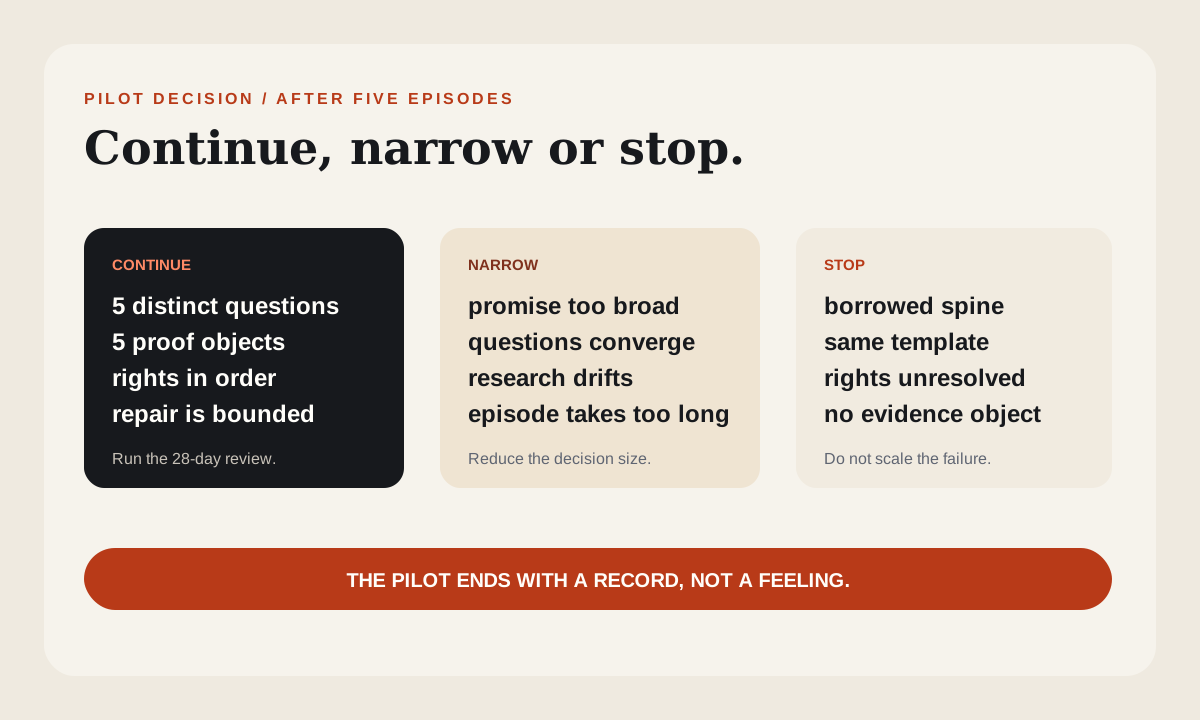
When the channel is worth continuing
Continue when the pilot produces five different questions, five inspectable proof objects and a repeatable production workflow, while keeping rights and corrections under control. Narrow the format when the output is honest but too broad to sustain. Stop when every episode depends on borrowed material, the same template or a presenter the creator will not provide.
Starting a faceless channel is still worth it in 2026 as an evidence-led test with a clear endpoint. It is not worth it as a purchase of passive income. The creator who measures the first five episodes will know more than someone who buys a year of tools and publishes a month of generic uploads.
Sources and claim notes
These links support the platform and policy statements named in this guide. The frameworks and production checks are original editorial analysis.
- YouTube Partner Program overview & eligibilityOfficial current subscriber, watch-hour and Shorts-view thresholds and channel review process.
- YouTube channel monetization policiesOfficial standards for original and authentic content and against mass-produced, generic or repetitive material.
- YouTube search and discovery tipsOfficial guidance on viewer behavior and the absence of a preferred video format.
- Live YouTube question searchPublic YouTube search snapshot taken 15 November 2026; used to verify current question activity, not profitability.
- DaVinci ResolveOfficial product page listing the free edition.
- diagrams.netOfficial site for the free diagram editor.