The useful automation plan does not begin with another tool. It begins with the evidence you keep, the decisions a person still owns and the checks that stop an unsafe upload.
Automation makes a production system faster. It does not transfer responsibility to that system. The practical question is therefore not “How much can I automate?” but “Which decisions must remain inspectable?”
Automate production work, not the release decision
A useful youtube automation workflow separates three kinds of work. Machine work is repeatable and easy to inspect: resizing a canvas, rendering the same title treatment, generating a draft transcript, creating thumbnail variants or exporting a second aspect ratio. Human work requires judgment: deciding whether a source is allowed, whether commentary adds real value, whether a scene looks realistic enough to require disclosure and whether the audience is children.
Release work is different again. A release decision must happen after the machine and human work are complete. It is the point where one person sees the evidence packet and says “publish,” “rework” or “hold.” If the same automatic agent can both create the content and approve its own compliance, the workflow has no control point.
| Stage | Safe to automate | Needs human approval | Release hold |
|---|---|---|---|
| Input | Collect links, filenames, licences and timestamps | Confirm the input can be used | Unknown owner or licence |
| Transformation | Apply the approved template, edit rhythm and render settings | Define the new evidence, argument or format | Only nouns, voice or colours changed |
| AI use | Flag generated or altered assets | Decide whether the result looks realistic | Realistic scene without a disclosure decision |
| Audience | Apply the selected audience value | Classify who the video is made for | Children are the audience but no review exists |
| Publish | Upload, set metadata and schedule | Approve every critical record | Any critical field says “unknown” |
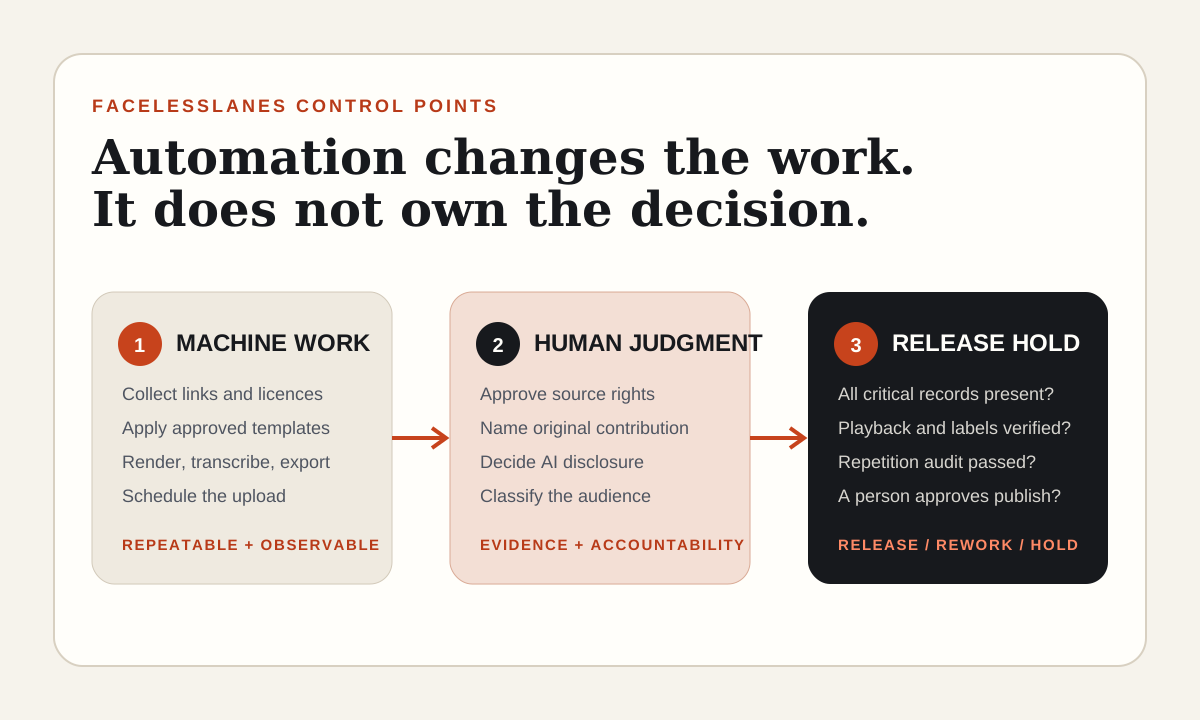
This model is deliberately conservative because it is cheaper to reject one episode than to rebuild a channel around an undocumented production pattern. The point of automation is to remove repeated labour, not to remove the person accountable for the result.
Build an evidence packet before the first tool runs
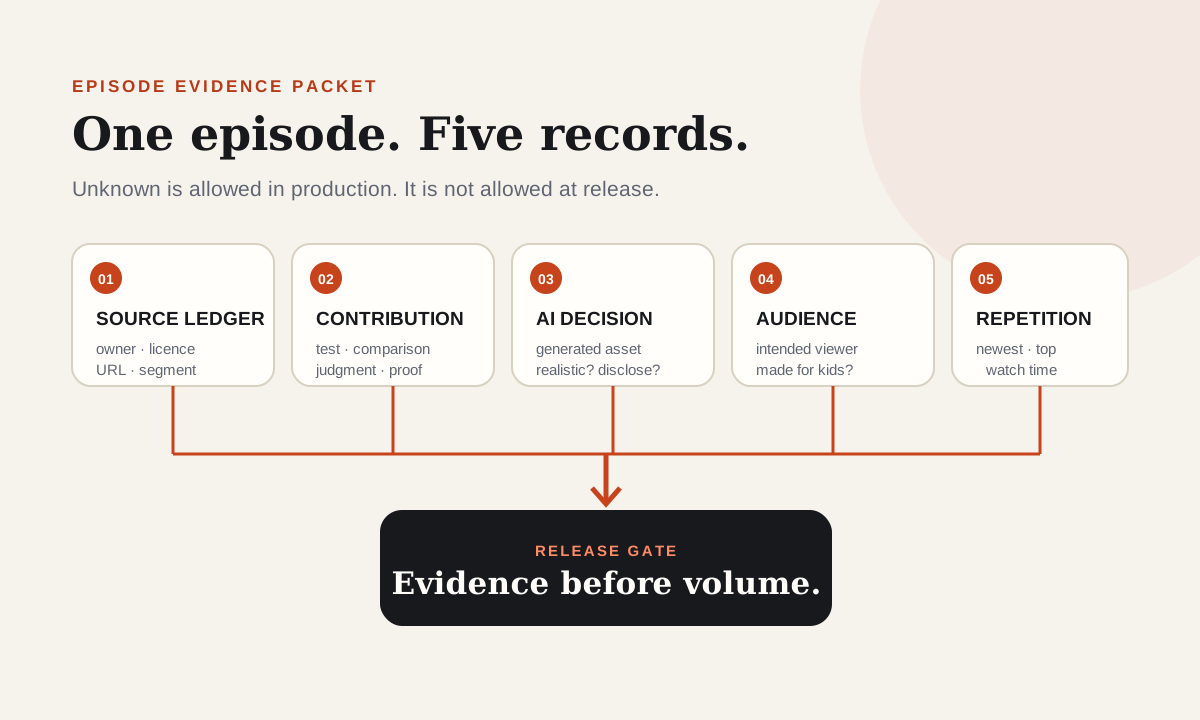
Most automation failures become invisible because there is no single record that explains how an upload was assembled. Fix that with a small evidence packet created for every episode. It does not need to be a long legal memo. It needs to be specific enough that another editor could reconstruct the decision without guessing.
Source ledger
List every third-party video, image, map, quotation, sound effect and music file with its URL, owner, licence and the exact segment used.
Transformation note
State what this episode adds: original analysis, a test, a comparison, a worked example, a correction, a new visual explanation or first-hand evidence.
AI decision
Record which assets were generated or meaningfully altered, whether the result seems realistic and whether the upload will use the AI-use declaration.
Audience decision
Record whether children are the primary audience or whether the subject matter is directed at children.
Repetition check
Compare the episode with the channel’s newest, most viewed and highest-watch-time videos. Name what changes beyond title, voice or colour.
The packet should travel with the project file, not live in someone’s memory. A searchable folder plus one short JSON or CSV record gives an operator enough evidence to audit the release later.
Unknown is a valid value during production. It is not a valid value at the release gate.
Use a rights gate before you generate anything
Rights problems often enter before the editing timeline exists. A research agent collects a screenshot, a voice model reads a paragraph from a website or a stock clip is downloaded from a search result with no visible licence. By the time the render is complete, the operator may know the composition but not the permission behind each input.
Use four input states:
- Owned: created by this channel, with the editable source file retained.
- Licensed: the exact licence, account or invoice is attached to the record.
- Cleared public-domain source: the source, jurisdiction note and proof of status are retained.
- Blocked: no owner, no licence, copied footage, unexplained screenshots, a direct re-upload or any asset the team cannot defend.
YouTube’s monetization policies require original creation and say borrowed content needs significant change to become the creator’s own. Significant change is not an automatic permission. A new voice track over someone else’s video, a translated re-upload or a lightly reworded script can still leave the value in the borrowed material.
The release test is therefore simple: if the original file disappeared, would the episode still stand on evidence this channel created, verified or clearly licensed? If the honest answer is no, the rights gate stays closed.
Prove transformation at the channel level
YouTube’s channel monetization policy describes original, authentic content and warns against mass-produced, generic or repetitive material. Reviewers may examine the channel’s main theme, most viewed videos, newest videos, largest watch-time videos, metadata and About section. That means an isolated original sentence is not enough if the surrounding channel still looks like one template with variables swapped.
Not enough
A different topic name, a second AI voice, a new colour preset or a few synonyms in the opening sentence.
Measurable change
A new proof object, a worked comparison, an original test, a documented process or a source trail the viewer can inspect.
Channel evidence
Three recent uploads that each answer a different question while preserving the same editorial promise.
Run a duplication audit every week instead of relying on the operator’s memory. Pull the newest video, the most viewed video and the video with the largest share of watch time. Put them beside the next planned episode and answer three questions:
- What evidence object changes?
- What judgment appears that the model could not infer from the previous episode?
- What would a returning viewer receive that is not merely another recital of the same answer?
This is the strongest use of human time in a youtube automation workflow. The person does not need to edit every frame. The person does need to make the channel-level pattern visible and decide whether the next upload adds something measurable.
Decide AI disclosure from what viewers could mistake as real
YouTube requires creators to disclose AI-generated or altered content that seems realistic. Its examples include making a real person appear to say or do something they did not do, altering footage of a real event or place, generating a realistic scene that did not occur, and creating music that is the main focus of the video.
The decision should not depend on which tool produced the file. It depends on the result and context. An obvious diagram, a stylised motion graphic or a minor cleanup is different from a synthetic newscaster, a believable empty street or a voice presenting itself as a real witness.
Keep the decision in the evidence packet even when the answer is “No.” A simple structure prevents later confusion:
| Asset | Generation or alteration | Realistic? | Upload decision | Evidence |
|---|---|---|---|---|
| Opening scene | Text prompt to image, animated | Photorealistic street | Disclose | Prompt, generation date, exact shot |
| Explainer diagram | Code-generated SVG | Clearly illustrative | No disclosure required | Editable SVG source |
| Narration | Synthetic voice | No real-person imitation | Review against current rules | Voice source and licence |
| Background music | Generated track | Music is the main focus | Disclose | Track record and generation notes |
YouTube states that disclosing AI content alone does not limit a video’s audience or its eligibility to earn money. Failing to disclose content that requires it carries its own risk. The release gate should therefore treat disclosure as a factual record, not a marketing decision.
Classify the audience as a legal question
The made-for-kids setting is not a CPM switch and should never be selected to chase a particular advertising outcome. YouTube explains that creators must identify whether content is made for kids under its agreement with the US Federal Trade Commission and to help comply with COPPA and other applicable laws.
Its guidance describes children as the primary audience or content directed at children because it features actors, characters, activities, games, songs, stories or subject matter that reflects an intent to target children. A video suitable for a general audience is not automatically “made for kids.”
In an automated workflow, the classification should happen from the script and visual plan, not from the title alone. Ask:
- Who is the intended viewer, not merely who could watch?
- Do the examples, characters, questions and visual references target children?
- Does the video’s main subject reflect an intent to reach children?
- Has a human reviewed ambiguous cases rather than allowing a metadata prompt to choose?
Write the answer and reasoning into the evidence packet. If the team cannot resolve an ambiguous case, it should stop and seek qualified advice rather than allowing volume to create a compliance debt.
Run the seven-check release gate
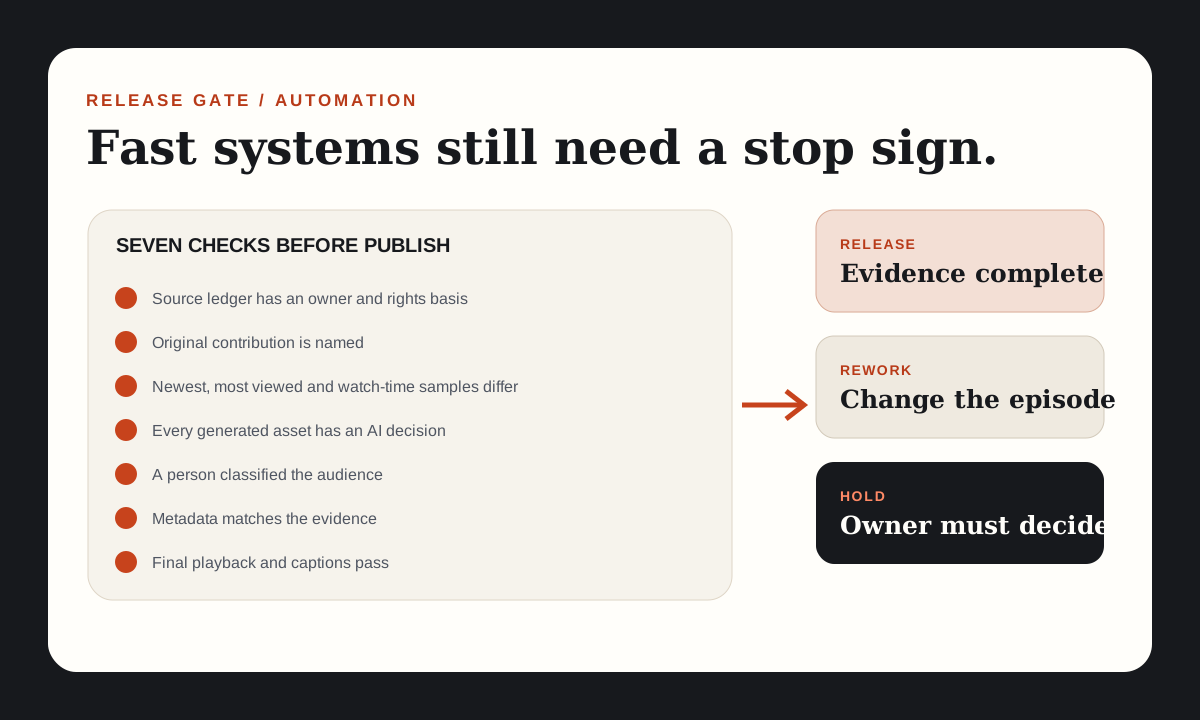
The release gate is the final control point. It should be fast enough to use every day and strict enough that a missing record cannot be silently skipped.
| Check | Pass condition | Failure action |
|---|---|---|
| 1. Source ledger | Every external asset has an owner and rights basis | Hold |
| 2. Original contribution | A named evidence object or human judgment changes the episode | Rework |
| 3. Repetition audit | Newest, most viewed and highest-watch-time samples show meaningful variation | Rework |
| 4. AI record | Every generated or altered asset has a disclosure decision | Hold |
| 5. Audience record | A human has classified the intended audience | Hold |
| 6. Metadata | Title, thumbnail and description accurately represent the evidence | Rework |
| 7. Final playback | Audio, captions, visuals and all labels survive the exported file | Hold |
Do not combine “hold” with “rework.” A hold means the evidence is missing or the issue is unresolved. A rework means the concept is acceptable but the episode needs a different proof object, edit or metadata. This distinction tells the operator exactly where to send the project.
| Decision | Meaning | Who owns next action |
|---|---|---|
| Release | All critical records exist and playback checks pass | Publisher |
| Rework | Concept can proceed after a defined change | Editor or researcher |
| Hold | Rights, disclosure or audience evidence is unresolved | Owner, not a scheduled job |
Worked example: audit one automated episode
Suppose an automated research agent proposes an episode titled “Why small channels fail in their first month.” The script arrives with six generic reasons, a synthetic voice and a stock-footage slideshow. The renderer completes the video without error. The automated system reports success.
The release gate asks for evidence. The source ledger says the stock clips came from an unexplained search folder. The transformation note says the script summarises three public listicles. The repetition audit shows the previous two uploads used the same opening, voice and slideshow cadence. The title and thumbnail promise an explanation, but no original dataset, operator record or test exists. The AI record says the generated scenes look realistic but no disclosure decision was made.
The correct result is not “published with a better title.” Three checks have failed:
- Rights: hold because clip ownership is unknown.
- Originality: rework because the episode needs an inspectable contribution.
- AI use: hold until each realistic scene receives a documented decision.
A stronger version would narrow the question: “We reviewed 12 first-month upload checklists and found that three omit the audience-classification step.” The episode could show an anonymised comparison table, the exact criteria used and one failure case where an ambiguous children’s topic needs human review. The stock folder disappears, the viewer receives a proof object and the channel adds judgment rather than another listicle.
The wider production system still does the useful work: collecting public links, extracting policy sections, building the comparison table, drafting the narration, rendering the diagrams and producing captions. Automation accelerates the version that can survive the gate. It does not decide whether the gate should open.
Record what changed after publication
A release gate protects the upload. A weekly audit protects the channel. Keep the evidence packet after publication and add one short retrospective record:
- Which proof object was most useful to viewers?
- Which claim required correction or more precise wording?
- Which asset caused the most rights or disclosure review?
- Which repeated template element is becoming too predictable?
- What should the next episode change without abandoning the channel promise?
These are editorial observations, not invented performance metrics. They help an operator notice repetition before it becomes a channel-level pattern and preserve the reasoning behind corrections.
Our own first two FacelessLanes explainers used three and five original SVG visual assets and ran for 29.94 and 53.59 seconds. The useful operational lesson was not that one duration was better. It was that the source ledger, visual ownership record, caption file and final playback check had to exist independently of the rendering session. If a tool or account changes, the evidence still explains what was published.
The mature youtube automation loop is therefore: gather inputs, create a draft, attach evidence, stop at the gate, release only a documented episode, then audit the pattern again. The bottleneck becomes deliberate review rather than accidental repetition.
The one rule to keep when everything else is automated
Automate collection, formatting, rendering, transcription, versioning and scheduling wherever those steps are repeatable and observable. Keep rights approval, original contribution, AI disclosure, audience classification and final release ownership with a person.
If the evidence packet is complete, an automated workflow can publish at a reliable cadence without turning the channel into a generic content factory. If the evidence packet is incomplete, speed only increases the distance between the upload and the correction that will eventually be necessary.
The release rule is short: no evidence, no upload.
Sources and claim notes
These links support the platform and policy statements named in this guide. The frameworks and production checks are original editorial analysis.
- YouTube channel monetization policiesOfficial standards for original, authentic content and the channel areas reviewers may inspect.
- Disclosing use of GenAI contentOfficial disclosure requirements for realistic generated or meaningfully altered content.
- Determining if your content is made for kidsOfficial audience-classification guidance tied to the FTC agreement, COPPA and other applicable law.
- Creating helpful, reliable, people-first contentGoogle Search guidance on original information, demonstrated expertise and added value.
- Is Anyone Actually Growing with YouTube Automation?Live Reddit discussion surfaced in a US-English Google result on 26 October 2026; used as a question source, not as a factual authority.