A channel idea becomes useful when it can survive a visible production log: what was made, what was rejected, which assets exist and which numbers remain unavailable.
Niche lists compare topics. They rarely show what a creator must do next week. A production log makes the channel idea testable: it records the assets produced, the claims changed, the work repeated and the facts that could not be measured.
Test the idea through the next three production cycles
A list of youtube channel ideas is only a set of labels. A usable idea must survive the same production loop three times. Each cycle needs a viewer question, a direct answer, an inspectable proof object and a reason to publish another episode that is related but not repetitive.
The practical test is not “Can I imagine fifty videos?” The better test is “Can I show three completed artifacts, explain how the second and third differ, and name what had to be reworked?” If that evidence does not exist, the idea is still a hypothesis.
Shared promise
All three episodes help the same intended viewer make one recognizable kind of decision.
Different proof
Each episode contains a distinct table, test, policy map, worked example or production record.
Visible rework
At least one correction or rejection can be explained without hiding the original failure.
Repeatable assets
The channel can reuse its format and standards without cloning the same script with substituted nouns.
Measurable boundary
The operator knows which time, cost or outcome values are tracked and which are unavailable.
This is a stronger filter than a long idea list because it tests the production system the idea will inherit. For the broader lane map, start with the faceless youtube channel ideas pillar page. This article asks a narrower question: what does the production evidence reveal after publication begins?
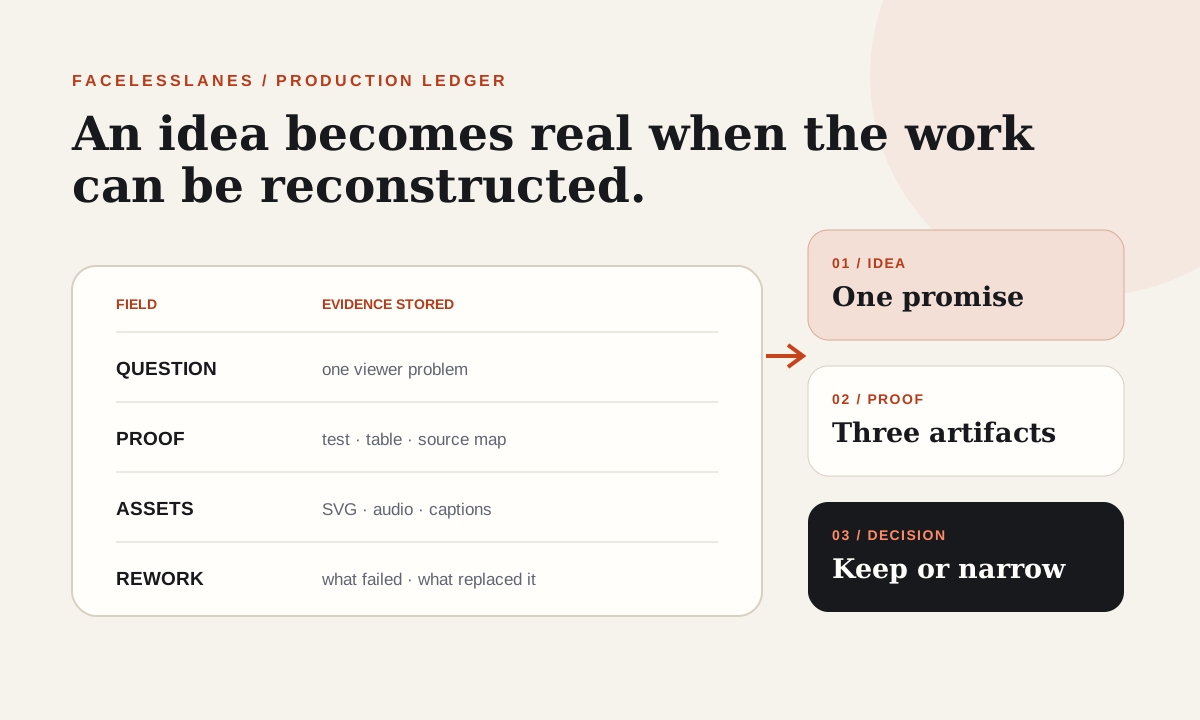
Record what is measured—and label what is unavailable
Transparency is not the same as claiming precision. The FacelessLanes project kept article source files, a build output, video logs, caption files and Studio publication results. From those records, several facts are available:
- Three English article pages were built for the first three publishing cycles.
- The build reported 1,842 words for the 50-episode plan, 1,726 words for the faceless growth guide and 2,228 words for the automation compliance guide.
- Three public explainers were recorded at 1920 × 1080 and logged at 29.94, 53.59 and 53.10 seconds.
- The first three article pages used three, five and three original SVG visual assets respectively.
- Copyright checks on all three uploaded videos returned no issues.
- English captions were uploaded before each video was made public.
Several values are unavailable. There was no consistent end-to-end timecard for research, writing, rendering and upload. There was no cash-expense ledger that can support a total production cost. There is no valid GSC or GA4 performance comparison in this record. Those gaps are part of the log, not invitations to substitute projections.
This distinction matters because an apparently precise “cost per video” built from guesses would be less useful than the verified list of assets, durations and rework events. A transparent log should make unavailable values impossible to miss.
Use a three-cycle baseline instead of a niche score
The following table compares only data retained in the project files. It does not rank the topics, predict traffic or claim one format performs better.
| Production cycle | Question answered | Website evidence | Video evidence | Recorded rework |
|---|---|---|---|---|
| 1. Channel planning | How can one narrow promise become a 50-episode plan? | 1,842-word article; three original SVGs; four source links | 29.94-second public explainer; captions published | The first production plan had to make the distinction between topic breadth and episode-level proof explicit. |
| 2. Growth and trust | When is a faceless format harder to grow? | 1,726-word article; five original SVGs; four source links | 53.59-second public explainer; captions published | An unsupported version of the opening claim was replaced after checking the official source. |
| 3. Automation and compliance | Which decisions must remain human in an automated workflow? | 2,228-word article; three original SVGs; five source links | 53.10-second public explainer; captions published | A first 61-second cut was rejected and the narration was shortened before publication. |
The table reveals the actual anchor of the channel idea: each production cycle required a new decision framework and a new visual system. The common thread was not “YouTube”; it was explaining how a faceless creator can preserve trust, evidence and compliance while producing at a repeatable cadence.
The table also exposes a missing metric. Without timecards and an expense ledger, the project cannot say which cycle consumed the most labour or cash. It can say where rework occurred because those changes were preserved in the files and publishing record.
First rework: an unsupported claim changes the opening
One draft framed the growth question too broadly. It implied that faceless channels receive equal distribution without documenting the exact platform statement. The final production log records a narrower correction: official YouTube guidance says AI-made videos can be recommended as broadly as videos made without AI, and separate guidance says disclosing AI content alone does not limit audience or monetization eligibility.
Those statements support a limited claim. They do not promise equal reach, equal revenue or equal viewer response. The rework changed the opening sentence and removed the unsupported inference.
This is a useful channel-idea test. If the central promise depends on a sweeping claim that cannot be tied to a primary source, the format has “source debt.” More publishing will not fix it. The creator must either narrow the claim or build an original test that can support it.
Draft debt
A broad sentence that sounds decisive but cannot be traced to a source.
Rework
Replace the inference with the exact official statement and explicitly state its boundary.
Reusable rule
Every factual paragraph must name the source, the claim being supported and the part that remains uncertain.
Second rework: the first cut exceeded the format limit
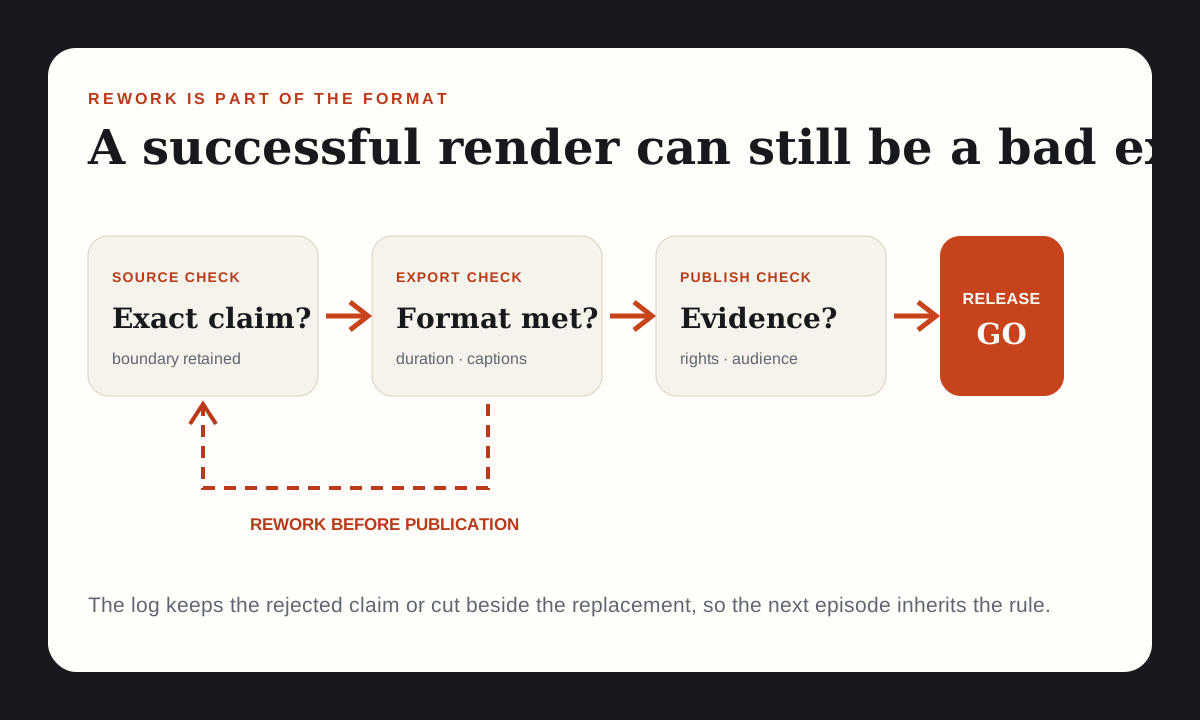
The automation checklist was designed as a short explainer. The first render ran for about 61 seconds in the upload interface. The audio, frames and download all completed, but the duration broke the production brief. The fix was not a cosmetic edit. The tool reran the narration with a faster voice setting and regenerated the timed captions from the new audio files.
The replacement video was 53.10 seconds in the browser metadata check. The final upload displayed a 54-second rounded duration. It was uploaded only after the shorter artifact existed, the SRT matched the new narration, the audience classification was reviewed, and the copyright check returned no issues.
This event produced a reusable gate for future episodes: duration must be read from the exported file before upload. A rendering tool saying “complete” is not evidence that the output matches the format target.
A successful render can still be a failed production artifact.
Use a production log that can survive a tool change
A useful log records artifacts, not just tasks. Tools and accounts change; files and decisions can remain inspectable. Keep the following fields with every episode:
| Field | What to store | Why it matters |
|---|---|---|
| Question | The one viewer problem the episode resolves | Prevents topic drift |
| Promise | The recurring benefit shared by the channel | Makes the series recognizable |
| Proof object | Document, test, table, comparison, map or first-party record | Shows what the episode adds |
| Sources | Official pages and exact claims used | Makes verification repeatable |
| Assets | Editable visuals, video, audio, captions and licence notes | Supports correction and reuse |
| Reworks | What failed, why it failed and what replaced it | Turns mistakes into operating knowledge |
| Verification | Duration, resolution, audience setting, captions and rights check | Confirms the published file matches the brief |
| Unavailable | Any missing time, cost, traffic or ranking data | Prevents fabricated precision |
The episode log should be short enough to maintain daily. A JSON line, a CSV row or a small Markdown file is enough. The goal is not an elaborate dashboard. The goal is to answer “What did we publish, what supported it and what changed?” without relying on memory.
Separate observable resource use from cash cost
A transparent production log can separate several resource types even when a cash total is unavailable:
- Artifact count: articles, source links, SVGs, audio segments, captions and published videos.
- Rework count: rejected claims, rejected durations, failed exports or metadata corrections.
- External dependency: platform account, rendering browser, voice source, storage and upload process.
- Measured cash cost: only amounts supported by an invoice or expense record.
- Unavailable: any time or cost value that was not tracked.
A creator who wants to compare channel ideas should add a simple timecard before claiming one idea is cheaper than another. Record start and stop times for research, scripting, design, rendering, captioning and upload. Add any explicit invoice amount. Until that exists, describe the workflow's dependencies and leave total cost unavailable.
This protects the channel from a common planning error: treating the absence of an invoice as proof that the work was free. The tool may already be owned, but the labour, review time and rework still consume the operator's capacity.
Score a channel idea with production evidence
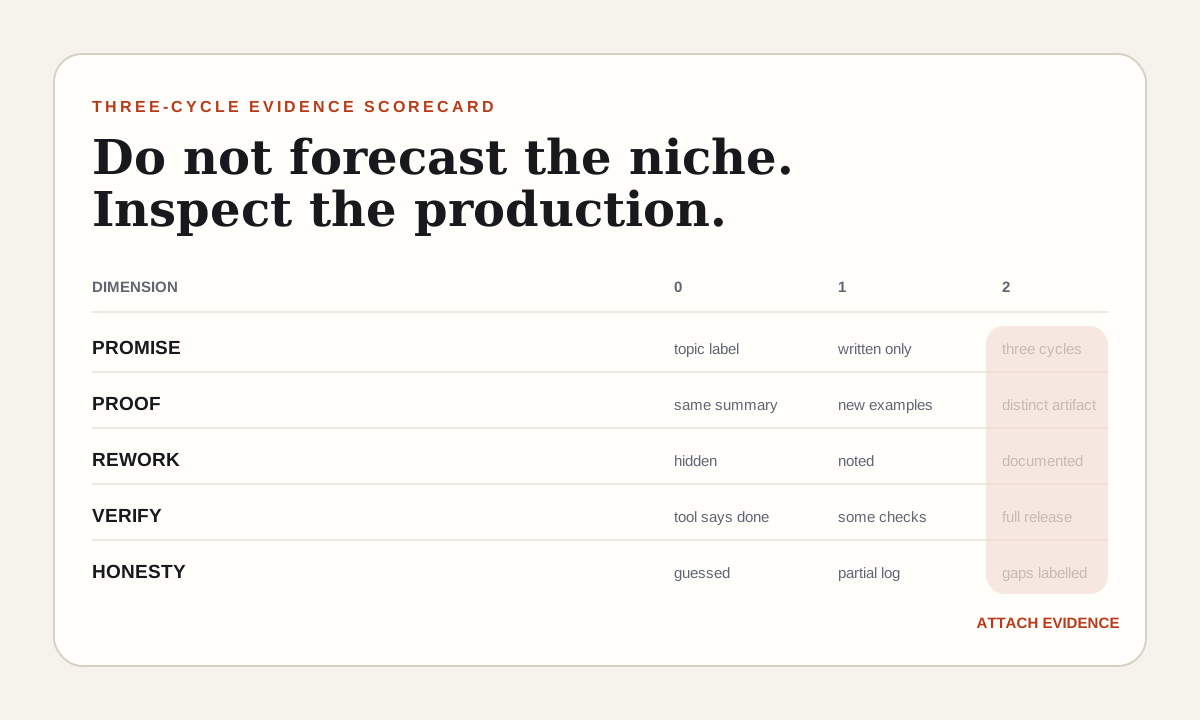
Use the same five questions after three completed cycles. A simple zero-to-two score for each dimension is enough for an internal decision, provided the evidence is attached.
| Dimension | 0 | 1 | 2 |
|---|---|---|---|
| Repeatable promise | Only a broad topic label | Promise written but not tested | Three episodes preserve one clear promise |
| Distinct proof | Same summary repeated | Some new examples | Every cycle has a different inspectable artifact |
| Rework visibility | Failures hidden | Changes noted informally | Rejected claims or cuts are documented |
| Verification | Tool says complete | Some output checks exist | Duration, captions, audience and rights checked |
| Measurement honesty | Numbers are guessed | Some values tracked | Unavailable values are labelled clearly |
A total of eight or more is not a market forecast. It is evidence that the production idea is coherent enough to continue testing. A score below eight identifies the next operational weakness to fix.
Choose the idea that makes the next three decisions easier
A channel idea is more credible when it narrows the next production decision. After three cycles, the operator should know which source standard to use, which proof object changes next and which verification step stops publication. If each episode forces the creator to invent a new channel, the idea has not become a format.
This is where a transparent log outperforms a niche ranking. It shows the idea under production pressure. It records where speed came from, where rework appeared and what remains unknown.
The decision rule is direct: continue the idea when three completed cycles preserve one promise while producing visibly different evidence, and when the log explains every correction. Do not add more tools, more topics or more uploads until that evidence exists.
Sources and claim notes
These links support the platform and policy statements named in this guide. The frameworks and production checks are original editorial analysis.
- YouTube channel monetization policiesOfficial policy language on original, authentic content and the channel areas reviewers may inspect.
- Creating helpful, reliable, people-first contentGoogle Search guidance on original information, substantial value and people-first publishing.
- What kind of YouTube channel should I start?Beginner question surfaced in a live US-English Google result on 27 October 2026; used as a question source, not as a factual authority.